
An op-amp is more than a small triangle symbol on a schematic. In real circuits, it helps engineers amplify weak signals, buffer sensitive voltage sources, filter unwanted noise, compare voltage levels, and condition sensor outputs before they reach microcontrollers, ADCs, audio stages, or control systems.
If you are asking “what do op amps do?”, the simplest answer is this: op-amps help electronic circuits control analog signals. They are used when a signal is too small, too weak, too noisy, too sensitive to load, or not yet suitable for the next stage of a circuit.
For a broader beginner-to-practical overview, you can also read our guide to operational amplifiers and circuits. This article focuses more directly on the job of an op-amp: what it does, why engineers use it, and what it is doing in real circuit examples.
What Is an Op-Amp in Simple Terms?
An op-amp is an analog integrated circuit with two input terminals and one output terminal. The two inputs are called the non-inverting input and the inverting input. The output voltage changes according to the voltage difference between those two inputs.
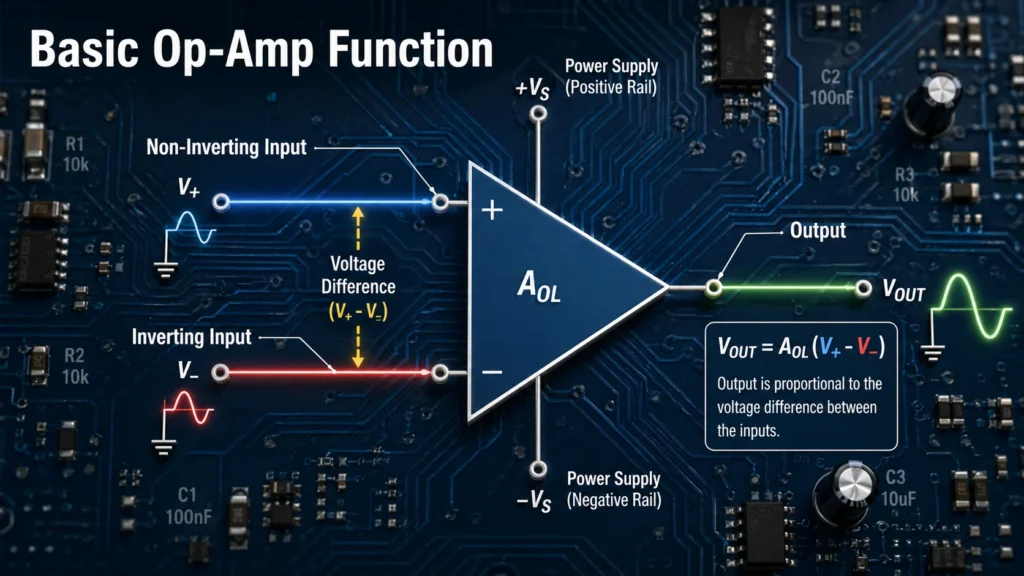
In simple terms, an op-amp is a high-gain voltage amplifier. If the non-inverting input is slightly higher than the inverting input, the output tends to move in the positive direction. If the inverting input is slightly higher, the output tends to move in the negative direction.
However, most real op-amp circuits do not use the op-amp by itself. They use external resistors, capacitors, or feedback networks to control what the op-amp does. That feedback network is what turns a very high-gain device into a predictable amplifier, buffer, active filter, current sensor, audio preamp, or signal-conditioning circuit.
The Core Function of an Op-Amp
It amplifies the voltage difference between two inputs
The main function of an op-amp is to amplify the difference between its two input voltages. This is why op-amps are called differential input amplifiers. They do not simply amplify “one pin.” They respond to the difference between the positive and negative input terminals.
In an ideal op-amp model, the open-loop gain is extremely high. That means even a tiny input difference can push the output strongly toward one supply rail or the other. This high open-loop gain is useful, but by itself it is not easy to control.
Negative feedback makes the op-amp useful
In most linear op-amp circuits, part of the output is fed back to the inverting input. This is called negative feedback. Negative feedback makes the op-amp adjust its output until the two input terminals are nearly equal.
This behavior is the secret behind many op-amp circuits. When feedback is added, the gain is no longer controlled mainly by the op-amp’s huge internal gain. Instead, the gain and function are mostly set by external components such as resistors and capacitors.
Non-inverting amplifier gain: Gain = 1 + Rf / Rin
Voltage follower gain: Gain ≈ 1
This is why the same basic op-amp can be used in so many different ways. A device such as LM358, LM324, OPA627, TLV series, or ADI precision amplifiers may all be “op-amps,” but the surrounding circuit decides whether the part behaves as a buffer, amplifier, filter, or signal conditioner.
What Are Op-Amps Used For?
Op-amps are used for analog signal processing. They appear in sensor interfaces, audio equipment, power supplies, industrial control boards, test instruments, data acquisition systems, medical devices, battery systems, motor control circuits, and many other electronic products.
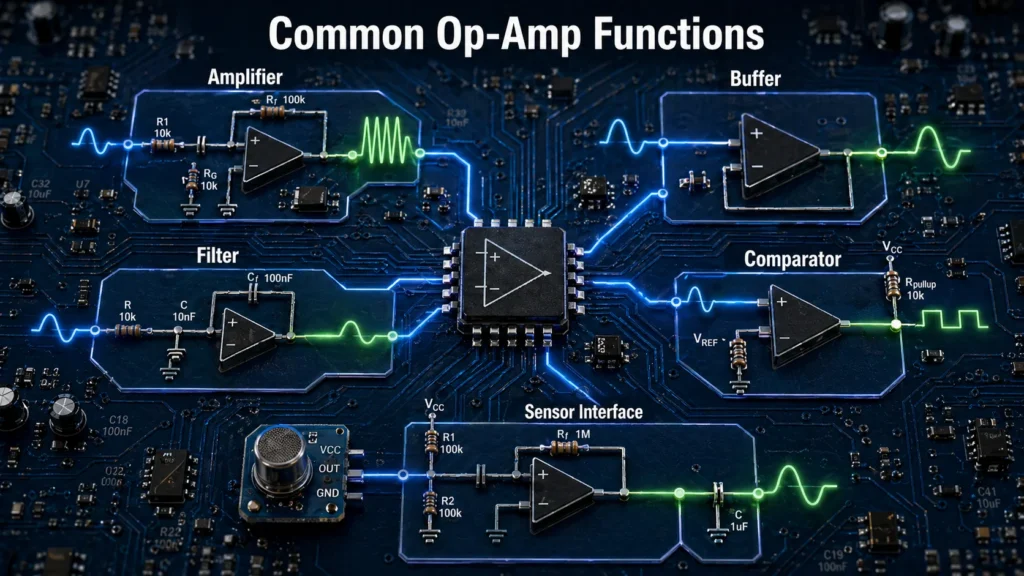
In a real design, an op-amp is usually chosen because the circuit needs a signal to be amplified, isolated from loading, filtered, compared, level-shifted, or prepared for an ADC or another processing stage. For related product sourcing, you can browse amplifiers, op amps, buffers, and instrumentation amplifiers in the MOZ Electronics catalog.
| Op-Amp Function | What It Does | Real Circuit Example |
|---|---|---|
| Signal amplification | Makes a small voltage signal larger and easier to process. | Microphone preamp, sensor amplifier, instrumentation front end. |
| Voltage buffering | Copies a voltage while preventing the source from being loaded by the next stage. | ADC input buffer, DAC output buffer, voltage reference buffer. |
| Filtering | Removes unwanted frequencies or noise from an analog signal. | Active low-pass filter, audio tone filter, anti-aliasing filter. |
| Voltage comparison | Detects whether one voltage is above or below another voltage. | Threshold detector, low-battery warning, light-level detector. |
| Signal summing | Adds multiple analog signals together in a controlled way. | Audio mixer, analog control summing node, sensor fusion front end. |
| Current-to-voltage conversion | Converts a small current into a measurable voltage. | Photodiode amplifier, transimpedance amplifier, optical sensor interface. |
| Sensor signal conditioning | Amplifies, filters, buffers, or shifts a raw sensor signal before measurement. | Thermistor, pressure sensor, current shunt, bridge sensor, gas sensor. |
Function 1: Signal Amplification
The most familiar op-amp function is signal amplification. Many real-world signals are too small to be used directly. A microphone may produce only a tiny AC voltage. A sensor may output a small change that needs to be scaled before an ADC can measure it accurately. A current shunt may generate only a few millivolts, but the controller needs a larger signal.
An op-amp amplifier solves this by increasing the voltage level while preserving the useful information in the signal. The two most common amplifier configurations are the inverting amplifier and the non-inverting amplifier.
Inverting amplifier
An inverting amplifier applies the input signal to the inverting input through an input resistor. A feedback resistor connects the output back to the inverting input. The output is amplified and inverted, meaning its polarity is opposite to the input signal.
Inverting amplifiers are useful when designers need accurate gain, summing behavior, or phase inversion. They are common in audio processing, analog control loops, and measurement circuits.
Non-inverting amplifier
A non-inverting amplifier applies the input signal to the non-inverting input. The output has the same polarity as the input, and the gain is set by the feedback resistor network. This configuration is popular because it has high input impedance and does not heavily load the signal source.
Non-inverting amplifiers are often used with sensors, voltage references, and analog outputs where the signal should be amplified without inversion.
Function 2: Voltage Buffering
A voltage buffer, also called a voltage follower, is one of the most important but often misunderstood op-amp circuits. A buffer does not usually make the voltage larger. Its voltage gain is approximately one. The output voltage follows the input voltage.
So why use it? Because a buffer prevents one circuit stage from loading another. It has high input impedance and low output impedance. That means it can read a voltage from a sensitive source without disturbing it, then drive the next circuit stage more effectively.
This is especially useful in ADC inputs, DAC outputs, voltage reference circuits, sensor outputs, and analog measurement systems. For example, a precision voltage reference may be accurate but not designed to drive a heavy load directly. A buffer op-amp can protect that reference and provide a stable signal to the rest of the system.
If you are working with DAC outputs or mixed-signal systems, the role of a buffer is also discussed in our AD5541 FPGA integration guide, where a buffer op-amp may be used to handle heavier output loads.
Function 3: Filtering and Noise Reduction
Op-amps are widely used in active filters. An active filter combines an op-amp with resistors and capacitors to shape the frequency response of a signal. It can reduce noise, remove unwanted frequency components, or keep only the part of the signal that matters.
A low-pass filter allows low-frequency signals to pass while reducing high-frequency noise. A high-pass filter blocks DC or low-frequency drift while passing higher-frequency signals. A band-pass filter keeps a selected frequency range and rejects signals outside that range.
Active filters are used in audio circuits, sensor front ends, anti-aliasing filters before ADCs, vibration measurement, medical instrumentation, and control systems. Compared with passive filters alone, op-amp-based filters can provide gain and better impedance control between stages.
Low-pass filter
Removes high-frequency noise
Useful before ADC inputs, sensor measurement stages, and slow-changing analog signals where high-frequency noise can reduce measurement accuracy.
High-pass filter
Removes DC offset or drift
Common in audio and AC-coupled measurement circuits where the useful signal changes over time and DC offset should be reduced.
Function 4: Comparing Voltages
An op-amp can be used as a simple voltage comparator in some low-speed or non-critical circuits. In this mode, the op-amp compares two input voltages. If one input is higher than the other, the output moves toward one rail. If the input relationship changes, the output moves toward the opposite rail.
This can be useful for simple threshold detection, low-battery warning circuits, light-level detection, over-temperature alarms, or zero-crossing detection.
However, an op-amp is not always a good replacement for a dedicated comparator. Comparators are designed for fast switching, clean logic output behavior, and reliable operation in threshold-detection applications. Op-amps are mainly designed for linear analog operation.
Function 5: Sensor Signal Conditioning
Sensor signal conditioning is one of the most practical answers to the question “what is an op amp used for?” Many sensors do not produce a clean, strong, ready-to-use signal. Their outputs may be small, noisy, high impedance, offset, nonlinear, or affected by cable length and environmental noise.
An op-amp can amplify a weak sensor output, filter unwanted noise, buffer a high-impedance source, shift the signal into the correct ADC range, or convert a sensor current into a voltage. This makes the op-amp a key part of analog front-end design.
| Sensor or Signal Source | Raw Signal Problem | What the Op-Amp Does |
|---|---|---|
| Thermistor | Small voltage change, nonlinear response. | Scales and buffers the signal before ADC measurement. |
| Photodiode | Very small current output. | Converts current into voltage using a transimpedance amplifier. |
| Pressure sensor bridge | Small differential output voltage. | Amplifies the bridge output for measurement. |
| Current shunt | Millivolt-level voltage across a resistor. | Amplifies the small voltage into a usable control signal. |
| Microphone | Weak AC audio signal. | Boosts the signal before filtering, mixing, or recording. |
This is also why common op-amp families such as LM358 and LM324 remain popular in practical designs. For example, our LM358 datasheet guide explains why LM358 is often used for DC signal amplification, sensor signal conditioning, and low-frequency control loops. For multi-channel signal paths, our LM324 op amp guide covers the role of a quad op-amp in compact analog designs.
Real Circuit Examples: What the Op-Amp Is Doing
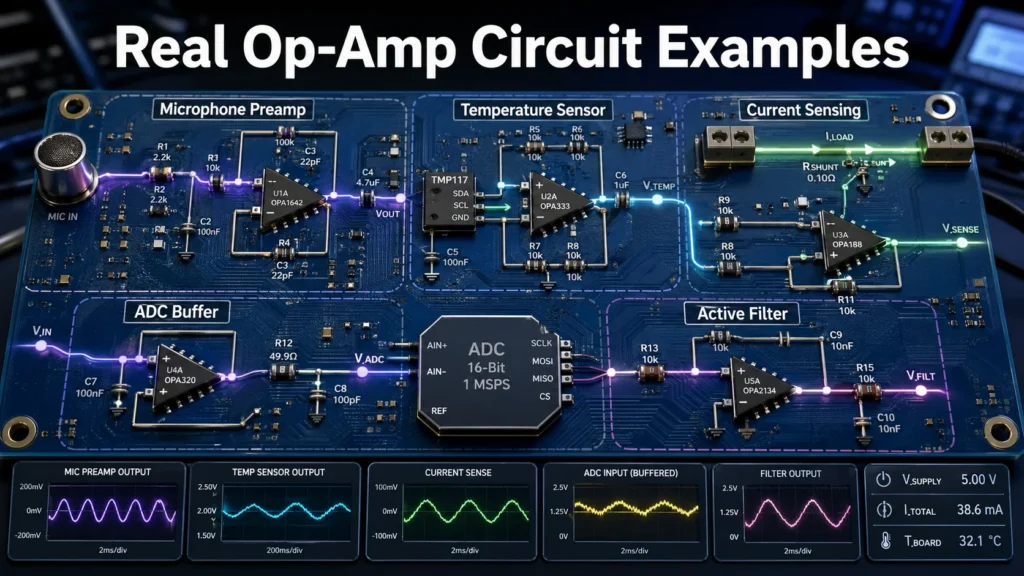
To understand what op-amps do, it helps to stop thinking only in terms of textbook symbols and start thinking in terms of real circuit jobs. Below are common examples where an op-amp has a clear purpose.
Example 1: Microphone preamplifier
A microphone produces a very small audio signal. If that signal goes directly into a processing circuit, it may be too weak and too noisy to use. An op-amp preamplifier increases the signal level before it reaches an audio codec, recorder, mixer, or amplifier stage.
In this circuit, the op-amp is not “creating” the sound. It is increasing the useful voltage variation from the microphone while keeping the signal shape usable for the next stage.
Example 2: Temperature sensor interface
A thermistor or analog temperature sensor may produce a voltage that changes slowly with temperature. The change may be small, and the microcontroller ADC may need a stronger or better-scaled signal.
The op-amp can buffer the sensor node, amplify the voltage range, and help filter noise. This gives the ADC a more stable and readable signal.
Example 3: Current sensing amplifier
Many power supplies, battery systems, and motor drivers measure current by placing a small shunt resistor in the current path. The voltage across that resistor is often only a few millivolts.
An op-amp can amplify that small voltage so the controller can estimate current. This is useful for overcurrent protection, battery charging, load monitoring, and power control.
Example 4: Voltage reference buffer
ADCs and DACs often depend on stable reference voltages. If the reference source is loaded directly, its voltage may shift slightly, reducing accuracy. A buffer op-amp can isolate the reference from changing loads.
In this case, the op-amp is not increasing the voltage. It is protecting signal integrity by improving drive capability and reducing interaction between circuit stages.
Example 5: Active low-pass filter
A sensor may pick up high-frequency noise from switching power supplies, motors, wireless modules, or nearby digital circuits. An active low-pass filter can reduce that noise before the signal reaches an ADC.
In this circuit, the op-amp is helping shape the frequency content of the signal. It keeps the useful slow-changing information and reduces unwanted fast-changing noise.
Example 6: Photodiode transimpedance amplifier
A photodiode often produces a tiny current instead of a convenient voltage. A transimpedance amplifier uses an op-amp and feedback resistor to convert that current into a measurable voltage.
This type of circuit is common in optical sensors, light meters, laser monitoring, spectroscopy, and precision measurement. For a related practical example, see our AMP100 transimpedance amplifier guide.
What an Op-Amp Does Not Do
Understanding what an op-amp cannot do is just as important as understanding what it can do. Beginners often imagine op-amps as ideal building blocks, but real devices have limits.
- An op-amp does not create energy. It uses power from its supply pins to control the output signal.
- An op-amp cannot output unlimited voltage. The output is limited by the supply rails and the output swing specification.
- An op-amp cannot drive unlimited current. Heavy loads may require a buffer stage, driver, or power amplifier.
- An op-amp does not automatically choose the correct gain. Gain is set by the circuit around it.
- An op-amp is not always a comparator replacement. Dedicated comparators are better for many switching applications.
- An op-amp is not ideal in real life. Offset voltage, bias current, noise, bandwidth, slew rate, and input range all matter.
This is why datasheet reading matters. If you are identifying or replacing an unknown IC on a board, our integrated circuit identification and pricing guide can help you evaluate package, marking, manufacturer, sourcing options, and practical replacement risk.
Key Op-Amp Parameters That Affect What It Can Do
Two op-amps may look similar in a schematic, but they can perform very differently in a real product. The right choice depends on signal level, frequency, supply voltage, accuracy, noise, load, and sourcing requirements.
| Parameter | Why It Matters | Typical Design Concern |
|---|---|---|
| Supply voltage | Defines the voltage range where the op-amp can operate. | Single-supply 3.3 V, 5 V, 12 V, or dual-supply systems. |
| Input common-mode range | Determines whether the input signal is valid for the op-amp. | Low-voltage sensor circuits and rail-to-rail inputs. |
| Output swing | Shows how close the output can get to the supply rails. | ADC input range, low-voltage systems, battery devices. |
| Gain bandwidth product | Limits how much gain is available at higher frequencies. | Audio, filters, fast sensors, signal measurement. |
| Slew rate | Limits how quickly the output voltage can change. | Fast waveforms, audio distortion, pulse response. |
| Input offset voltage | Creates measurement error in precision DC circuits. | Current sensing, bridge sensors, low-level signal amplification. |
| Input bias current | Can affect high-impedance sensors and feedback networks. | Photodiodes, pH sensors, large resistor values. |
| Noise | Affects small-signal accuracy and audio quality. | Microphones, medical sensors, precision measurement. |
| Output current | Determines how much load the op-amp can drive. | Buffers, cables, ADC inputs, light loads. |
| Package and availability | Affects PCB fit, thermal behavior, sourcing, and replacement. | SOT-23, SOIC, DIP, MSOP, lifecycle, stock status. |
If you are comparing op-amp families, manufacturer pages can also help with sourcing context. MOZ Electronics maintains pages for major analog IC manufacturers such as Texas Instruments and Analog Devices, both of which are widely associated with precision amplifiers, data converters, interface ICs, and analog signal-chain components.
How to Choose the Right Op-Amp for a Circuit
Choosing an op-amp starts with the job the circuit needs to perform. A low-cost sensor buffer does not need the same specifications as a high-speed audio amplifier or a precision current-sense circuit. The best op-amp is not always the most expensive one; it is the one that fits the electrical requirements, package, availability, and risk level of the design.
- Check the supply voltage. Make sure the op-amp works with the available rails.
- Check the input voltage range. The signal must stay inside the valid common-mode range.
- Check output swing. Low-voltage systems often need rail-to-rail output behavior.
- Match bandwidth to signal frequency. Higher gain reduces available bandwidth.
- Check slew rate. Fast or large signals need faster output movement.
- Use low-noise op-amps for small signals. Audio, medical, and sensor circuits are sensitive to noise.
- Use precision op-amps for small DC measurements. Offset voltage and drift matter.
- Check package and lifecycle. Replacement sourcing can become a problem if the package or part number is difficult to find.
For general analog IC browsing, start with the Linear Integrated Circuits category. For broader IC classification and selection context, see our guide to types of integrated circuits, which explains where analog ICs such as op-amps, comparators, voltage references, and regulators fit into a complete electronic system.
Common Mistakes When Using Op-Amps
Op-amps are flexible, but that flexibility can lead to design mistakes. Many problems happen because the schematic looks correct, but the chosen op-amp cannot operate correctly under the real voltage, frequency, load, or accuracy conditions.
Mistake 1
Ignoring input common-mode range
An op-amp may not work correctly if its input voltage is too close to or outside the allowed input range. This is especially important in single-supply circuits.
Mistake 2
Expecting rail-to-rail output from a non-rail-to-rail part
Some op-amps cannot drive the output close to the supply rails. This can reduce usable signal range in 3.3 V or 5 V systems.
Mistake 3
Using a slow op-amp for a fast signal
Gain bandwidth product and slew rate limit how quickly an op-amp can respond. A circuit may amplify DC correctly but distort faster signals.
Mistake 4
Replacing op-amps only by pin count
Pin compatibility is not enough. Supply range, input type, output swing, offset, noise, package, and stability should also be reviewed.
If you are replacing common op-amp parts, related guides such as LM358 alternatives and equivalents and LM324 alternatives and equivalents can help you think beyond simple part-number matching.
FAQ: What Do Op-Amps Do?
What do op amps do in simple words?
Op amps amplify the voltage difference between two input pins. With external feedback components, they can amplify signals, buffer voltages, filter noise, compare levels, add signals, and condition sensor outputs for other circuits.
What is the main function of an op-amp?
The main function of an op-amp is voltage amplification. In real circuits, however, the feedback network determines whether the op-amp behaves as an amplifier, buffer, filter, comparator-like threshold detector, summing amplifier, or signal conditioner.
What is an op amp used for?
An op amp is used for analog signal processing. Common uses include sensor amplification, audio preamps, voltage followers, active filters, current sensing, photodiode amplifiers, ADC input buffers, DAC output buffers, and control-loop circuits.
Why do op-amps need feedback?
Op-amps have very high open-loop gain. Feedback controls that gain and turns the op-amp into a predictable circuit. Without feedback, the output often swings strongly toward one supply rail or the other.
Is an op-amp only used to make signals bigger?
No. Signal amplification is only one op-amp function. Op-amps are also used to buffer signals, reduce noise, shape frequency response, compare voltage levels, convert current to voltage, and prepare sensor signals for digital systems.
Can an op-amp be used as a comparator?
Sometimes, yes. An op-amp can compare voltages in simple or low-speed circuits. However, a dedicated comparator is usually better for fast switching, clean logic output, and reliable threshold detection.
What does an op-amp do in a sensor circuit?
In a sensor circuit, an op-amp may amplify a weak signal, filter noise, buffer a high-impedance sensor, shift the voltage level, or convert a small current into a voltage that an ADC can measure.
What does an op-amp do in an audio circuit?
In an audio circuit, an op-amp can amplify a microphone signal, buffer an audio line, mix multiple signals, filter frequencies, or drive the next stage of an audio system.
Conclusion
An op-amp does much more than simply make a signal bigger. Its basic job is to amplify the voltage difference between two inputs, but its real circuit function depends on the feedback and external components around it. That is why the same type of device can be used as an amplifier, buffer, active filter, threshold detector, current-to-voltage converter, or sensor signal-conditioning stage.
Once you understand feedback, input range, output swing, bandwidth, slew rate, noise, and offset voltage, op-amp circuits become much easier to read. Instead of asking only “what does this op-amp do?”, you can look at the surrounding components and ask a more useful question: is this stage amplifying, buffering, filtering, comparing, or conditioning the signal?
Need to Source Op-Amps or Analog ICs?
If you are selecting op-amps, buffers, instrumentation amplifiers, or other analog ICs for a BOM, start with the MOZ Electronics op-amp and amplifier category. For broader sourcing decisions, our electronic components and parts suppliers guide explains how engineers and buyers choose the right source by project risk, availability, traceability, and application needs.