
Sourcing Guide / Electronic Components
Finding reliable electronic components and parts suppliers is no longer just about who has the lowest unit price. For engineers, OEM buyers, repair teams, and contract manufacturers, the real question is: which supplier is the right fit for your stage, risk level, and sourcing scenario?
Some suppliers are best for rapid prototyping and broad in-stock selection. Others are built for enterprise-scale procurement, lifecycle support, or shortage recovery. There are also low-cost platforms for standard parts, and comparison tools that help buyers review pricing and stock before committing to an order.
In this guide, we break down the real supplier landscape in a way that is useful for both searchers and decision-makers. Instead of dumping a generic “top 10” list, we explain how supplier types differ, when to use each one, and where MOZ Electronics fits in as a sourcing partner for hard-to-find, cost-sensitive, and procurement-driven projects.
Authorized distributors are best for traceability and production-grade sourcing, maker-focused stores are best for learning and prototyping, low-cost platforms work for budget-sensitive standard parts, and experienced sourcing partners like MOZ Electronics can help when you need alternate sourcing, shortage support, RFQ handling, or hard-to-find components.
Why This Topic Matters More Than Ever
In electronics procurement, choosing the wrong source can cause much bigger problems than a small price difference. A buyer may save a few dollars on paper, then lose weeks to questionable traceability, mismatched date codes, long lead times, or redesign work caused by unavailable parts.
That is why serious buyers usually evaluate suppliers on multiple dimensions:
- Authenticity and traceability
- Inventory depth and replenishment visibility
- Pricing and quantity breaks
- Lead time and logistics flexibility
- Technical documentation and lifecycle data
- Support for prototypes, production, or shortage situations
If your content only says “DigiKey is good” or “Mouser is popular,” it will not stand out. What users really want is a practical answer to questions like:
- Where should I buy parts for a prototype?
- Which supplier is safer for production?
- Who helps with obsolete or hard-to-find parts?
- Where can I compare live stock and price breaks quickly?
- When should I work with a sourcing partner instead of buying directly online?
Types of Electronic Components and Parts Suppliers
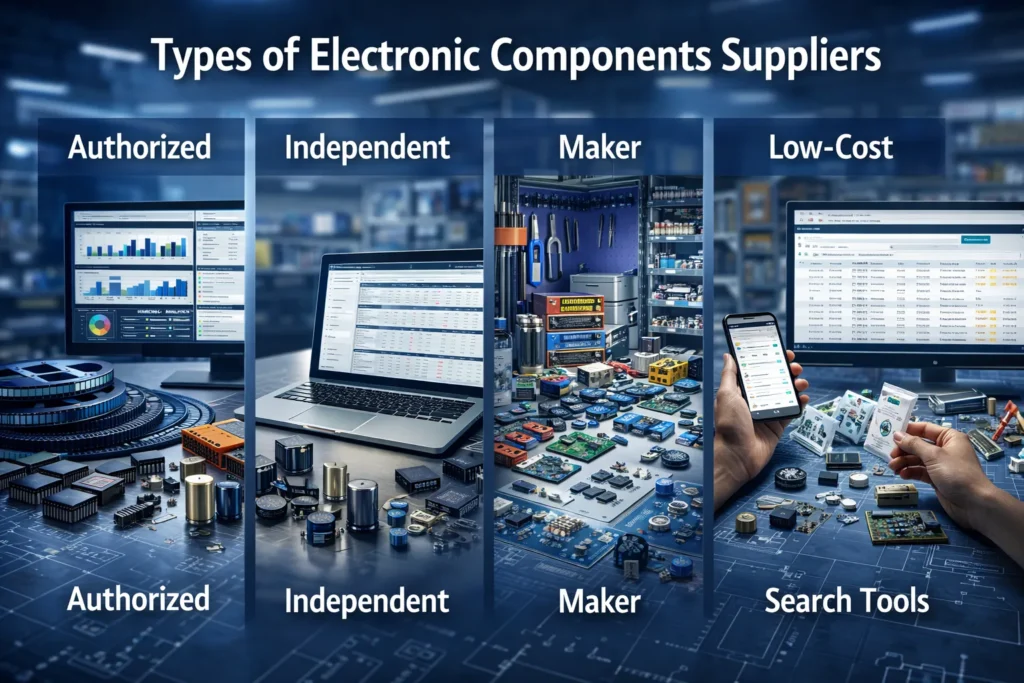
Not all electronic components and parts suppliers serve the same purpose. Some are built for production-grade traceability, some are better for hard-to-find sourcing, and others are designed for makers, students, or cost-sensitive BOM purchasing. That is why the smartest buyers do not ask, “Which supplier is best?” They ask, “Which supplier type is best for this exact sourcing situation?”
| Supplier Type | Best For | Main Strength | Main Trade-Off | Typical Examples |
|---|---|---|---|---|
| Authorized distributors | Production, traceability, formal sourcing | Manufacturer-backed supply, documentation, lifecycle visibility | Not always the lowest cost route | DigiKey, Mouser, Arrow, Avnet, Newark, Farnell, Rochester Electronics |
| Independent distributors | Shortages, obsolete parts, urgent procurement | Flexibility, sourcing reach, hard-to-find support | Requires stronger supplier vetting and risk control | Smith, RFQ-based sourcing partners, specialty supply networks |
| Maker and educational retailers | Arduino, Raspberry Pi, learning kits, quick prototyping | Tutorials, modules, beginner-friendly buying experience | Not ideal for every formal production workflow | SparkFun, Adafruit, Jameco, Micro Center |
| Low-cost volume platforms | Budget-sensitive BOMs, common parts, passives | Competitive pricing and broad standard-part access | Consistency, logistics, and qualification must be evaluated carefully | LCSC, Tayda, MOZ Electronics |
| Part search engines and BOM comparison tools | Price checks, stock comparison, MPN sourcing | Fast market visibility across multiple sellers | You still need to choose the final source | Octopart, Findchips |
Authorized distributors
Authorized distributors are usually the first choice for companies that need a dependable and traceable supply chain. These suppliers work through formal manufacturer relationships, which gives buyers stronger confidence in product documentation, lifecycle data, traceability, and alignment with official sourcing requirements.
They are especially well suited to OEMs, industrial buyers, and engineering teams moving from prototype to production. If your project depends on approved vendor processes, predictable quality, and better sourcing transparency, this is often the safest category to prioritize.
A useful special case inside this group is Rochester Electronics. Rochester is particularly relevant when your project involves legacy systems, obsolete semiconductors, or long-life equipment that cannot depend on standard broadline availability alone.
Independent distributors
Independent distributors become highly valuable when mainstream channels cannot solve the problem. This usually happens during shortages, long lead times, end-of-life transitions, excess stock opportunities, or urgent procurement situations where waiting is not commercially realistic.
The best independent distributors add value through sourcing reach, supplier networks, inspection processes, and practical risk control. In this category, flexibility is often the main advantage. You are not buying convenience alone. You are buying access and recovery options when normal sourcing routes break down.
This is also the category where quality processes matter most. Experienced buyers look for signs of supplier screening, inspection capability, authenticity support, and controlled procurement workflows rather than assuming all independent sources are equal.
Maker and educational retailers
Maker and educational retailers serve a completely different use case from formal production sourcing. These suppliers are ideal for students, hobbyists, engineering labs, proof-of-concept builds, and developers who want modules, breakout boards, kits, and easy-to-follow tutorials.
Their biggest advantage is usability. Instead of forcing users to navigate industrial sourcing workflows, these retailers make it easy to get started quickly with Arduino, Raspberry Pi, sensors, displays, and beginner-friendly accessories. That makes them especially effective for learning, demos, and early-stage project work.
While they may not always be the preferred source for long-term production programs, they are often the most practical source for fast experimentation and hands-on engineering education.
Low-cost volume platforms
Low-cost volume platforms are attractive when BOM cost is highly sensitive and the project is suitable for a more price-driven sourcing model. These platforms are often used for standard passives, common semiconductors, connectors, and frequently purchased parts where lower pricing can have a meaningful impact on total build cost.
They can be especially useful for startups, budget-sensitive product teams, DIY builders, and engineers exploring multiple component options before committing to higher-cost channels. In the right context, these platforms can deliver excellent value.
The trade-off is that buyers should evaluate consistency, shipping performance, packaging expectations, and whether the sourcing route matches the product’s actual quality and lifecycle needs. Cheap parts are only a win if they still fit the project requirement.
Part search engines and BOM comparison tools
Part search engines and BOM comparison tools are critical because many users are not looking for a single supplier first. They are looking for the best route to buy a specific manufacturer part number. That is why this category plays such an important role in modern electronics procurement.
These tools help buyers compare stock levels, pricing, distributor listings, and alternate market options before deciding where to order. For exact-MPN sourcing, they can save a great deal of time and quickly show whether the part is widely available, expensive, constrained, or offered through multiple channels.
This category also aligns extremely well with real-world search intent, especially for queries like “where can I buy this part,” “compare electronic component suppliers,” and “check stock by part number.” In many workflows, these tools are the smartest first step before a final purchasing decision is made.
Which supplier type should you choose?
If your priority is production reliability, start with authorized distributors. If your part is difficult to source, independent distributors and sourcing partners become much more valuable. If you are building an Arduino project or teaching electronics, maker-focused retailers are often the easiest route. If BOM cost is the main driver, low-cost volume platforms deserve a look. And if you are still comparing options, part search engines should come first.
Start with the risk level of the project, not with the brand name of the supplier. High-risk or production-critical projects usually justify more controlled sourcing. Low-risk, educational, or budget-sensitive builds can often use faster or lower-cost channels more effectively.
Best Electronic Components and Parts Suppliers by Scenario
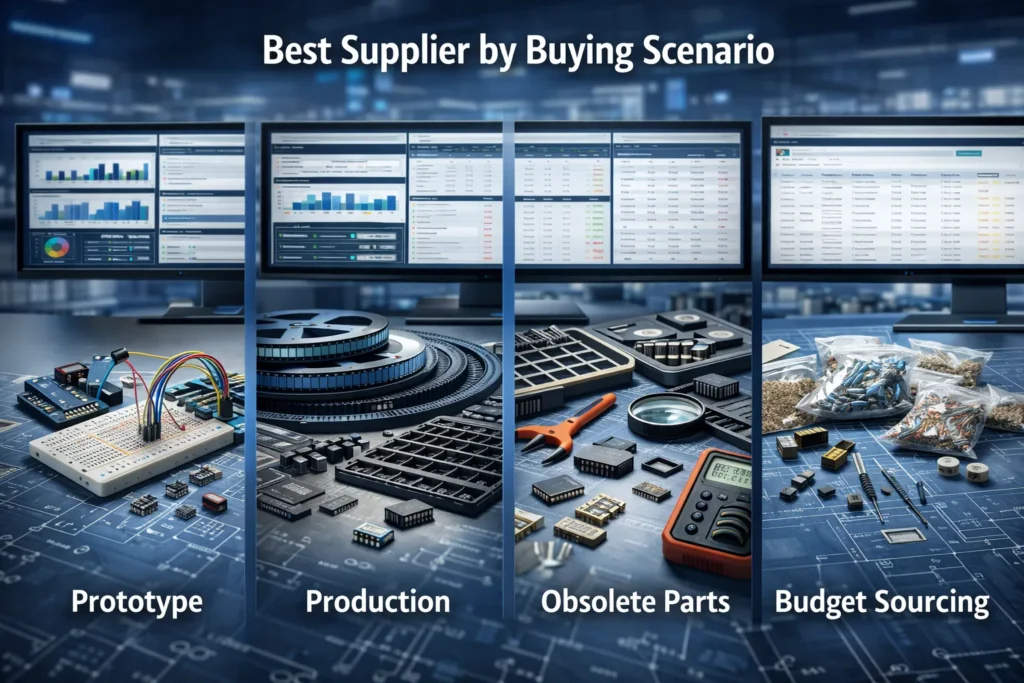
The best electronic components supplier depends less on brand popularity and more on the exact sourcing situation. A distributor that works perfectly for prototype builds may not be the best fit for long-term production. A low-cost platform that makes sense for standard passives may be the wrong choice for lifecycle-sensitive semiconductors. And when a part is obsolete or hard to find, a sourcing specialist can be more useful than a mainstream catalog distributor.
| Scenario | Best Supplier Type | Why It Fits | Typical Examples |
|---|---|---|---|
| Rapid prototyping | Broad authorized distributors | Strong in-stock access, fast ordering, wide category coverage | DigiKey, Mouser |
| New product evaluation | Design-focused authorized distributors | Good visibility into new devices, development-friendly ecosystem | Mouser, DigiKey |
| Production and repeat purchasing | Enterprise-oriented authorized distributors | Better fit for structured procurement, supply continuity, lifecycle support | Arrow, Avnet, Newark, Farnell |
| Obsolete and end-of-life components | Lifecycle specialists | Focused on continuity, legacy support, and difficult semiconductor sourcing | Rochester Electronics |
| Shortage recovery and hard-to-find parts | Independent distributors and sourcing partners | Flexible sourcing reach, RFQ handling, alternate supply access | Smith, MOZ Electronics |
| Arduino, Raspberry Pi, and maker projects | Maker and educational retailers | Tutorials, modules, breakout boards, easy entry point | SparkFun, Adafruit, Jameco |
| Budget-sensitive common BOM parts | Low-cost volume platforms | Competitive pricing for standard components and passives | LCSC, Tayda |
| Comparing offers before buying | Part search and BOM comparison tools | Fast visibility into stock, price breaks, and source options | Octopart, Findchips |
Best for rapid prototyping
When engineers are moving quickly, the ideal supplier is usually one with broad in-stock inventory, fast order processing, and a strong self-service catalog experience. At this stage, speed matters more than perfect commercial optimization. Buyers and engineers want to find the exact part, review the datasheet, confirm stock, and place an order without friction.
This is why broad authorized distributors are often the default choice for prototyping. They make it easier to source semiconductors, passives, connectors, sensors, and development accessories in one place, which reduces search time and helps teams move from concept to bench testing more quickly.
Best for new product evaluation
During the design and evaluation stage, engineers often care about access to newly introduced parts, development-friendly product pages, and a strong technical discovery experience. This is where design-focused authorized distributors stand out.
The goal here is not just to buy a part. It is to understand what is available, compare options, and move confidently into design selection. For engineering teams assessing microcontrollers, power devices, sensors, or interface ICs, distributors with strong new-product visibility can be especially helpful.
Best for production and repeat purchasing
Once a product is moving into regular manufacturing, the sourcing priority changes. At that point, repeatability, documentation, supply continuity, and procurement structure become much more important than one-time convenience.
Enterprise-oriented authorized distributors are a stronger fit here because they better support formal sourcing workflows, approved vendor strategies, and longer-term supply planning. This category is especially useful when multiple stakeholders are involved, including engineering, purchasing, operations, and supply chain teams.
Best for obsolete and end-of-life components
Obsolete and end-of-life parts require a completely different sourcing mindset. In these cases, the challenge is not simply availability. It is continuity, authenticity, lifecycle awareness, and fit for legacy systems that may still be operational for years.
This is where lifecycle specialists stand out. They are more relevant than general catalog distributors when a design depends on older semiconductors, long-life industrial systems, or field support for installed equipment. For buyers working in industrial, medical, defense, transportation, or maintenance-heavy environments, this scenario deserves its own sourcing strategy.
Best for shortage recovery and hard-to-find parts
In shortage situations, buyers need flexibility more than catalog convenience. Standard channels may show zero stock, unacceptable lead times, or commercial conditions that no longer work for the program. At that point, sourcing becomes a problem-solving exercise rather than a routine transaction.
Independent distributors and RFQ-based sourcing partners are often most useful in this situation because they can search outside mainstream channel inventory, suggest alternate routes, and respond to specific procurement constraints. This is also where a company like MOZ Electronics fits naturally into the discussion: as a sourcing partner for buyers who need quote-based support, faster response, and help securing difficult component lines.
Best for Arduino, Raspberry Pi, and maker projects
Hobbyists, students, makers, and lab users usually do not need the same sourcing model as OEM procurement teams. They need easy-to-buy modules, compatible accessories, tutorials, and a smoother on-ramp into electronics building.
That is why maker and educational retailers are usually the best choice in this scenario. They help users build quickly with breakout boards, displays, sensors, cables, kits, and developer-friendly content. For many learning-based projects, this is far more valuable than a formal industrial distribution workflow.
Best for budget-sensitive common BOM parts
Some projects are driven heavily by cost. In those cases, buyers may focus on standard resistors, capacitors, connectors, diodes, transistors, and other common components where the sourcing priority is keeping BOM cost under control.
Low-cost volume platforms are often attractive in this scenario because they provide access to affordable standard parts and can be especially useful when the project does not require the strictest sourcing structure. That said, buyers still need to judge whether the sourcing route aligns with quality expectations, logistics needs, and product risk.
Best for comparing offers before buying
Sometimes the smartest supplier decision starts with not choosing a supplier at all. Instead, it starts with a comparison tool. When a buyer already has the exact manufacturer part number, the first need is often visibility: who has stock, how prices differ, and which channels look most realistic.
Part search engines and BOM comparison tools are extremely useful here because they make the market easier to read. Rather than checking multiple suppliers one by one, buyers can begin with a single search and quickly compare pricing, source options, and availability before deciding which seller to trust.
Which supplier scenario fits your project?
If you are moving quickly on a prototype, broad authorized distributors are often the best fit. If you are evaluating new components, choose suppliers that support engineering discovery. If you are buying for production, use channels that support continuity and procurement discipline. If you are facing shortages or obsolete parts, use sourcing specialists. If you are building educational or maker projects, choose retailers designed for usability. And if you are still checking the market, begin with comparison tools before you commit.
Match the supplier to the scenario, not just to the brand name. The more critical the project, the more controlled your sourcing strategy should be. The more experimental or budget-driven the project, the more flexible your sourcing options can be.
Separate engineering convenience from procurement requirements
Engineers often optimize for fast access to the right part. Procurement teams often optimize for approved sourcing, negotiated pricing, lead time, and supply continuity. A good article should acknowledge both perspectives.
Check lifecycle before you fall in love with a part
One of the most expensive sourcing mistakes is selecting a part only because it is easy to buy today. Buyers should also check whether the part is active, mature, NRND, or at end-of-life risk.
Use comparison tools before RFQ volume decisions
For exact manufacturer part numbers, comparison engines can help buyers understand whether the apparent “best price” is actually competitive after stock availability, packaging, distributor credibility, and order quantity are considered.
Know when a sourcing partner adds more value than a shopping cart
There are many procurement cases where direct online ordering is not enough:
- The part is out of stock in mainstream channels
- The BOM includes difficult or mixed-source items
- You need alternate sourcing suggestions
- You need support for MOQ, date code, package, or RFQ handling
- You are comparing price, availability, and lead time across multiple supply routes
In those cases, a sourcing partner like MOZ Electronics can be more useful than another generic list of online stores.
Where MOZ Electronics Fits in This Supplier Landscape
Most articles stop after naming the big distributors. But many real buyers do not just need “a place to buy.” They need a partner who can help with:
- RFQ-driven sourcing
- Hard-to-find and supply-constrained parts
- Alternative sourcing paths
- Commercially competitive quotes
- Mixed procurement needs across multiple part lines
- Faster decision support than self-service catalog browsing alone
That is where MOZ Electronics can be positioned effectively in this article. Not as a replacement for every authorized distributor, and not as a generic marketplace, but as a practical sourcing partner for buyers who need responsiveness, sourcing flexibility, and quote-based support.
You already know the part number, need a quote, want help sourcing difficult components, need a faster commercial response, or want a procurement partner who can support shortage-driven and RFQ-based sourcing workflows.
Common Mistakes Buyers Make When Choosing Parts Suppliers
Choosing the cheapest listing without checking source quality
Low price only matters if the part, condition, packaging, and sourcing path match your requirement. For critical components, cost without confidence can become expensive very quickly.
Using the same supplier logic for hobby builds and production BOMs
The ideal supplier for an Arduino experiment is not automatically the ideal supplier for a product you plan to manufacture repeatedly.
Ignoring shortage risk until the part disappears
Good sourcing starts before the shortage. If a part is central to your product, you should already know your alternates, second sources, and backup procurement options.
Forgetting logistics and commercial details
Buyers often compare only list price, but real procurement also includes shipping, MOQ, packaging, lead time, customs friction, and whether the seller can support repeated supply.
Our Practical Verdict
There is no single best answer to the question, “Who is the best electronic components and parts supplier?” The better question is:
If you want the broadest mainstream catalog experience, authorized distributors like DigiKey and Mouser are often the first stop. If your business needs larger-scale supply chain coordination, Arrow and Avnet deserve attention. If lifecycle continuity or obsolete parts are the issue, Rochester Electronics becomes highly relevant. If supply is constrained or the part is hard to find, shortage-oriented sourcing specialists matter much more. If you are building, learning, or experimenting, SparkFun, Adafruit, and Jameco can be more practical than enterprise channels. And if your real goal is comparison, Octopart and Findchips are often the smartest first click.
For buyers who need quote support, alternative sourcing, hard-to-find parts assistance, or faster RFQ-based procurement help, MOZ Electronics can occupy a valuable position between self-service catalog platforms and one-size-fits-all distributor lists.
Need help sourcing electronic components faster?
If you already have part numbers, BOM lines, or hard-to-find requirements, MOZ Electronics can help with quote-based sourcing support, alternative supply options, and procurement assistance for difficult electronic components.
Frequently Asked Questions
What is the difference between an authorized distributor and an independent electronic components supplier?
An authorized distributor works through formal manufacturer relationships and is usually preferred for traceability, original documentation, and production-grade sourcing. An independent supplier is often more flexible in shortage or obsolete-part situations and may provide access when mainstream channels are unavailable.
What is the best place to buy electronic components for prototyping?
For broad prototype sourcing, authorized catalog distributors are often the easiest choice. For boards, modules, kits, and educational accessories, maker-focused stores may be a better fit.
Where can I find hard-to-find or obsolete electronic components?
This usually requires a lifecycle specialist or an experienced sourcing partner. If a part is no longer easy to buy through standard channels, buyers often work with obsolete-part specialists or RFQ-based sourcing companies.
Are low-cost electronic component platforms good for all projects?
Not always. They can be excellent for standard parts and cost-sensitive projects, but the right choice depends on your quality requirements, documentation needs, and sourcing risk tolerance.
When should I contact MOZ Electronics instead of buying directly online?
Contact MOZ Electronics when you need quote-based support, help with hard-to-find parts, alternative sourcing options, or commercial assistance for BOM lines that are difficult to secure through standard online catalog workflows.