
Diodes are among the most important components in electronics. They appear in power supplies, protection circuits, LED indicators, sensor modules, switching designs, and communication hardware. To read a circuit correctly, you need to understand what each diode symbol means, how to identify the anode and cathode, and why different diode types use slightly different schematic marks.
In simple terms, a diode allows current to flow mainly in one direction and blocks it in the other. That basic behavior supports many practical jobs, such as rectifying AC into DC, regulating voltage, reducing switching loss, sensing light, emitting light, and protecting circuits from voltage spikes. Once you understand the symbol, you can read the function much faster.
If you are learning how to read electronic schematics more confidently, it also helps to compare diode markings with other common component references, such as this guide to capacitor symbols.
What Is a Diode?
A diode is a two-terminal semiconductor device that is designed to conduct current primarily in one direction. It has an anode and a cathode. When the diode is forward-biased, current can pass through it. When it is reverse-biased, the diode resists current flow, except in special cases such as Zener breakdown or leakage behavior.
This one-way behavior makes diodes useful in many circuit tasks:
- Converting AC to DC in power supplies
- Protecting circuits from reverse polarity
- Clamping or regulating voltage
- Reducing switching loss in high-speed designs
- Creating visual indicators with LEDs
- Detecting light in optical systems
- Suppressing surge and transient voltage events
Quick definition: A diode symbol is a schematic sign that shows a component with directional current behavior. Variations of the base symbol indicate different diode functions, such as voltage regulation, light emission, light sensing, or surge protection.
How to Read a Diode Symbol on a Schematic
The first step is to identify the two ends of the symbol. One side represents the anode. The other side includes the bar, which marks the cathode. In most diagrams, the symbol is drawn to show the permitted direction of conventional current flow from anode to cathode when forward-biased.
The same idea appears in other schematic components as well. For example, the potentiometer symbol also uses small visual changes to show how the component behaves electrically in a circuit.
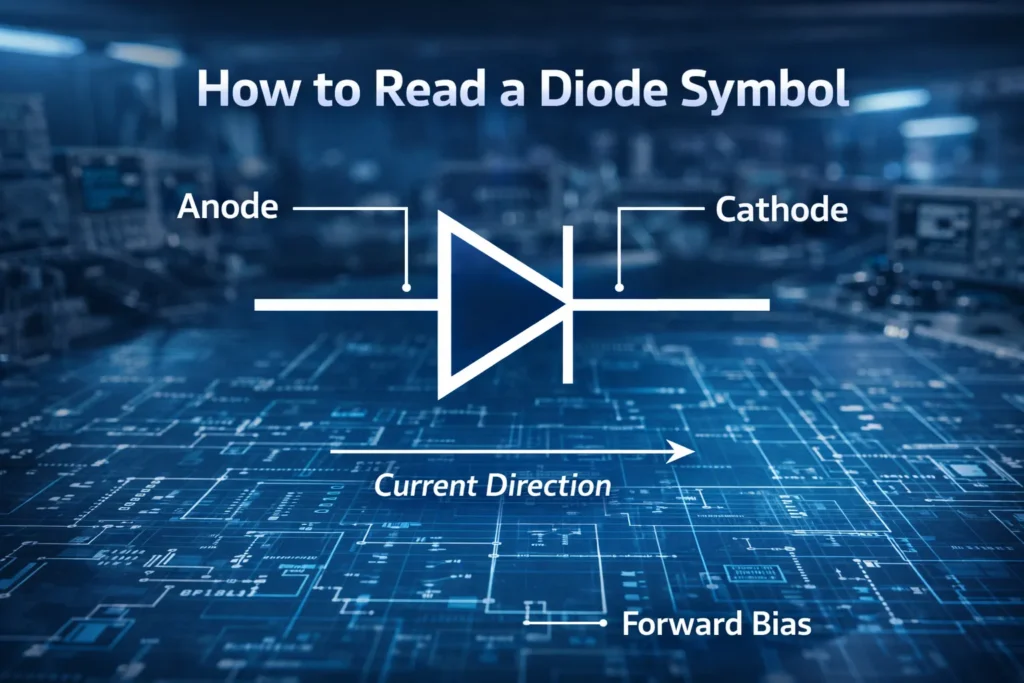
Anode vs Cathode
The anode is the side where conventional current enters the diode in forward operation. The cathode is the side marked by the bar. When you read a schematic, the bar is usually the fastest visual clue.
What the Bar Means
The bar identifies the cathode side. In practical circuit reading, engineers often start by locating the bar first because it immediately tells them polarity orientation.
Why Symbol Variations Matter
Not all diodes are used for the same job. A rectifier diode, Zener diode, Schottky diode, LED, and photodiode all share the same core one-way device concept, but each symbol adds features to indicate its special function. Those small changes matter because they tell you how the device behaves in a real circuit.
Simple Rule to Remember
If you can identify the cathode bar and understand what kind of diode is being shown, you can usually predict the component’s job in the circuit much faster.
Common Diode Symbols and Their Functions
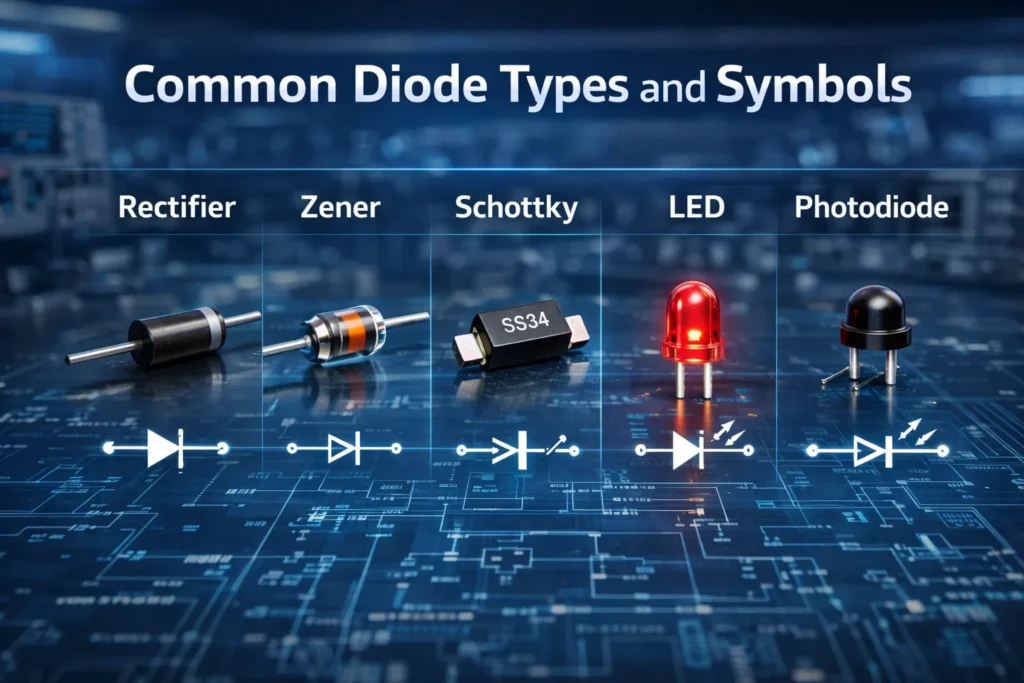
| Diode Type | Main Symbol Clue | Main Function | Typical Use |
|---|---|---|---|
| Standard Rectifier Diode | Base diode symbol | One-way current flow and rectification | AC to DC conversion, reverse-polarity blocking |
| Small Signal / Switching Diode | Base diode symbol | Fast switching of low current signals | Logic, signal routing, protection |
| Zener Diode | Modified cathode line | Voltage regulation or clamping in reverse bias | Voltage reference, overvoltage control |
| Schottky Diode | Modified cathode line | Low forward voltage drop and fast switching | SMPS, high-speed rectification, power efficiency |
| LED | Arrows pointing outward | Light emission | Indicators, displays, lighting |
| Photodiode | Arrows pointing inward | Light detection | Sensors, optical receivers, measurement systems |
| TVS Diode | Protection-oriented diode symbol variation | Transient suppression | ESD and surge protection |
| Varactor / Varicap Diode | Capacitor-related symbol variation | Voltage-controlled capacitance | Tuning circuits, RF applications |
| Bridge Rectifier | Four diodes in bridge form | Full-wave rectification | Power supplies, adapters, industrial electronics |
Standard Rectifier Diode Symbol and Function
The standard rectifier diode is the most common form of diode in circuit diagrams. Its job is simple but essential: it lets current pass in one direction and blocks it in the reverse direction. This is why rectifier diodes are widely used in power conversion circuits.
What It Does
In a power supply, rectifier diodes convert alternating current into direct current. In protection circuits, they can stop reverse connection damage. In relay or motor circuits, they can help manage inductive effects when paired correctly in flyback or freewheeling arrangements.
Where It Appears
- AC-DC power supplies
- Input reverse-polarity protection
- Battery-connected products
- Bridge rectifier modules
- General-purpose electronics boards
Zener Diode Symbol and Function
A Zener diode is designed to operate in reverse bias once a specific breakdown voltage is reached. Unlike a standard rectifier diode, which is mainly used to block reverse current, a Zener diode intentionally uses controlled reverse breakdown to regulate or clamp voltage.
How Its Symbol Differs
The symbol looks similar to a standard diode, but the cathode line is modified. That visual change signals that the diode has a voltage regulation role rather than simple one-way rectification.
Why Engineers Use It
- Voltage reference circuits
- Simple regulator designs
- Input protection stages
- Clamping circuits
- Overvoltage control in low-power systems
Practical note: A Zener diode is often selected by its Zener voltage, power rating, tolerance, and package. It is commonly placed in parallel with the protected or regulated node.
Schottky Diode Symbol and Function
A Schottky diode is chosen when low forward voltage drop and fast switching speed matter more than high reverse blocking performance. In many modern designs, that makes Schottky diodes very attractive for efficient power paths.
How Its Symbol Differs
The Schottky symbol uses a modified cathode line to distinguish it from a normal PN junction diode. The exact drawing style can vary slightly by reference source, but the purpose is the same: it indicates a diode built for lower loss and faster response.
Main Benefits
- Lower forward voltage drop
- Reduced heat in many power applications
- Faster switching behavior
- Better efficiency in high-frequency circuits
Common Applications
- Switch-mode power supplies
- Output rectification
- Solar power blocking paths
- Battery charging circuits
- OR-ing and power-path control
LED Symbol and Function
An LED, or light-emitting diode, is one of the easiest diode symbols to recognize. It uses the base diode form with small arrows pointing outward to show that the device emits light.
Why the Arrows Point Outward
The arrows represent light leaving the device. This makes the LED symbol visually different from ordinary rectifier and switching diodes.
Common Uses of LEDs
- Status indicators
- Display backlighting
- Consumer electronics
- Signal panels
- Architectural and functional lighting
Important Design Note
LEDs still need current limiting in most circuits. The symbol tells you it is a light-emitting device, but the circuit still needs proper resistor sizing or a constant-current driver.
Photodiode Symbol and Function
A photodiode works in the opposite visual direction from an LED symbol. Its arrows point inward, indicating that light is entering the device. Instead of emitting light, the photodiode senses it.
What a Photodiode Does
When light strikes the photodiode, it generates or modulates electrical current. That makes photodiodes useful in optical detection, measurement, sensing, and communication systems.
Common Applications
- Optical sensors
- Remote control receivers
- Industrial light detection
- Fiber and communication systems
- Medical and measurement equipment
Other Useful Diode Symbols You Should Know
TVS Diode
A transient voltage suppression diode is designed to protect circuits from voltage spikes. It is commonly used on power rails, communication lines, automotive systems, and ESD-sensitive electronics.
Varactor or Varicap Diode
A varactor diode is used as a voltage-controlled capacitor. It appears in RF tuning and frequency control circuits where capacitance changes with reverse-bias voltage.
Laser Diode
A laser diode is a light-emitting semiconductor device designed for coherent light output. It is common in optical communication, barcode readers, alignment tools, sensing modules, and storage systems.
Bridge Rectifier
A bridge rectifier symbol combines four diodes in a full-wave arrangement. Instead of representing one single diode, it shows a complete rectification block used to turn AC input into pulsating DC output.
Why This Matters in Real Projects
In practical electronics work, recognizing the symbol is only the first step. You also need to understand the intended electrical role: rectification, protection, regulation, sensing, or emission. That is what allows faster troubleshooting and better component selection.
Diode Symbol vs Real Diode Package Marking
Reading a schematic is not the same as identifying a real diode on a board or in a parts bag. In a physical component, the cathode is often marked with a band on the diode body. On an LED, lead length, flat-edge marking, or package type may indicate polarity. On a PCB, silkscreen may also show polarity orientation.
This schematic-to-hardware reading skill is also important for other polarized components. Our guide to capacitor polarity symbols explains how diagram markings connect to real-world positive and negative terminal identification.

What to Look For on a Real Part
- Band marking on axial diodes
- Package polarity diagrams in the datasheet
- PCB silkscreen cathode indicator
- Lead length or flat side on some LEDs
- Pin-1 or polarity marks on SMD packages
Why This Section Helps
Many beginners can read a diode symbol but still install the real part backward. That mistake is common in repair work, prototyping, and low-volume assembly.
How to Choose the Right Diode for a Circuit
Once you know the symbol, the next step is selecting the right device. Engineers do not choose a diode by symbol alone. They choose it by electrical performance.

Key Selection Factors
- Reverse voltage rating: The maximum reverse voltage the diode can handle safely
- Forward current rating: How much current it can conduct without overheating
- Forward voltage drop: Important for efficiency and thermal performance
- Switching speed: Critical in fast digital and power circuits
- Power dissipation: Affects package choice and heat management
- Leakage current: Important in precision, low-power, and sensing applications
- Package style: Axial, SMD, power package, or module
| If Your Goal Is… | Best Diode Type to Consider |
|---|---|
| AC to DC conversion | Rectifier diode or bridge rectifier |
| Low loss and fast power switching | Schottky diode |
| Simple voltage regulation | Zener diode |
| Visual indication | LED |
| Light sensing | Photodiode |
| Surge and ESD protection | TVS diode |
| RF tuning | Varactor diode |
Common Mistakes When Reading Diode Symbols
- Confusing the cathode side with the current direction
- Assuming every diode is a rectifier diode
- Mixing up LED and photodiode arrow directions
- Ignoring symbol differences between Zener and Schottky types
- Forgetting that physical package polarity must also be checked
- Choosing a diode by type name only without checking ratings
- Assuming all schematic libraries draw every diode symbol exactly the same way
Quick Reference: Diode Symbols at a Glance
If you remember only a few points, remember these:
- The bar usually marks the cathode.
- A standard diode is for one-way conduction and rectification.
- A Zener diode is for voltage regulation and clamping.
- A Schottky diode is for low loss and fast switching.
- An LED has arrows pointing outward because it emits light.
- A photodiode has arrows pointing inward because it senses light.
- A bridge rectifier uses four diodes to convert AC to DC more efficiently.
Frequently Asked Questions
What is the symbol of a standard diode?
A standard diode symbol is the basic schematic mark used for a two-terminal device that allows current mainly in one direction. The cathode side is identified by a bar.
How do you tell anode and cathode in a diode symbol?
The cathode is the side marked by the bar. The opposite side is the anode.
What does the bar mean in a diode symbol?
The bar marks the cathode. It is the most important visual reference when identifying polarity on a schematic.
Why do LED symbols have arrows pointing outward?
Because LEDs emit light. The outward arrows show light leaving the device.
Why do photodiode symbols have arrows pointing inward?
Because photodiodes detect incoming light. The inward arrows show light entering the device.
What is the difference between a Zener diode and a Schottky diode?
A Zener diode is mainly used for reverse-bias voltage regulation or clamping. A Schottky diode is used for low forward voltage drop and fast switching.
What is a bridge rectifier symbol used for?
It represents a four-diode arrangement used for full-wave AC to DC rectification in power circuits.
How do you identify diode polarity on a real component?
On many physical diodes, the cathode is marked with a band. You should also confirm polarity in the datasheet and check the PCB silkscreen.
Final Thoughts
Learning diode symbols is one of the fastest ways to improve your circuit reading skills. Once you understand the cathode bar, the anode side, and the visual differences between common diode types, circuit diagrams become much easier to follow. More importantly, you begin to connect the symbol to the real electrical job the diode performs in the design.
Whether you are studying electronics, sourcing components, reviewing a datasheet, or troubleshooting a board, diode symbol literacy saves time and prevents mistakes. It also helps you choose the right device for the real application, not just the right-looking part on paper.