
Industrial electronic components are used in factory automation, control cabinets, power systems, industrial equipment, and maintenance repair. Common examples include semiconductors, sensors, relays, contactors, power supplies, connectors, circuit protection devices, passive components, PLC modules, and thermal management parts.
What Are Industrial Electronic Components?
Industrial electronic components are parts designed or selected for use in industrial systems where long-term reliability, electrical stability, mechanical durability, and serviceability matter. These components can be mounted on printed circuit boards, installed inside control cabinets, integrated into sensors and drives, or used as replacement parts for maintenance and repair.
A typical industrial system may include semiconductor ICs for signal processing, discrete semiconductors for switching and protection, sensors for feedback, power supply products for stable voltage conversion, and electromechanical components such as relays, fans, and switches.
In real industrial applications, the term is broader than basic PCB parts. It may also include DIN rail power supplies, PLC processors, I/O modules, interface modules, terminal blocks, solid state relays, current sensors, thermal management devices, and obsolete replacement components used to keep legacy equipment running.
Industrial Electronic Components vs Consumer Electronic Components
Many basic functions are similar across electronics. A resistor still limits current, a capacitor still stores charge, and a diode still controls current direction. However, industrial applications usually require a higher level of reliability, documentation, and compatibility checking.
| Factor | Industrial Electronic Components | Consumer Electronic Components |
|---|---|---|
| Operating environment | Harsh, noisy, high vibration, continuous operation | Controlled indoor or consumer-use environment |
| Temperature range | Often wider and industrial-grade | Usually narrower |
| Lifecycle | Longer service life and replacement planning | Faster product turnover |
| Reliability focus | Stability, safety, uptime, documentation | Cost, size, volume production |
| Typical use cases | PLCs, drives, sensors, control panels, power systems | Phones, home appliances, gadgets, office electronics |
Industrial equipment may remain in operation for 10, 15, or even 20 years. However, the original electronic components inside that equipment may become obsolete much earlier. This creates sourcing challenges for maintenance teams, especially when a production line depends on an old relay, sensor, microcontroller, display driver, connector, or power module.
A relay with the same shape may have a different coil voltage. A sensor with the same housing may have a different output type. A voltage regulator with the same package may have different thermal limits. In industrial maintenance, small differences can lead to installation failure or equipment downtime.
Main Types of Industrial Electronic Components
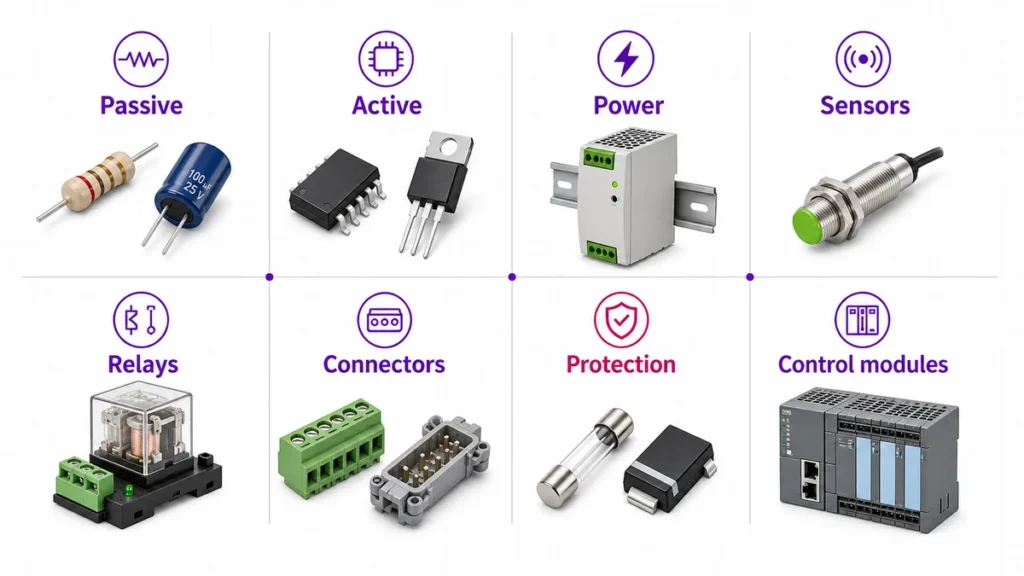
Passive Components
Resistors, capacitors, inductors, transformers, crystals, and oscillators used for filtering, energy storage, current limiting, timing, and stabilization.
Active Components
Diodes, transistors, MOSFETs, IGBTs, ICs, regulators, op-amps, logic ICs, microcontrollers, and interface devices.
Power Components
AC/DC supplies, DC/DC converters, UPS modules, rectifiers, fuses, circuit breakers, surge protection, and power modules.
1. Passive Components
Passive components do not amplify signals or require an external control signal to operate. They are used to store energy, limit current, divide voltage, filter noise, tune circuits, and stabilize power rails. Common passive parts include resistors, capacitors, inductors, transformers, crystals, and oscillators.
In industrial electronics, passive components are found in power supplies, motor control boards, signal conditioning circuits, communication modules, sensor interfaces, and protection networks. For example, resistors may be used for current limiting, pull-up networks, voltage dividers, and sensing circuits.
Capacitors are equally important in industrial equipment. They smooth power rails, reduce ripple, support motor drive circuits, and filter electromagnetic interference. When selecting capacitors for industrial use, voltage rating, capacitance, ESR, temperature rating, lifetime, and package style should all be checked carefully.
Inductors and transformers are used in power conversion, EMI filtering, isolation, and energy storage. In switching power supplies and industrial converters, the wrong magnetic component can affect efficiency, heat generation, noise performance, and reliability.
2. Active Components and Semiconductors
Active components control, amplify, switch, or process electrical signals. This group includes diodes, transistors, MOSFETs, IGBTs, voltage regulators, op-amps, logic ICs, microcontrollers, interface ICs, memory ICs, and power management devices.
Industrial control boards often depend on integrated circuits for processing, timing, communication, conversion, and control logic. If you are working with board-level sourcing, the guide to integrated circuit identification and pricing is useful when part markings, package types, and availability need to be checked before purchase.
Discrete semiconductors are also essential. Diodes and rectifiers, TVS diodes, Zener diodes, Schottky diodes, BJTs, MOSFETs, and thyristors are used for rectification, switching, clamping, voltage regulation, load control, and ESD protection.
In motor drives and power equipment, MOSFETs and IGBTs are especially important. They switch current at high speed and must be selected according to voltage rating, current rating, switching frequency, gate drive requirement, thermal resistance, and package type.
3. Power Supply and Power Conversion Components
Power stability is one of the most important requirements in industrial electronics. PLCs, sensors, relays, HMIs, communication modules, motor drives, and control boards all depend on stable input power. Industrial power systems may include power supply products, AC/DC power supplies, DC/DC converters, UPS modules, voltage regulators, rectifier bridges, transformers, fuses, and surge protection devices.
When selecting power supply products, engineers should check input voltage, output voltage, output current, wattage, efficiency, isolation, ripple, derating curve, protection features, and mounting method. For control cabinets, 24V DC is common, but the exact system requirement must always be confirmed from the machine documentation or original module label.
In many industrial faults, the visible symptom may be a controller reset, unstable sensor signal, communication error, or relay malfunction, while the root cause may actually be unstable power, insufficient current capacity, aging capacitors, poor grounding, or inadequate surge protection.
4. Sensors and Signal Devices
Sensors convert physical conditions into electrical signals. They allow industrial systems to detect position, current, pressure, temperature, flow, motion, proximity, vibration, light, and other operating conditions. Common industrial sensor types include proximity sensors, current sensors, position sensors, optical sensors, motion sensors, pressure sensors, and temperature sensors.
In automation systems, sensors provide the feedback that allows controllers to make decisions. A PLC may read a sensor input, compare it with programmed logic, and then activate a relay, motor drive, valve, alarm, or actuator.
Before sourcing a replacement sensor, check supply voltage, sensing range, output type, connector style, mounting method, response time, operating temperature, and environmental rating. One of the most common mistakes in industrial repair is confusing NPN and PNP sensor outputs, or replacing a 4-20 mA analog output sensor with a voltage-output model.
Current sensors are often used in power monitoring, motor control, battery systems, UPS equipment, and protection circuits. Proximity sensors and photoelectric sensors are widely used on production lines to detect object presence, position, or movement.
5. Control and Automation Components
Control and automation components coordinate the operation of machines and production systems. This category includes PLC processors, I/O modules, communication modules, HMIs, industrial PCs, motor drives, interface boards, and embedded controllers.
In a typical control panel, a PLC receives input signals from sensors and switches, processes logic, and sends output signals to relays, contactors, valves, lights, alarms, or drives. Buyers sourcing PLC-related hardware can review available PLC processors and broader industrial automation categories when matching replacement modules.
Embedded controllers may also appear inside industrial products. Microcontrollers can be used in control boards, communication devices, instrumentation, and embedded industrial systems where processing and peripheral integration are required.
6. Relays, Contactors, and Switching Devices
Relays and contactors allow a low-power control signal to switch a higher-power circuit. They are widely used in motor control, lighting systems, pumps, heaters, safety circuits, alarm systems, HVAC equipment, and industrial control panels.
There are several relay types, including electromechanical relays, power relays, reed relays, signal relays, and solid state relays. Electromechanical relays use physical contacts, while SSRs use semiconductor switching elements. SSRs are often selected when silent operation, fast switching, long mechanical life, or high switching frequency is required.
When replacing a relay, check the coil voltage, contact arrangement, contact rating, load type, switching voltage, mounting style, terminal layout, and safety approvals. A relay may look identical but fail if the coil voltage or contact rating is wrong.
7. Connectors, Terminals, and Wiring Components
Industrial connectors and interconnects are responsible for reliable electrical connection under vibration, movement, dust, and frequent maintenance. These include terminal blocks, circular connectors, rectangular connectors, PCB headers, cable assemblies, wire harnesses, cable glands, and industrial Ethernet connectors.
The key specifications include pin count, pitch, current rating, voltage rating, locking method, wire size, mating cycle rating, IP rating, and operating temperature. In field equipment, connector reliability can be just as important as the electronics behind it.
Terminal blocks are especially common in control cabinets because they make wiring organized, serviceable, and easier to troubleshoot. For networked industrial equipment, the guide to industrial RJ45 connectors for harsh environments is a useful related reference.
8. Circuit Protection and Thermal Management
Industrial systems need protection against overload, short circuit, electrostatic discharge, surge, reverse polarity, overheating, and transient voltage events. Circuit protection parts include fuses, fuse holders, TVS diodes, varistors, gas discharge tubes, resettable fuses, circuit breakers, and protection ICs.
Thermal management components include heat sinks, cooling fans, thermal pads, and airflow accessories. In control cabinets and power electronics, temperature has a direct impact on reliability. Overheated components may drift out of specification, age faster, or fail suddenly.
AC fans and DC cooling fans are often used in control cabinets, power supplies, drives, and enclosures. When replacing thermal components, buyers should confirm dimensions, airflow, voltage, connector type, bearing type, noise level, and service life.
Common Applications of Industrial Electronic Components
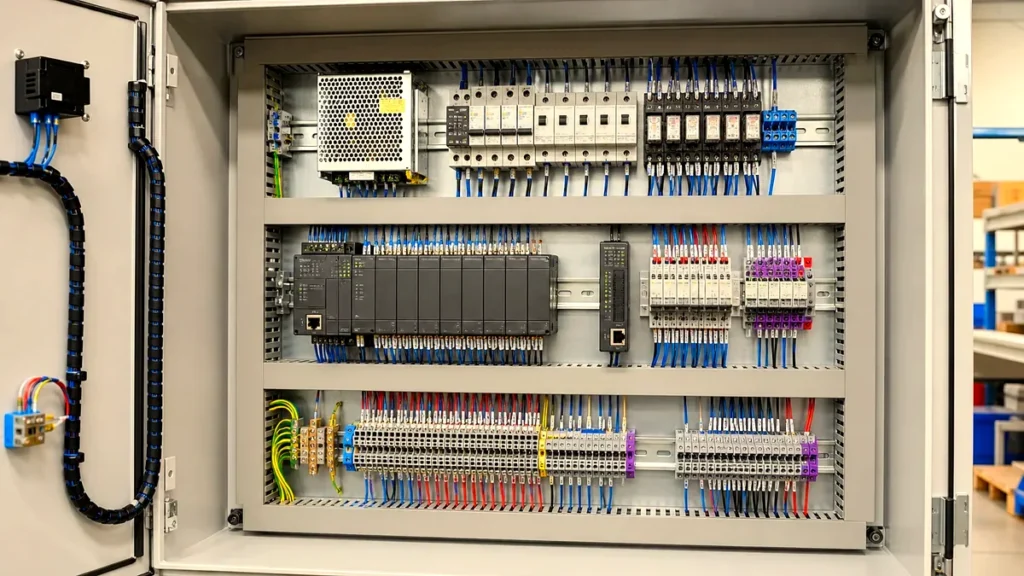
Factory Automation
Used in conveyors, robotic arms, packaging lines, assembly systems, inspection machines, and automated production cells.
Control Panels
Used in PLCs, DIN rail power supplies, circuit breakers, relays, contactors, terminals, fans, and communication modules.
Energy and Power Systems
Used in solar inverters, UPS systems, battery systems, converters, power distribution units, and motor control equipment.
Maintenance and Repair
Used to replace obsolete ICs, sensors, relays, power modules, fans, connectors, and board-level parts.
In factory automation, sensors detect product position, PLCs process control logic, relays switch loads, drives control motors, and power supplies feed control circuits. In process control, sensors and signal devices monitor temperature, pressure, flow, level, vibration, and current. These signals are used to control pumps, valves, heaters, mixers, compressors, and other equipment.
In maintenance and repair, industrial electronic components are needed to restore equipment quickly. MRO teams often source obsolete ICs, replacement sensors, relays, power modules, fans, connectors, and board-level parts. A correct replacement can reduce downtime and extend the service life of valuable machinery.
Key Specifications to Check Before Sourcing
For industrial buyers, the most important step is not simply finding a visually similar part. The goal is to confirm whether the part will work safely and reliably in the target system.
| Component Type | Key Parameters to Check |
|---|---|
| ICs and microcontrollers | Full part number, package, voltage, memory, speed, interface, temperature grade, lifecycle status |
| Relays | Coil voltage, contact form, contact rating, load type, mounting style, terminal layout |
| Sensors | Supply voltage, output type, sensing range, connector, mounting method, response time, IP rating |
| Power supplies | Input voltage, output voltage, current, wattage, isolation, efficiency, derating, protection features |
| Connectors | Pin count, pitch, current rating, voltage rating, locking type, mating part, wire size |
| Capacitors | Capacitance, voltage, ESR, tolerance, lifetime, temperature, size, polarity |
| MOSFETs and IGBTs | Voltage, current, RDS(on), gate charge, switching speed, package, thermal resistance |
| Protection devices | Clamping voltage, working voltage, surge rating, response time, package, application standard |
How to Choose Reliable Industrial Electronic Components
Reliable component selection starts with the complete part number. Many manufacturers use suffixes to indicate package type, temperature grade, packing method, lead finish, RoHS status, automotive grade, or revision. Removing a suffix may lead to a different part.
Next, compare the datasheet instead of relying only on marketplace descriptions. Confirm the electrical limits, mechanical dimensions, recommended operating conditions, and environmental ratings. If the original part is unavailable, a replacement should be evaluated by function, pinout, package, voltage, current, timing, thermal performance, and safety requirements.
Buyers should also consider lifecycle risk. Industrial equipment often remains in service much longer than the electronic components inside it. If a machine still depends on discontinued parts, this guide on how to source obsolete electronic components safely can help teams reduce counterfeit, compatibility, and documentation risks.
Common Challenges in Industrial Component Sourcing
Obsolescence
Obsolescence is one of the biggest problems in industrial maintenance. Manufacturers may discontinue components because of process changes, low demand, material restrictions, or product line updates. However, industrial equipment may still depend on those parts for many years.
Long Lead Times
Industrial-grade components, special modules, PLC-related hardware, relays, sensors, and power components may have long lead times, especially when demand increases or production capacity is limited.
Counterfeit and Quality Risk
Rare or discontinued parts may carry a higher risk of counterfeit, remarked, refurbished, or poorly stored inventory. Buyers should request clear photos, inspection details, packaging information, traceability if available, and testing options for high-risk components.
Incomplete Part Numbers
Industrial RFQs often arrive with partial part numbers, machine descriptions, old labels, or photos from installed equipment. A missing suffix can change the result. Before ordering, confirm the complete manufacturer part number, manufacturer name, package, quantity, and application.
Parameter Mismatch
A part may be available, but not suitable. Common mismatch examples include relay coil voltage, sensor output type, connector pinout, capacitor voltage rating, MOSFET current rating, regulator package, or operating temperature grade.
Common Manufacturers in Industrial Electronic Components
Industrial electronic components are supplied by many global manufacturers. Depending on the category, buyers may encounter brands such as Texas Instruments, STMicroelectronics, Infineon, onsemi, Analog Devices, NXP Semiconductors, Microchip Technology, Vishay, Panasonic, Honeywell Sensing and Productivity Solutions, Omron, TE Connectivity, Molex, Phoenix Contact, Siemens, Eaton, Littelfuse, Murata, TDK, and many others.
Different manufacturers are strong in different categories. Semiconductor companies may specialize in ICs, power devices, memory, analog parts, and microcontrollers. Automation brands may focus on PLCs, relays, sensors, contactors, and control cabinet hardware. Connector manufacturers may provide terminal blocks, circular connectors, wire-to-board connectors, and industrial cable assemblies.
Industrial Electronic Components Sourcing Checklist
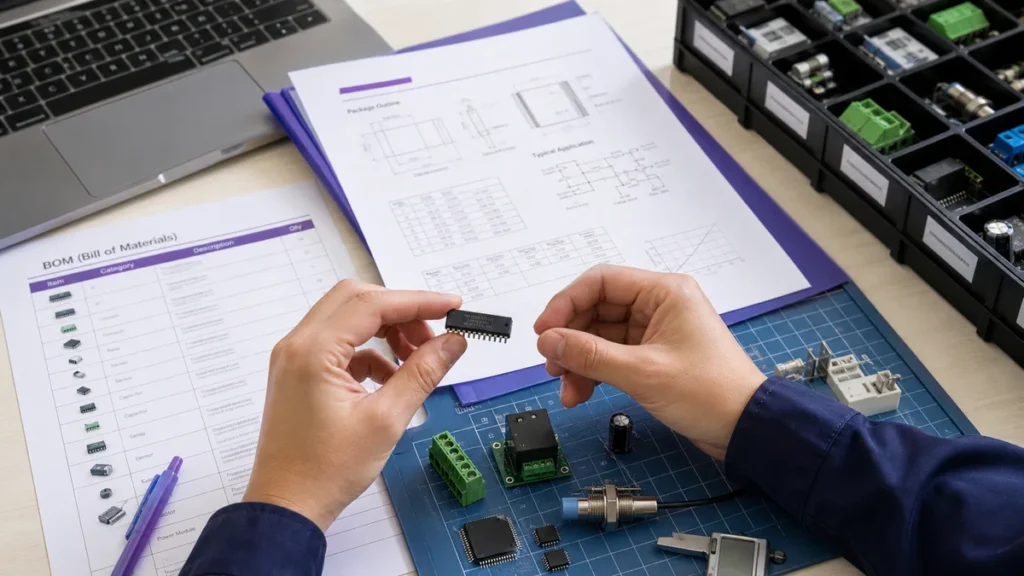
Before sending a request for quotation, prepare as much information as possible. A complete RFQ reduces back-and-forth communication and helps the supplier confirm the correct item faster.
| RFQ Information | Status |
|---|---|
| Complete manufacturer part number | Required |
| Manufacturer or brand name | Required |
| Quantity required | Required |
| Condition requirement: new, unused, original, refurbished, tested | Recommended |
| Package type or mounting style | Recommended |
| Date code requirement | If applicable |
| Photos, datasheet, or original label | Helpful |
| Whether alternatives are acceptable | Helpful |
If the exact part number is obsolete or difficult to source, specify whether a compatible replacement can be considered. A supplier can then check pin-to-pin replacements, functional equivalents, same-series options, or updated manufacturer recommendations.
Related Guides and Categories
Types of Integrated Circuits
A useful guide for understanding analog, digital, mixed-signal, and power IC categories.
How Proximity Sensors Work
A practical explanation of proximity sensor technologies used in automation systems.
Thermal Management Components
Selection guidance for cooling, airflow, heat dissipation, and compact electronic assemblies.
Obsolete Parts and Lifecycle Risk
Why product lifecycle planning matters when sourcing older industrial components.
FAQ: Industrial Electronic Components
What are industrial electronic components?
Industrial electronic components are electronic, electrical, and electromechanical parts used in automation systems, control panels, machinery, energy equipment, sensors, drives, and maintenance repair. Examples include ICs, discrete semiconductors, sensors, relays, power supplies, connectors, passive components, and circuit protection devices.
What is the difference between industrial and consumer electronic components?
Industrial components are selected for harsher environments, longer service life, higher reliability, better documentation, and continuous operation. Consumer components are often optimized for compact size, cost, and high-volume production.
What components are commonly used in industrial automation?
Common industrial automation components include PLCs, I/O modules, sensors, relays, contactors, power supplies, circuit breakers, terminal blocks, HMIs, motor drives, connectors, and communication modules.
Why are power supplies important in industrial systems?
Power supplies convert and stabilize voltage for PLCs, sensors, relays, control boards, HMIs, and communication modules. Incorrect power supply selection can cause unstable operation, unexpected shutdowns, or equipment damage.
Can obsolete industrial components be replaced?
Yes, but replacement requires careful comparison. Engineers should check function, package, pinout, voltage, current, timing, temperature range, certifications, and application requirements before approving a substitute.
What information is needed to request a quote?
A good RFQ should include the full part number, manufacturer, quantity, condition requirement, package, date code requirement, delivery location, target lead time, and whether alternatives are acceptable.
Conclusion
Industrial electronic components are essential to automation, control, power conversion, sensing, switching, communication, and maintenance repair. Choosing the right part requires more than identifying a similar-looking component. Engineers and buyers must verify electrical ratings, package type, temperature grade, lifecycle status, compliance, and compatibility with the equipment.
For new designs, reliable component selection improves long-term system performance. For maintenance teams, accurate sourcing can reduce downtime and extend the service life of valuable industrial equipment. Whether you need semiconductors, sensors, relays, power supplies, passive components, connectors, or obsolete replacement parts, careful specification review is the key to a safer and more reliable sourcing process.