
Integrated circuits (ICs) are the foundation of modern electronics. They power everything from simple consumer devices and industrial sensors to automotive ECUs, medical equipment, networking hardware, and embedded computing systems. But “IC” is not a single device category. Different integrated circuits are designed for different electrical tasks, signal environments, packaging constraints, and system architectures.
An integrated circuit is a semiconductor device that combines many electronic components on a single chip to perform analog, digital, mixed-signal, power, memory, processing, communication, or RF functions. The main types of integrated circuits include analog ICs, digital ICs, mixed-signal ICs, power management ICs (PMICs), microcontrollers and processors, memory ICs, interface ICs, and RF or wireless ICs. Engineers usually classify ICs by function, signal domain, integration scale, and semiconductor process.
This guide explains the main types of integrated circuits, how they are classified, where they are used, and how to choose the right IC family for a design, sourcing decision, or BOM review. It is written as a practical hub page, so readers can start here and then move into deeper topics like IC packaging types, datasheet reading, and replacement selection.
The main IC categories are analog, digital, mixed-signal, PMIC, processing, memory, interface, and RF ICs. The best IC type depends on what the circuit needs to do: amplify, compute, convert, regulate, store, communicate, or transmit wirelessly. Package choice also affects heat dissipation, signal integrity, PCB density, manufacturability, and long-term reliability.
What Is an Integrated Circuit (IC)?
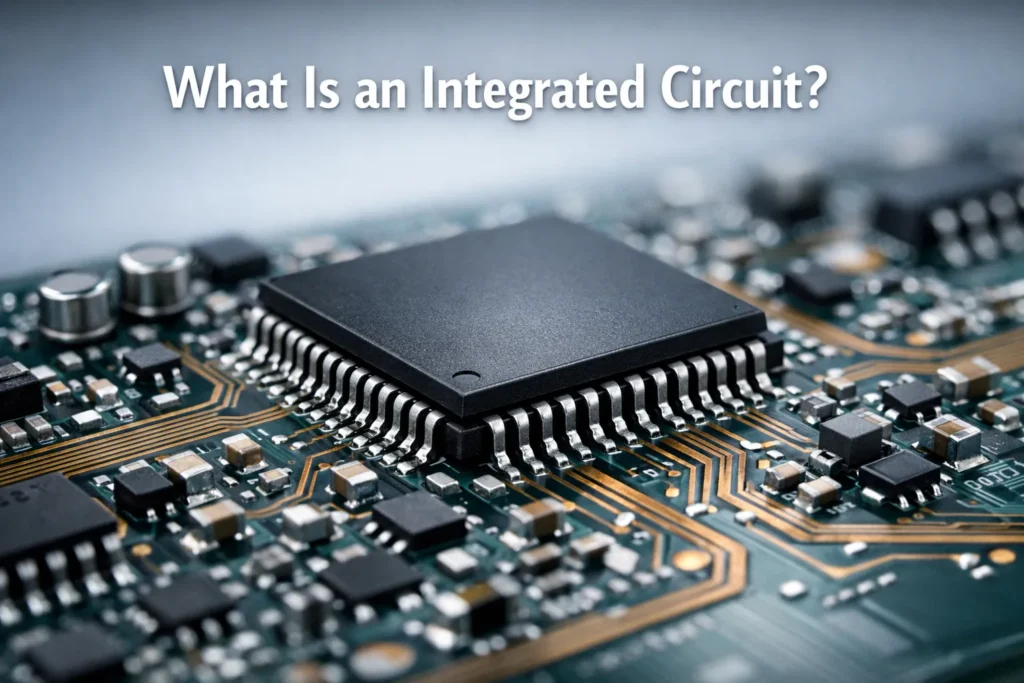
An integrated circuit is a semiconductor device that contains many electronic elements, such as transistors, resistors, capacitors, and interconnect structures, on a single silicon die. Instead of assembling every function from discrete parts, designers use ICs to integrate amplification, logic, signal conversion, control, storage, communication, and power regulation into compact, repeatable building blocks.
IC vs. Discrete Components
Before integrated circuits became standard, electronic systems relied on individual resistors, transistors, diodes, and capacitors wired together as discrete circuits. Compared with discrete designs, IC-based designs usually offer:
- Higher reliability because there are fewer solder joints and interconnect failures
- Smaller size through dense integration
- Lower cost at scale in volume manufacturing
- Better electrical performance due to shorter internal signal paths
- Lower power consumption in many applications
Why IC Classification Matters
Different IC types exist because different tasks require different electrical behavior. Some circuits must process continuous analog voltages, some must execute binary logic, some must convert between analog and digital domains, and some must regulate power or manage wireless communication. Choosing the wrong IC category can create noise problems, thermal issues, compatibility failures, or expensive redesigns later.
Integrated Circuit vs Chip vs Microchip vs Semiconductor: What’s the Difference?
These terms are related, but they are not always interchangeable.
Integrated Circuit (IC)
The most precise engineering term for a device that integrates many circuit elements on one semiconductor die to perform a defined function.
Chip
A broader, more informal term often used for an IC, processor, memory device, or semiconductor die in general.
Microchip
Often used as a consumer-friendly synonym for IC, though it can also refer to the company Microchip Technology depending on context.
Semiconductor
The broadest term. It can refer to a material class, a device category, or the industry as a whole. Not every semiconductor device is an IC.
In practical search behavior, users may search “IC,” “chip,” and “microchip” for the same intent. But on a well-structured electronics site, integrated circuit should be the primary technical hub term, while chip and microchip can be explained as adjacent language variants.
How Engineers Classify Integrated Circuits
Engineers rarely classify ICs using only one method. A useful overview usually combines function, signal domain, integration scale, and semiconductor process.
By Function
Analog, digital, mixed-signal, PMIC, processing, memory, interface, and RF ICs.
By Signal Domain
Analog for continuous signals, digital for logic states, and mixed-signal for systems that bridge both domains.
By Integration Scale
SSI, MSI, LSI, VLSI, and ULSI depending on the complexity and density of integration.
By Semiconductor Process
CMOS, BiCMOS, GaN, GaAs, SiGe, and BCD depending on the electrical and manufacturing requirements.
How to Choose the Right Type of IC for Your Design
For engineers, buyers, and sourcing teams, the fastest way to narrow options is to start from the job the circuit must perform. This prevents jumping into part numbers before the device category is even correct.
| Design Need | Recommended IC Type | Why It Fits | Typical Examples |
|---|---|---|---|
| Amplify, filter, or condition real-world signals | Analog IC | Handles continuous voltages and currents with precision | Op-amps, comparators, references, analog switches |
| Perform binary logic or digital control | Digital IC | Designed for 0/1 logic states, timing, and logic processing | Logic gates, counters, shift registers, timing ICs |
| Bridge sensors and processors | Mixed-signal IC | Combines analog acquisition with digital conversion or control | ADCs, DACs, AFEs |
| Regulate or distribute power rails | PMIC | Optimized for regulation, conversion, charging, and protection | Buck converters, LDOs, chargers, load switches |
| Run firmware or operating systems | MCU / MPU / DSP | Supports control, computation, and algorithm execution | Microcontrollers, processors, DSPs |
| Store code, parameters, or data | Memory IC | Provides volatile or non-volatile storage | SRAM, DRAM, NOR Flash, NAND Flash, EEPROM, FRAM |
| Connect different buses or protocols | Interface IC | Improves compatibility, robustness, and communication integrity | CAN, RS-485, Ethernet PHY, USB bridge, level shifter |
| Transmit, receive, or process RF signals | RF / Wireless IC | Built for high-frequency operation and radio performance | LNA, mixer, PLL, PA, RF transceiver |
Main Types of Integrated Circuits
Analog Integrated Circuits
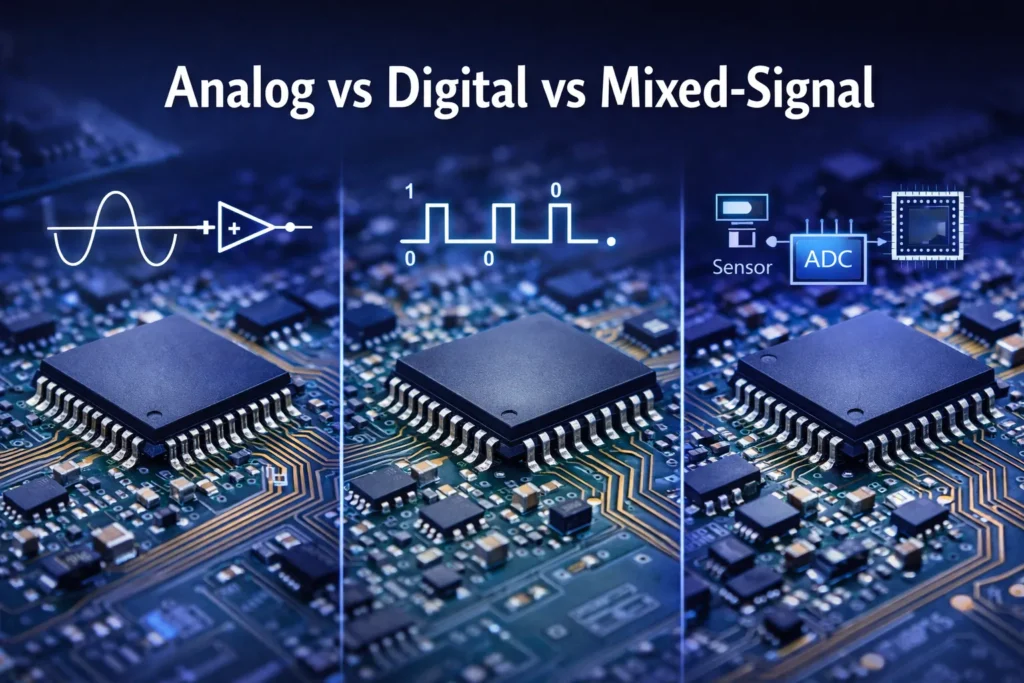
Analog ICs work with continuous electrical signals. They are essential wherever circuits interact directly with the physical world, including sensor outputs, measurement chains, audio paths, control loops, and precision references.
Common analog IC types: op-amps, comparators, linear regulators, voltage references, and analog switches.
Typical applications: sensor front ends, instrumentation, audio, industrial signal conditioning, medical electronics, and battery monitoring.
Digital Integrated Circuits
Digital ICs interpret signals as binary logic states and form the core of computing, timing, logic control, and digital state management.
Common digital IC types: logic gates, flip-flops, counters, shift registers, CPLDs, FPGAs, and timing ICs.
Typical applications: embedded control, bus timing, data routing, peripheral expansion, and protocol handling.
Mixed-Signal Integrated Circuits
Mixed-signal ICs combine analog and digital circuitry on the same die. They are critical whenever a system must convert real-world analog signals into digital data, or generate analog output from digital control.
Common mixed-signal IC types: ADCs, DACs, AFEs, and clock/data conversion devices.
Power Management ICs (PMICs)
PMICs regulate, convert, sequence, protect, and monitor power rails inside an electronic system. In portable, automotive, industrial, and embedded products, PMIC choice has a major impact on efficiency, thermal behavior, battery life, EMI, and reliability.
Common PMIC types: DC-DC converter ICs, LDO regulators, battery chargers, fuel gauges, load switches, and motor drivers.
Microcontrollers, Microprocessors, and DSPs
These are the main processing ICs in embedded and computing systems, but they serve different roles.
| Type | Best For | Strengths | Typical Trade-Offs |
|---|---|---|---|
| MCU | Real-time control and embedded products | Low power, integrated peripherals, lower BOM complexity | Lower compute performance than MPUs |
| MPU | Rich operating systems and advanced interfaces | High performance, OS support, strong application-layer capability | Needs external memory and more complex board design |
| DSP | Signal-heavy workloads | Efficient MAC operations, strong real-time signal processing | More specialized than general-purpose MCUs |
Related reading: Microcontroller vs microprocessor.
Memory ICs
Memory ICs store firmware, configuration data, application data, buffers, logs, or high-volume system memory. The right memory type depends on speed, cost, density, write endurance, retention needs, and power budget.
| Memory Type | Volatile? | Main Strength | Main Limitation | Best Use |
|---|---|---|---|---|
| SRAM | Yes | Very fast | High cost per bit | Caches, FIFOs, high-speed buffers |
| DRAM | Yes | High density | Needs refresh | Main system memory |
| NOR Flash | No | Fast read access | Lower density | Firmware storage |
| NAND Flash | No | High density | More complex management | Mass storage |
| EEPROM | No | Byte-level updates | Low density and slower writes | Calibration and parameter data |
| FRAM | No | High endurance and low-power writes | Lower density than flash | Energy-sensitive logging |
Related reading: SRAM vs DRAM.
Interface and Communication ICs
Interface ICs make it possible for devices, buses, and voltage domains to communicate reliably. They are essential in automotive, industrial, consumer, and networking systems where protocol differences, cable lengths, ESD events, and voltage mismatches can otherwise create instability.
RF and Wireless ICs
RF ICs operate at frequencies where parasitics, impedance matching, phase noise, shielding, and PCB layout become critical. They are central to wireless communication, GNSS, radar, and many high-frequency sensing systems.
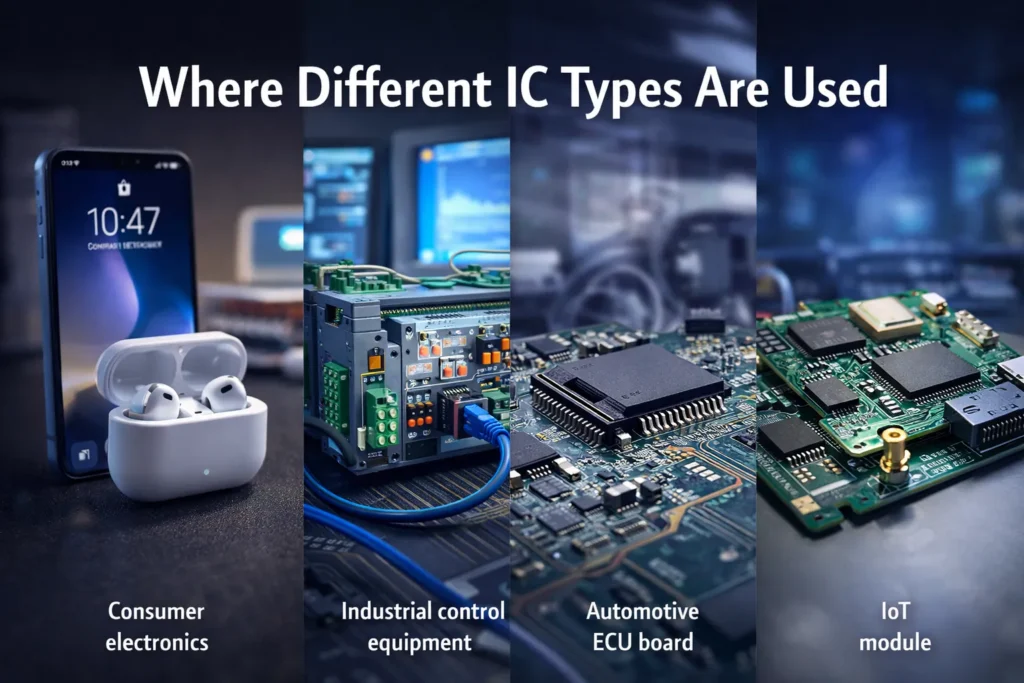
Common Applications of Different IC Types
| Application Area | Most Common IC Types | What They Usually Do |
|---|---|---|
| Consumer electronics | PMICs, memory, MCUs, interface ICs, RF ICs | Power rails, storage, embedded control, connectivity, wireless functions |
| Industrial automation | Analog, mixed-signal, MCUs, interface ICs, PMICs | Sensing, control loops, conversion, field communication, power regulation |
| Automotive electronics | PMICs, interface ICs, analog ICs, MCUs, RF ICs | ECU control, CAN/LIN, battery management, sensing, telematics |
| Medical devices | Analog, mixed-signal, low-power MCUs, memory ICs | Signal conditioning, biosignal capture, data logging, precision conversion |
| IoT and edge devices | MCUs, PMICs, memory ICs, RF ICs, interface ICs | Embedded control, battery operation, wireless transmission, local data handling |
| Networking and computing | MPUs, memory ICs, interface ICs, RF/high-speed ICs | Processing, buffering, protocol layers, high-speed communication |
How IC Packages Affect Performance and Selection
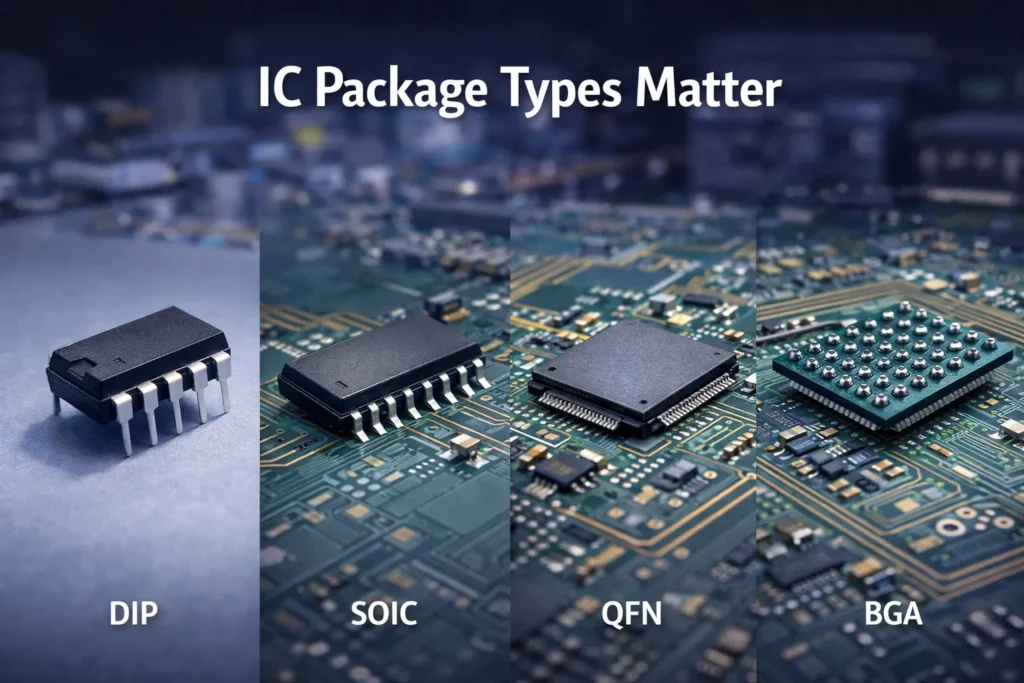
An IC package is not just a protective shell. It also affects thermal performance, electrical parasitics, PCB area, assembly difficulty, inspection requirements, and long-term reliability. For that reason, package choice is part of IC selection, not an afterthought.
DIP is easier for prototyping and hand soldering. SOIC and TSSOP are practical for general-purpose SMT designs. QFN is strong for compact and higher-performance layouts. BGA is best for high pin count and high-speed processors or memory. WLCSP is ideal where space is extremely limited.
For a full breakdown of package families, thermal behavior, and assembly trade-offs, read IC Packaging Types Explained.
Related Reading on MOZ Electronics
FAQ: Types of Integrated Circuits
What are the main types of integrated circuits?
The main integrated circuit categories are analog ICs, digital ICs, mixed-signal ICs, power management ICs, microcontrollers and processors, memory ICs, interface ICs, and RF or wireless ICs.
What is the difference between analog and digital ICs?
Analog ICs work with continuous signals such as voltage and current, while digital ICs work with discrete logic states such as 0 and 1.
What are mixed-signal ICs used for?
Mixed-signal ICs are used when analog signals must be measured, converted, or controlled by digital systems. ADCs, DACs, and AFEs are common examples.
What is the difference between an IC and a chip?
In everyday usage, people often mean the same thing. Technically, “integrated circuit” is the more precise engineering term, while “chip” is broader and more informal.
Why do IC packages matter?
IC packages affect heat dissipation, signal integrity, PCB density, assembly difficulty, inspection methods, and long-term reliability.
What should I check before substituting one IC for another?
Check function, pinout, package, voltage range, timing, startup behavior, thermal limits, and key performance specs. Pin compatibility alone is not enough.
Conclusion
The term “integrated circuit” covers a wide range of device categories, from precision analog amplifiers and mixed-signal converters to PMICs, processors, memory, interface devices, and RF front ends. The most effective way to choose the right IC is to classify the need correctly first, then compare the electrical, thermal, package, lifecycle, and application constraints that matter for that category.
As a hub page, this article should help readers understand the full IC landscape at a glance. From here, the next step is usually more specific: package selection, datasheet interpretation, or finding an equivalent replacement.