
A voltage regulator module, often called a VRM, is a power conversion circuit or module that converts a higher input voltage into a stable output voltage required by sensitive electronic components.
A voltage regulator module, often called a VRM, is a power conversion circuit or module that converts a higher input voltage into a stable output voltage required by sensitive electronic components. In modern electronics, CPUs, GPUs, FPGAs, memory devices, sensors, communication ICs, and embedded controllers usually cannot run directly from the main power supply. They need clean, stable, and accurately regulated voltage rails.
In a PC motherboard, the VRM is commonly known as the power delivery section around the CPU socket. It takes power from the system supply, often 12V, and steps it down to the low voltage required by the processor. In broader electronic design, a voltage regulator module can also refer to a compact DC-DC power module used on industrial boards, embedded systems, telecom equipment, automotive electronics, or custom PCB designs.
Although the term VRM is often used in computer hardware discussions, the concept is much wider. A voltage regulator module is not just a “computer part.” It is one of the most important building blocks in power electronics and board-level power design.
What Is a Voltage Regulator Module?
A voltage regulator module is a circuit or integrated power module designed to provide a controlled output voltage to a specific load. The load may be a CPU, GPU, FPGA, microcontroller, memory chip, analog circuit, or any other electronic device that needs a stable supply voltage.
In simple terms, a VRM answers one important question:
How do we turn an available input voltage into the exact voltage a circuit needs?
For example, a system may have a 12V input supply, but the processor on the board may need around 1.0V, the memory may need 1.2V, the logic circuit may need 3.3V, and some analog section may need 5V. A voltage regulator module helps create one or more of these local voltage rails.
VRM in Computers vs General Electronics
In the PC hardware world, VRM usually refers to the power delivery circuit that supplies the CPU or GPU. This circuit is typically located close to the processor and includes power stages, inductors, capacitors, and a controller. Its job is to deliver high current at a very low voltage while responding quickly to sudden load changes.
In general electronics, the term voltage regulator module can mean a broader range of solutions, such as:
This distinction is important. A motherboard VRM is one type of voltage regulator module, but not every voltage regulator module is a motherboard VRM.
How Does a Voltage Regulator Module Work?
Most high-efficiency voltage regulator modules work by converting a higher input voltage into a lower regulated output voltage. This is usually done through a switching regulator topology, especially a buck converter.
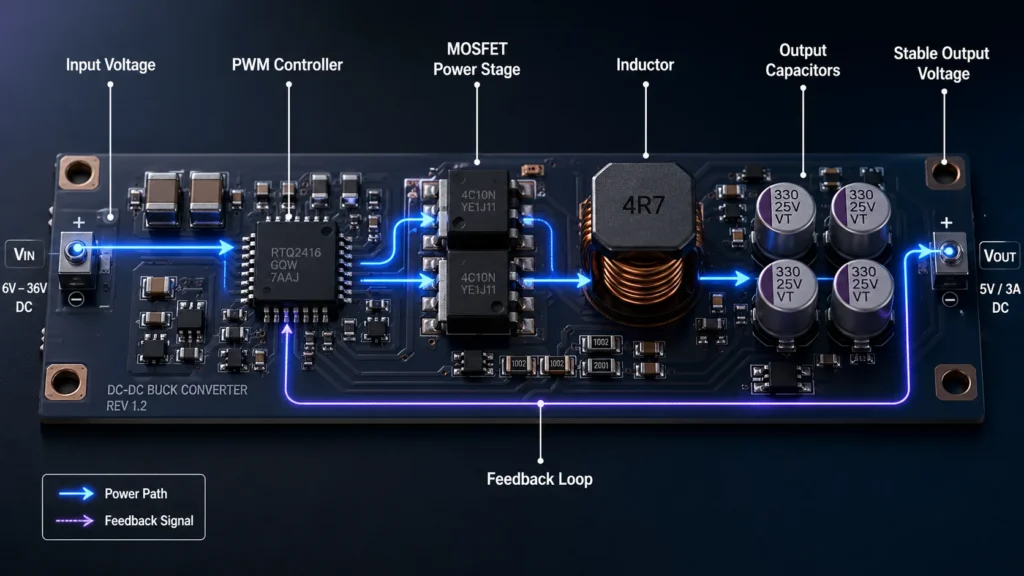
A buck converter is a step-down DC-DC converter. It uses high-speed switching, an inductor, capacitors, and feedback control to produce a stable output voltage. Unlike a simple linear regulator, a buck converter does not simply burn off extra voltage as heat. Instead, it switches energy into an inductor and filters it into a smooth DC output.
Step-Down Voltage Conversion
Suppose a board has a 12V input supply, but a processor core needs 1.1V. The voltage regulator module must reduce the voltage while still supplying enough current. In high-performance systems, that current can be very large. A modern CPU or GPU can draw tens or even hundreds of amps under load.
This is why VRM design is not just about voltage. It is also about current delivery, efficiency, heat, transient response, ripple, and protection.
Buck Converter Principle
A basic buck-based VRM usually includes:
The controller turns the MOSFETs on and off at high speed. This switching action creates a pulsed waveform. The inductor and output capacitors smooth that waveform into a stable DC voltage.
The output voltage is controlled by adjusting the duty cycle, which is the percentage of time the switch is on during each switching cycle. If the output voltage drops, the controller increases the energy delivered. If the output voltage rises too high, the controller reduces the energy delivered.
Feedback Control and Output Stability
Feedback control is what allows a VRM to maintain a stable output voltage. The module continuously senses the output voltage and compares it with a reference value. If the load suddenly increases, the output voltage may begin to drop. The controller reacts by changing the switching behavior to bring the voltage back to the target level.
This response speed is especially important for CPUs, GPUs, FPGAs, and other digital ICs. These devices can change from low power to high power very quickly. A weak regulator may not respond fast enough, causing voltage droop, instability, resets, or performance throttling.
Main Components of a VRM
A voltage regulator module may look simple from the outside, but it usually contains several important functional blocks. In some modules, these parts are integrated into a compact package. In motherboard VRMs, they may be placed as separate components around the processor socket.
| Component | Function |
|---|---|
| PWM controller | Controls the switching timing, feedback loop, and output regulation |
| MOSFETs / power stages | Switch current efficiently to transfer energy |
| Inductor | Stores energy and smooths current flow |
| Output capacitors | Reduce voltage ripple and support fast load changes |
| Input capacitors | Stabilize the input supply and reduce input noise |
| Feedback network | Senses output voltage and helps maintain regulation |
| Protection circuit | Provides overcurrent, overvoltage, thermal, or short-circuit protection |
| Thermal path | Helps remove heat from MOSFETs, inductors, and power stages |
In low-current regulator modules, many of these functions may be integrated into a single IC or module package. In high-current VRMs, such as those used for CPUs and GPUs, the design often uses multiple phases and larger external components to spread current and heat.
Types of Voltage Regulator Modules
Voltage regulator modules can be classified by topology, integration level, output current, application, and regulation method. Understanding the main types helps you choose the right one for a specific circuit.
Linear Regulator Modules
A linear regulator module provides a stable output voltage by dissipating the voltage difference as heat. Linear regulators are simple, low-noise, and easy to use. They are commonly used for low-current rails, analog circuits, sensors, and noise-sensitive applications.
However, linear regulators are not efficient when the input-output voltage difference is large or when the load current is high. For example, regulating 12V down to 1.8V at high current with a linear regulator would create excessive heat.
For a deeper look at a common LDO family, see our AMS1117 LDO regulator guide.
Switching Regulator Modules
Switching regulator modules use high-frequency switching to convert voltage more efficiently. They are widely used when efficiency matters, especially in battery-powered devices, industrial systems, communication equipment, and processor power supplies.
Switching regulators can be step-down, step-up, or inverting. For most VRM applications, the most common type is the step-down buck regulator.
Buck Regulator Modules
A buck regulator module steps down a higher input voltage to a lower output voltage. This is the most common form of VRM in modern digital systems.
Common examples include:
Buck modules are used in embedded boards, industrial controllers, communication systems, servers, graphics cards, and motherboard CPU power circuits.
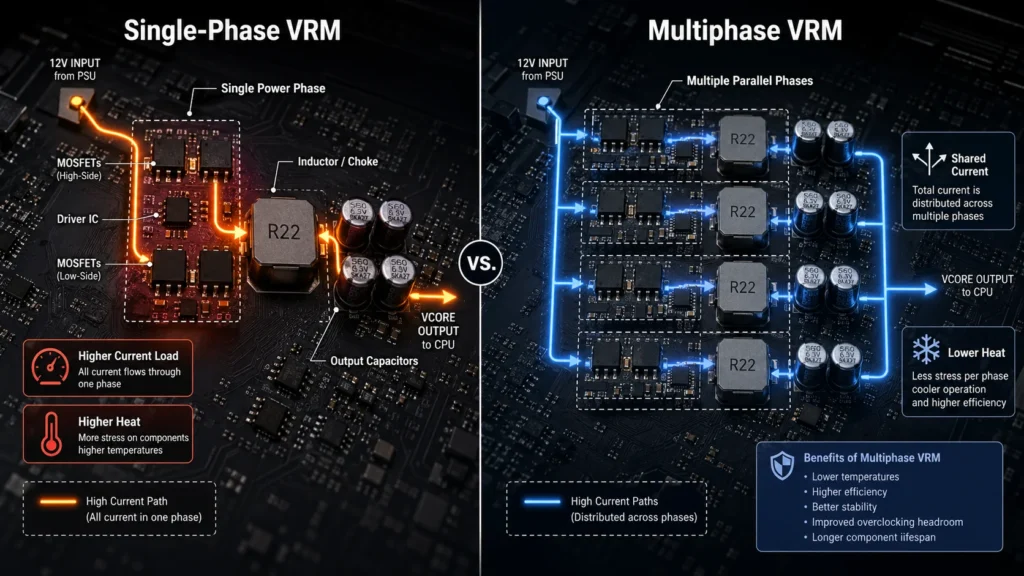
Multiphase VRMs
A multiphase VRM uses several regulator phases working in parallel. Each phase usually has its own power stage and inductor. The phases are controlled by one controller and operate with timing offsets.
Multiphase design is common in high-current CPU and GPU power systems because it offers several advantages:
This is why motherboard specifications often mention the number of VRM phases. However, more phases do not automatically mean better quality. Component quality, controller design, layout, cooling, and real current capacity matter more than the phase count alone.
Integrated Power Modules
An integrated power module combines multiple power components into one package. Depending on the design, it may include the controller, MOSFETs, inductor, compensation network, and protection functions.
These modules simplify power design and reduce layout complexity. They are useful when engineers want faster development, smaller PCB area, and predictable performance. The tradeoff is that they may cost more than a fully discrete solution and offer less flexibility.
VRM vs Voltage Regulator vs Buck Converter vs LDO
Many people use these terms interchangeably, but they are not exactly the same. Understanding the difference helps avoid confusion during design, repair, or sourcing.
| Term | What It Means | Best For | Limitation |
|---|---|---|---|
| Voltage regulator | General term for any circuit that controls voltage | Broad power supply design | Too general; can mean many types |
| LDO regulator | A low-dropout linear regulator | Low-noise, low-current rails | Lower efficiency with large voltage drop |
| Buck converter | A switching step-down DC-DC converter | Efficiently reducing voltage | More layout-sensitive and can generate EMI |
| Voltage regulator module | A complete regulator circuit or module for a load | CPUs, GPUs, FPGAs, embedded boards, industrial systems | Must be selected for current, heat, ripple, transient response, and footprint |
A buck converter can be part of a voltage regulator module. An LDO can also be used as a regulator, but it is not normally used for very high-current CPU-style VRM applications. A VRM is usually a more complete power solution designed to serve a specific load or voltage rail.
AMS1117-3.3 LDO Voltage Regulator
A common 3.3V low-dropout regulator used in embedded and consumer electronics.
STMicroelectronics L7805CV
A widely used 5V linear voltage regulator for power supply and industrial electronics.
Where Are Voltage Regulator Modules Used?
Voltage regulator modules are used anywhere a circuit needs a stable local voltage rail from a higher or variable input supply.
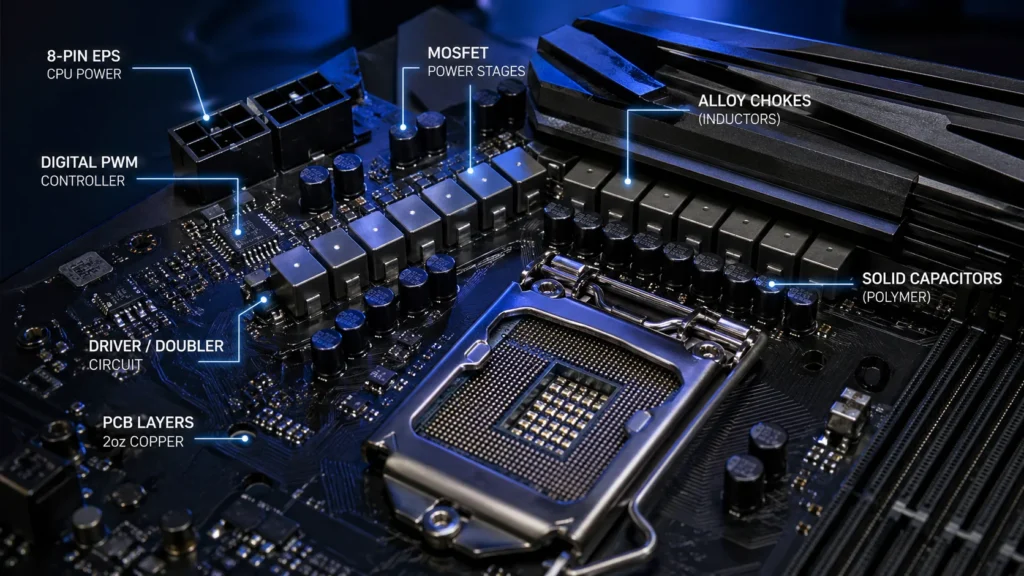
Common applications include:
In computer hardware, the VRM directly affects system stability, overclocking capability, thermal behavior, and long-term reliability. In industrial and embedded electronics, the voltage regulator module affects power integrity, board efficiency, electromagnetic compatibility, and component lifetime.
How to Choose a Voltage Regulator Module
Choosing a voltage regulator module is not just about matching the output voltage. A good selection process considers the complete power requirement of the load and the real operating environment.
1. Input Voltage Range
Start with the input supply. Is the module powered from 5V, 12V, 24V, a battery pack, a vehicle supply, or another DC rail?
Check the minimum, typical, and maximum input voltage. Industrial and automotive systems may have wider voltage variation than consumer electronics. If the input can surge or drop, the module must tolerate those conditions.
2. Output Voltage and Tolerance
Next, confirm the required output voltage. Common rails include 5V, 3.3V, 2.5V, 1.8V, 1.2V, 1.0V, and lower processor core voltages.
Also check the voltage tolerance required by the load. Some ICs can tolerate wider variation, while processors, FPGAs, ADCs, RF circuits, and memory devices may require tighter regulation.
3. Output Current and Peak Load
The output current rating must be higher than the real load current. Do not only look at average current. Many loads have startup current, peak current, or fast transient current demand.
For example, a processor may draw much more current during heavy computation than during idle operation. If the VRM cannot handle peak demand, the voltage may droop and cause instability.
4. Efficiency and Heat
Efficiency determines how much power is wasted as heat. A module with 90% efficiency wastes less energy than one with 75% efficiency.
Power loss becomes especially important at high current. Even a small efficiency difference can create significant heat. Always consider thermal performance, airflow, copper area, heatsinking, and maximum ambient temperature.
5. Ripple, Noise, and Transient Response
Output ripple is the small AC variation on the DC output voltage. Some circuits are more sensitive to ripple than others. Analog, RF, precision measurement, ADC, DAC, and clock circuits may require very low noise.
Transient response describes how quickly the regulator responds to sudden load changes. CPUs, GPUs, and FPGAs can change load current very quickly, so transient response is critical.
6. Protection Features
A reliable VRM should include appropriate protection functions, especially in industrial, automotive, server, and high-current applications.
These features help protect both the regulator and the load.
7. Package, Layout, and Thermal Design
The physical package matters. Check the footprint, pinout, height, thermal pad, recommended PCB layout, and required external components.
For switching regulator modules, PCB layout can strongly affect performance. Poor layout can cause excessive ripple, EMI, instability, and heat concentration. Always follow the manufacturer’s layout guidelines when designing a new board.
8. Lifecycle, Availability, and Replacement Risk
For sourcing and purchasing, check more than the electrical specifications. Also consider:
Not all voltage regulator modules are interchangeable. Two modules may have the same output voltage and current rating but different pinouts, compensation behavior, protection thresholds, thermal performance, or transient response.
Common VRM Problems and Symptoms
A voltage regulator module can fail or perform poorly for several reasons. Some problems come from component selection, while others come from layout, thermal design, or operating conditions.
| Problem | Possible Cause | Typical Symptom |
|---|---|---|
| Overheating | Insufficient current rating, poor airflow, weak thermal path | Shutdown, throttling, reduced lifetime |
| Voltage droop | Poor transient response or undersized output capacitors | Instability under sudden load |
| Excessive ripple | Poor capacitor selection, high ESR, bad layout | Noise, resets, data errors |
| EMI issues | Large switching loops or poor PCB layout | Interference, compliance failure |
| No output | Damaged regulator, short circuit, UVLO condition | System fails to start |
| Unstable output | Wrong compensation, poor feedback layout, overload | Oscillation or random resets |
| Component aging | Heat stress, capacitor degradation | Increasing ripple or intermittent failure |
In PC systems, weak VRM performance may appear as CPU throttling, system crashes, unstable overclocking, or excessive motherboard temperatures. In embedded systems, VRM issues may appear as random resets, sensor errors, communication failures, or unstable logic behavior.
A common mistake is selecting a VRM only by voltage and current rating. Real performance also depends on transient response, thermal margin, ripple, PCB layout, and load behavior.
Voltage Regulator Module Design Tips for Engineers
For engineers designing with voltage regulator modules, the datasheet and layout guide are just as important as the electrical rating.
Here are practical design tips:
For high-current designs, layout can make the difference between a stable power rail and an unreliable board. A good VRM schematic can still fail if the PCB layout creates noise, poor grounding, or excessive thermal resistance.
Datasheet Parameters to Check Before Selecting a VRM
Before using or replacing a voltage regulator module, check these datasheet parameters carefully:
| Parameter | Why It Matters |
|---|---|
| Input voltage range | Ensures the module can handle the supply rail |
| Output voltage | Must match the load requirement |
| Output current | Must support continuous and peak load |
| Efficiency curve | Shows real performance at different loads |
| Switching frequency | Affects inductor size, ripple, and EMI |
| Output ripple | Important for sensitive circuits |
| Load transient response | Important for CPUs, FPGAs, and fast digital loads |
| Protection features | Helps prevent damage during fault conditions |
| Operating temperature | Critical for industrial and high-power use |
| Package and pinout | Determines PCB compatibility |
| External component requirements | Affects design complexity and BOM cost |
For replacement or repair, never assume that a regulator module is compatible just because the voltage and current look similar. Pinout, enable logic, feedback configuration, power-good signal, switching behavior, and thermal design may all differ.
Voltage Regulators
Explore voltage regulator ICs and related power management components.
AMS1117-5.0 LDO Voltage Regulator
A 5V fixed-output LDO regulator for embedded systems and industrial controls.
FAQ About Voltage Regulator Modules
What does a voltage regulator module do?
A voltage regulator module converts an input voltage into a stable output voltage required by electronic components. It helps supply clean and controlled power to CPUs, GPUs, FPGAs, memory, microcontrollers, sensors, and other circuits.
Is a VRM the same as a buck converter?
Not exactly. A buck converter is a step-down switching regulator topology. A VRM may use a buck converter internally, but a voltage regulator module is a more complete power solution that includes control, switching, filtering, feedback, and protection functions.
Why does a CPU need a VRM?
A CPU needs a low, stable, high-current power supply. The main system power rail is usually too high and not precise enough for the CPU core. The motherboard VRM converts the input power into the correct CPU core voltage and responds to rapid load changes.
What is a multiphase VRM?
A multiphase VRM uses multiple power phases in parallel to share current. This improves current capability, spreads heat, reduces ripple, and improves transient response. Multiphase VRMs are common in CPUs, GPUs, servers, and high-performance power systems.
What causes VRM overheating?
VRM overheating can be caused by excessive load current, poor airflow, insufficient copper area, weak heatsinking, low efficiency, poor component quality, or operation beyond the rated temperature range.
How do I choose the right voltage regulator module?
Choose a VRM by checking input voltage, output voltage, output current, efficiency, ripple, transient response, protection features, package, thermal performance, layout requirements, and availability. For critical designs, always review the datasheet and test the module under real load conditions.
Can I replace one voltage regulator module with another?
Only if the electrical specifications, pinout, package, control logic, protection behavior, thermal performance, and layout requirements are compatible. Similar voltage and current ratings are not enough to guarantee a safe replacement.
What is the difference between an LDO and a VRM?
An LDO is a type of linear voltage regulator, usually used for low-noise and lower-current applications. A VRM is a broader term for a complete voltage regulation circuit or module and often uses switching conversion for higher efficiency and higher current.
Final Thoughts
A voltage regulator module is a critical part of modern electronic systems. It converts available input power into stable voltage rails for sensitive components such as CPUs, GPUs, FPGAs, memory, microcontrollers, and industrial control circuits.
For beginners, the key idea is simple: a VRM provides the right voltage to the right part of the circuit. For engineers, the details matter much more. Current rating, transient response, ripple, efficiency, heat, protection features, layout, and sourcing risk all affect real-world performance.
Whether you are designing a PCB, repairing a motherboard, selecting a DC-DC module, or sourcing replacement components, a voltage regulator module should never be judged by voltage alone. A reliable VRM is a complete power solution, and choosing the right one can directly improve system stability, efficiency, and long-term reliability.