
Operational amplifiers and circuits are one of the most important foundations in analog electronics. If you understand how an op amp circuit behaves, you can design better sensor interfaces, audio stages, filters, signal-conditioning blocks, and threshold detection circuits. From simple voltage followers to differential amplifiers, the operational amplifier remains one of the most versatile analog building blocks in modern electronics.
This guide explains what an operational amplifier is, how a basic circuit of op amp works, the main op-amp circuit types, common real-world applications, practical beginner examples, and the most important points to check when choosing a device for a real design. It is written to work as a pillar page for your op-amp topic cluster, while also being useful enough for readers who want a practical overview before moving into datasheets, application notes, or part selection.
Operational amplifiers are still central to analog design because real-world signals begin as voltage, current, sound, light, pressure, or motion. Before those signals can be measured, filtered, compared, or digitized, they often pass through one or more op-amp stages.
What Is an Operational Amplifier?
An operational amplifier, usually called an op-amp, is a high-gain analog integrated circuit that amplifies the voltage difference between two input terminals. A typical op-amp has a non-inverting input (+), an inverting input (−), an output, and power supply pins. In its simplest form, the output follows the relationship between those two inputs and the amplifier’s internal gain.
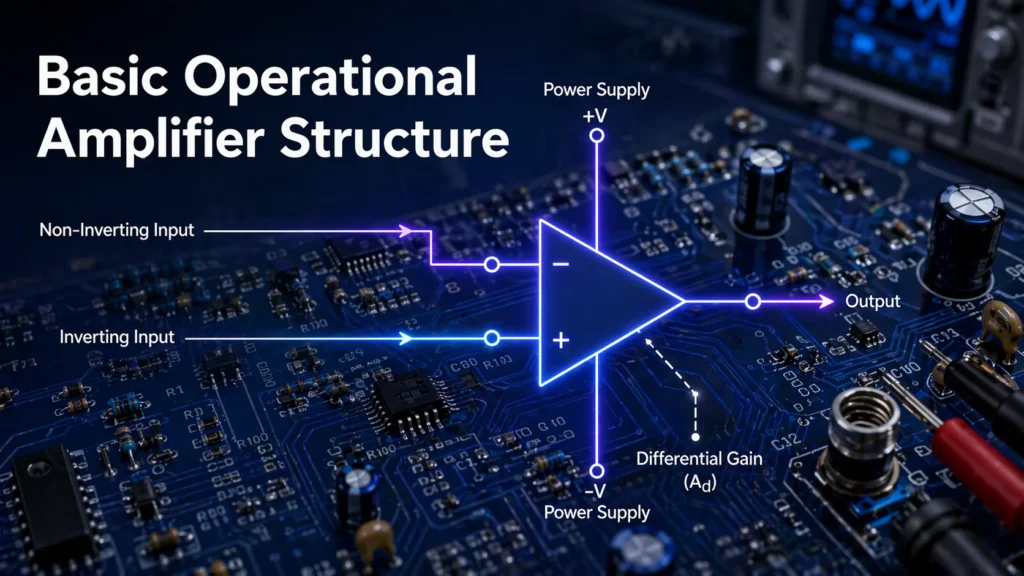
Basic definition of an op-amp
An op-amp is designed to sense the voltage difference between its two input terminals and generate an output based on that difference. In an idealized model, the open-loop gain is extremely large, so even a very small difference between the two inputs can produce a strong output response. This is why op-amps are powerful but also why they are rarely used in open-loop linear operation.
Instead, most practical operational amplifier circuits rely on external feedback components to make gain predictable and stable. Once feedback is added, the op-amp becomes less of a “black box amplifier” and more of a configurable analog function block.
Why op-amps are used in analog circuits
Op-amps are popular because one device can support many analog functions without requiring a large number of discrete transistors or complex bias networks. Engineers use op-amps for:
- signal amplification
- buffering and impedance isolation
- active filtering
- threshold comparison
- sensor signal conditioning
- summing multiple signals
- differential signal processing
This flexibility is why the opamp circuit concept appears in industrial controllers, instrumentation front ends, audio devices, power monitoring systems, and embedded analog sections inside larger products.
If you want to see how operational amplifiers fit into the wider analog IC landscape, your existing guide on types of integrated circuits is a natural supporting read.
How an Op-Amp Circuit Works
To understand an op amp circuit, it helps to focus on two ideas: the op-amp amplifies the difference between its inputs, and the external feedback network determines how that amplification behaves in practice.
Input terminals and output behavior
The two input pins are not interchangeable in circuit behavior. When the voltage at the non-inverting input rises relative to the inverting input, the output tends to rise. When the inverting input rises relative to the non-inverting input, the output tends to fall. This directional relationship is what gives us inverting and non-inverting amplifier topologies.
Because the internal open-loop gain is extremely high, a raw op-amp without feedback often saturates near one of its supply rails. In other words, it acts more like a switch than a linear amplifier unless feedback is used. That is why almost all useful linear operational amplifiers and circuits depend on a carefully chosen feedback path.
The role of gain and feedback
External resistors, capacitors, and sometimes diodes shape how much of the output is fed back to the input. This determines the closed-loop gain, linearity, stability, and frequency response of the circuit. In practical designs, feedback makes the difference between a wild, saturating device and a predictable analog stage.
Feedback is what allows engineers to build:
- fixed-gain amplifiers
- unity-gain buffers
- active filters
- integrators and differentiators
- weighted signal summing stages
- precision measurement blocks
Why negative feedback matters
Most linear op-amp circuits use negative feedback, which sends part of the output back to the input in a way that reduces the difference between the two input terminals. This improves predictability, reduces distortion, and helps define closed-loop gain using external components rather than relying on the op-amp’s uncontrolled open-loop behavior.
If you are analyzing a linear op-amp circuit with negative feedback, a useful first approximation is that the op-amp will drive its output so the two input pins sit at nearly the same voltage, as long as the device remains within its supply and output limits.
Basic Op-Amp Circuit Diagram
A basic circuit of op amp usually contains four things: the op-amp itself, power rails, an input signal path, and a feedback path. The exact resistor or capacitor arrangement determines whether the circuit becomes an amplifier, filter, buffer, comparator, or another analog function.
Power supply connections
Op-amps may be powered from a dual supply such as +15V and −15V, or from a single supply such as 5V and ground. Dual-supply operation is common in classic analog systems because it allows the output to swing above and below ground. Single-supply operation is common in battery-powered and microcontroller-driven designs.
In either case, local decoupling capacitors placed near the power pins are standard good practice. They reduce supply noise, improve stability, and help the amplifier respond more cleanly to dynamic current demand.
Input and feedback resistor arrangement
In most standard operational amplifier circuits, resistors define how the input enters the amplifier and how the output is fed back. In an inverting amplifier, the input and feedback both connect to the inverting input node through separate resistors. In a non-inverting amplifier, the input goes straight to the non-inverting terminal and a resistor divider sets the feedback ratio on the inverting side.
Output interpretation
The output of an op-amp can only swing within the real limits imposed by its power rails, internal output stage, and load conditions. Even if a gain calculation suggests a larger signal, the actual output will clip or saturate when those limits are reached. This is why output swing, common-mode range, and load drive capability must always be checked in a practical design.
Main Types of Op-Amp Circuits
One reason operational amplifiers and circuits are so important is that a single amplifier architecture can support many useful topologies.
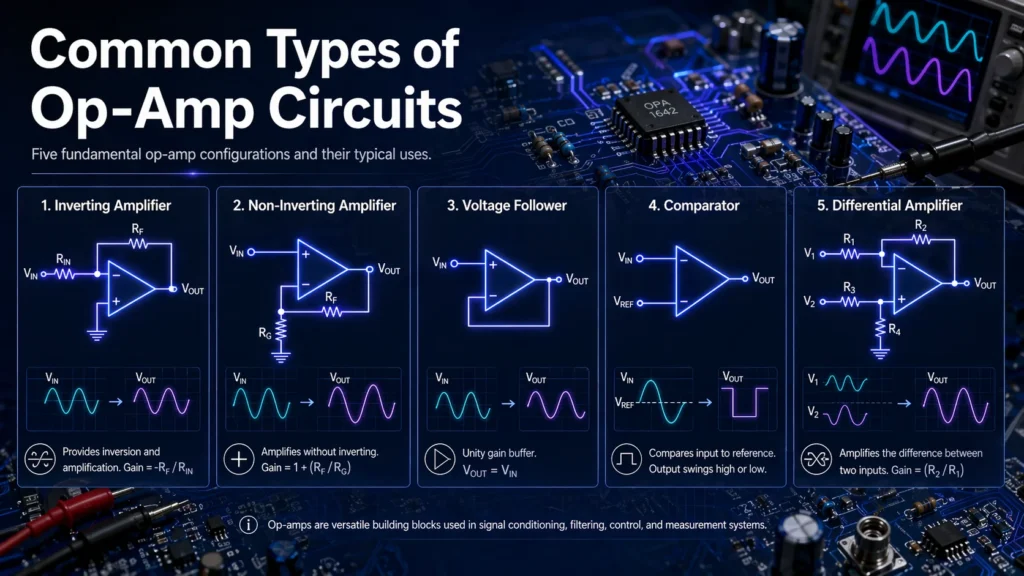
| Op-Amp Circuit Type | Main Function | Typical Use |
|---|---|---|
| Inverting amplifier | Amplifies and inverts signal phase | Precision gain stage |
| Non-inverting amplifier | Amplifies without phase inversion | Sensor and general signal amplification |
| Voltage follower | Unity-gain buffer | Impedance isolation |
| Comparator | Compares two voltages | Threshold detection |
| Summing amplifier | Combines multiple inputs | Audio and analog signal mixing |
| Differential amplifier | Amplifies voltage difference | Instrumentation and noise rejection |
| Integrator / Differentiator | Time-domain signal shaping | Control and waveform processing |
Inverting amplifier
In the inverting amplifier, the signal enters through an input resistor into the inverting input, while feedback from the output returns through a second resistor. The output is inverted relative to the input, and the gain is determined by the resistor ratio. This is a classic topology when precise gain control matters.
Non-inverting amplifier
In the non-inverting amplifier, the input is applied to the non-inverting terminal. The output stays in phase with the input, and the input impedance is generally higher than in the inverting topology. This makes it especially useful for sensor and measurement circuits.
Voltage follower
A voltage follower, also called a buffer, is a non-inverting amplifier configured for a gain of one. It is one of the most practical beginner examples because it keeps the same voltage level while isolating a weak source from a heavier downstream load.
Comparator
In comparator-style use, the op-amp compares two voltages and drives the output high or low depending on which one is larger. Although dedicated comparators are often better for fast switching and logic interfacing, a basic op-amp comparator still helps readers understand threshold detection clearly.
Summing amplifier
A summing amplifier adds multiple input signals into one output. This is useful in analog mixing, weighted signal combination, and certain sensor-processing stages.
Differential amplifier
A differential amplifier amplifies the difference between two signals while rejecting common-mode voltage. This is extremely useful in bridge sensing, instrumentation, and noisy industrial environments where small differential signals must be extracted from larger shared noise.
Integrator and differentiator
When capacitors are used in the signal or feedback path, the op-amp can perform time-domain processing. Integrators produce an output related to the accumulated input over time, while differentiators respond to the rate of change of the input. These circuits appear in control loops, waveform shaping, and active filter design.
Common Applications of Operational Amplifier Circuits
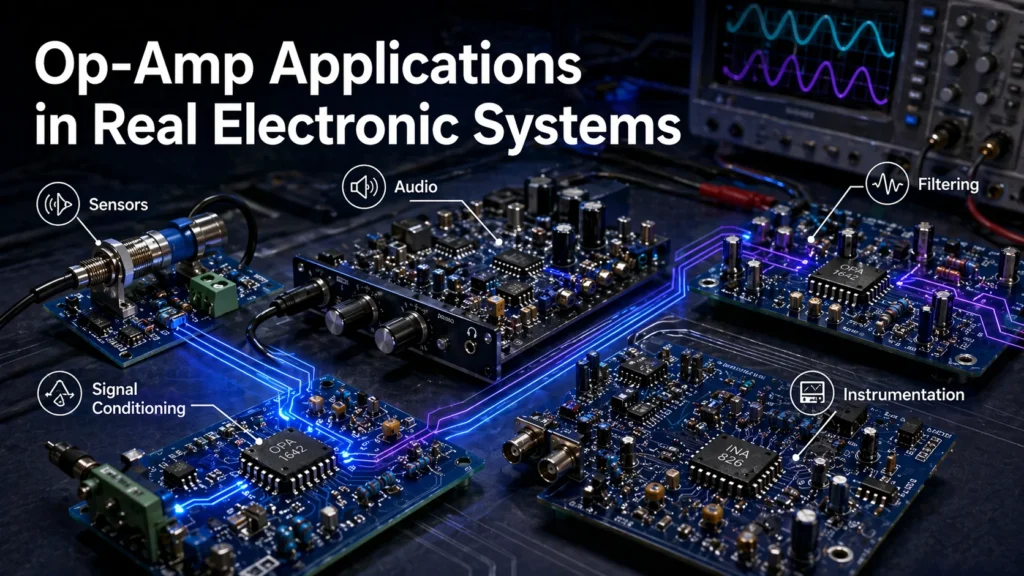
Signal amplification
Small analog signals often need amplification before they are useful. Op-amps are ideal for boosting sensor outputs, microphones, low-level instrumentation signals, and transducer interfaces.
Filtering
Op-amps are widely used in active low-pass, high-pass, band-pass, and notch filters. Compared with passive-only filters, active filters can provide gain and better control of impedance interaction between stages.
Sensor conditioning
Many sensors do not produce a ready-to-use signal for an ADC or microcontroller. An op-amp may be needed to amplify, bias-shift, filter, or buffer the signal before it reaches the digital section.
Audio circuits
In audio electronics, op-amps are used in microphone preamps, tone-control circuits, line-level buffers, active crossovers, and low-distortion gain stages. Practical readers may also want to compare general principles here with your site’s more device-focused op-amp content.
Threshold detection
Whenever a circuit must detect whether a voltage has crossed a certain level, an op-amp or comparator-style stage can be used. This appears in power monitoring, protection circuits, battery status detection, and signal windowing.
Simple Op-Amp Circuit Examples
Basic non-inverting amplifier
In a non-inverting amplifier, the signal goes to the non-inverting input and the feedback divider sets gain. If Rf = 9kΩ and Rg = 1kΩ, the closed-loop gain is 10. A 0.2V input ideally becomes 2V, provided the power rails support that output range.
Basic inverting amplifier
In an inverting amplifier, if Rf = 10kΩ and Rin = 2kΩ, the gain is −5. A 0.5V input ideally becomes −2.5V in a suitable dual-supply circuit. This is a clean example for teaching gain ratio, inversion, and feedback behavior.
Voltage follower example
In a voltage follower, the output is connected directly to the inverting input, and the signal is applied to the non-inverting input. The output tracks the input. This is especially helpful when a high-impedance sensor must feed a lower-impedance load without significant signal loss.
After this general guide, readers are likely to continue into device-specific content such as LM324 OP Amp guide, LM358 datasheet explained, LM358 alternatives, and LM324 alternatives.
Ideal vs Real Op-Amps
Infinite gain vs practical gain
The ideal op-amp model assumes infinite gain, infinite input impedance, zero output impedance, zero noise, and unlimited bandwidth. Real op-amps do not meet these assumptions, but the ideal model remains very useful for first-pass circuit analysis and for understanding the effect of feedback.
Input offset voltage
Real op-amps may produce a small output error even when both inputs are at the same voltage. This happens because of input offset voltage. In precision DC measurement and low-level sensor amplification, this parameter can become a meaningful source of error.
Slew rate and bandwidth
Bandwidth and slew rate strongly affect how well the output follows fast or high-frequency inputs. If an op-amp is too slow for the application, the output may become distorted, delayed, or unable to reproduce the intended waveform properly.
How to Choose an Op-Amp for a Circuit
Supply voltage
Always begin with the available power rails. Some op-amps are optimized for low-voltage single-supply systems, while others are intended for wider bipolar rails.
Bandwidth
Make sure the amplifier is fast enough for both the signal frequency and the required gain. High closed-loop gain reduces available bandwidth, so this tradeoff matters early in design.
Noise
Noise matters more as signal levels get smaller. Audio, instrumentation, photodiode, and precision measurement circuits often need low-noise devices.
Input bias current
Input bias current becomes important when using very large resistors or high-impedance sensors. Too much bias current can create unwanted voltage error.
Output swing
In low-voltage designs especially, verify that the output can swing close enough to the rails under the real load. Some devices are rail-to-rail, while others are not.
Readers who want to move from theory to specific device selection can also explore the Texas Instruments OPA627AP product page or the broader Amplifiers – Op Amps, Buffer, Instrumentation category to compare how different op-amps are positioned for precision, audio, or instrumentation use.
Design Best Practices for Op-Amp Circuits
- Place decoupling capacitors close to the supply pins.
- Keep sensitive input traces short and quiet.
- Use clean grounding and return paths.
- Avoid unnecessarily large resistor values unless input current allows it.
- Check output drive capability and capacitive-load stability.
- Read the datasheet carefully for common-mode limits and recommended layout notes.
These practical habits often matter as much as the gain equation itself, especially when the circuit must work reliably outside the simulator.
FAQs About Operational Amplifiers and Circuits
What does an operational amplifier do?
An operational amplifier amplifies the voltage difference between two inputs. With the right feedback network, it can also buffer, filter, compare, sum, or condition analog signals.
What is the simplest op-amp circuit?
The voltage follower is usually the simplest practical example. It has unity gain and is mainly used for buffering and impedance isolation.
What is the difference between inverting and non-inverting op-amp circuits?
An inverting amplifier flips signal phase and sets gain through a resistor ratio, while a non-inverting amplifier keeps the signal in phase and usually offers higher input impedance.
Why is negative feedback used in op-amp circuits?
Negative feedback makes the circuit stable, predictable, and linear. It lets external components define the closed-loop gain instead of relying on uncontrolled open-loop behavior.
Can an op-amp be used as a comparator?
Yes. An op-amp can compare two voltages in a basic threshold circuit, although a dedicated comparator is usually preferred for fast switching and cleaner output behavior.
How do I choose the right op-amp?
Start with supply voltage, bandwidth, noise, input offset voltage, input bias current, and output swing. Then confirm that the device fits the signal range, load, and application environment.
Conclusion
Learning operational amplifiers and circuits gives you a foundation that applies across a huge range of analog and mixed-signal systems. Once you understand how an op amp circuit uses feedback, how inverting and non-inverting stages differ, and where buffers, comparators, filters, and differential amplifiers fit, you can move from basic analog theory into practical design with much more confidence.
As a pillar page, this article should naturally support deeper cluster content around op-amp functions, circuit types, datasheet interpretation, and real component choices. On your current site, the strongest internal-link paths after this guide are the broader IC fundamentals article, the device-level LM324 guide, the practical LM358 datasheet guide, and the selection-oriented replacement articles for LM358 and LM324.