
A TCR is not just a theoretical power electronics circuit. In real power systems, it is often part of a larger SVC system that may include thyristor-switched capacitors, fixed capacitors, harmonic filters, transformers, protection equipment, cooling systems, and digital control cabinets.
A thyristor-controlled reactor is a shunt-connected reactor whose AC current is controlled by thyristors, allowing fast and continuous adjustment of inductive reactive power in an electrical power system.
This guide explains what a thyristor-controlled reactor is, how it works, why it is used in SVC systems, what harmonics it creates, where it is applied, and what engineers should consider when selecting or specifying one.
What Is a Thyristor-Controlled Reactor?
A thyristor-controlled reactor is a shunt-connected inductive branch consisting of a reactor connected in series with a thyristor valve. The thyristor valve usually contains two anti-parallel thyristors, allowing current to flow in both directions during the positive and negative half cycles of an AC waveform.
The main function of a TCR is to absorb reactive power from the AC system. By adjusting the firing angle of the thyristors, the reactor current can be increased or decreased. This changes the amount of inductive reactive power absorbed by the reactor.
In power system language, a TCR is a controllable inductive load. It does not generate active power. Instead, it dynamically adjusts the reactive power balance of the system.
The semiconductor control element inside a TCR is closely related to the wider family of thyristors. For readers who want to understand the device-level switching behavior first, the guide on silicon controlled rectifiers and how they work is a useful supporting reference.
A TCR should not be treated as a simple on/off switching device. Its value comes from continuously controlling reactor current through thyristor firing angle adjustment.
Why Power Systems Need Thyristor-Controlled Reactors
Modern power systems are not static. Load demand changes constantly. Industrial equipment can draw large and rapidly changing reactive currents. Long transmission lines can experience voltage rise under light-load conditions. Renewable energy plants can create voltage fluctuation at grid connection points.
A thyristor-controlled reactor helps address these issues by absorbing variable reactive power when needed.
Voltage Regulation
TCRs help stabilize bus voltage by absorbing reactive power when voltage rises or when system conditions require inductive compensation.
Industrial Power Quality
Heavy industrial loads such as arc furnaces and rolling mills can create flicker and reactive power swings. A TCR-based SVC can respond dynamically.
Reactive Power Compensation
When combined with capacitors, a TCR helps control net reactive power output and supports dynamic power factor correction.
Grid Stability
TCRs are used in utility and industrial systems where fast reactive power control is needed to maintain voltage stability.
For example, an electric arc furnace can cause rapid voltage fluctuations because its load changes violently during operation. A TCR-based SVC can respond quickly by adjusting reactive power absorption, helping to reduce voltage flicker and improve power quality.
In transmission systems, a TCR can help control overvoltage caused by capacitive charging effects in long lines, especially during light-load conditions.
How Does a Thyristor-Controlled Reactor Work?
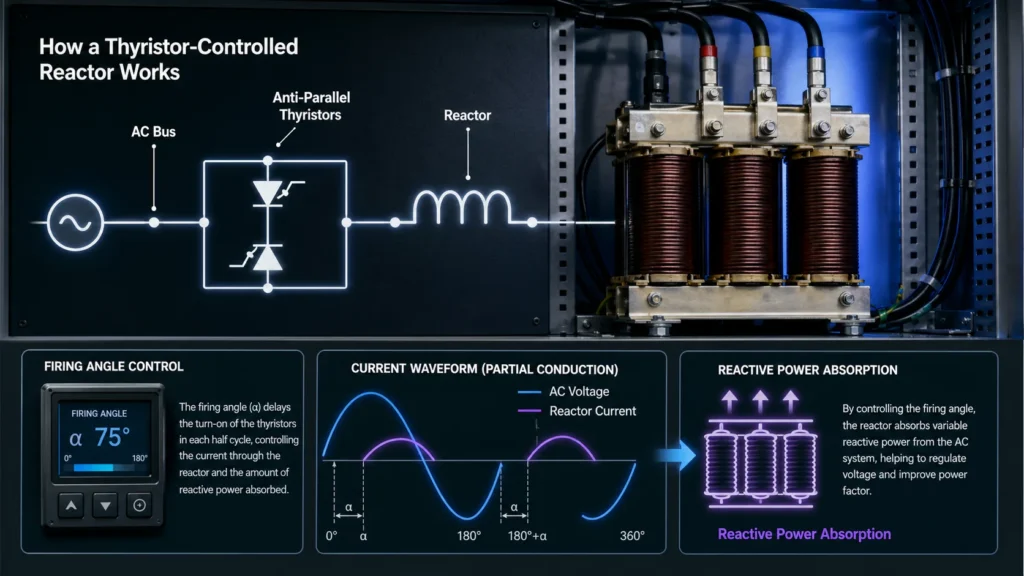
A thyristor-controlled reactor works by controlling when the thyristors are triggered during each AC half cycle. This triggering point is called the firing angle.
The basic circuit includes an AC bus, a reactor, a pair of anti-parallel thyristors, a firing control system, and measurement and protection circuits.
The reactor is the inductive element that absorbs reactive power. The thyristors act as controllable switches. The control system measures system conditions, calculates the required reactive power absorption, and sends gate pulses to the thyristors at the correct firing angle.
When the thyristors are triggered earlier in the AC waveform, they conduct for a larger portion of the cycle. More current flows through the reactor, so the TCR absorbs more reactive power.
When the thyristors are triggered later, they conduct for a smaller portion of the cycle. Less current flows, so the TCR absorbs less reactive power.
A TCR controls reactive power by delaying the firing angle of anti-parallel thyristors connected in series with a reactor. Earlier firing allows more reactor current. Later firing reduces reactor current.
This allows the TCR to provide smooth and continuous control between minimum and maximum reactor current.
Understanding Firing Angle in a TCR
The firing angle is one of the most important concepts in a thyristor-controlled reactor.
In an AC waveform, the thyristor does not automatically conduct at the beginning of each half cycle. Instead, the control system delays the gate pulse by a certain angle. This delay angle determines how much of the waveform is allowed to pass through the reactor.
When the firing angle is close to full conduction, the reactor current is high. The TCR absorbs more inductive reactive power. When the firing angle is delayed further, the current becomes smaller and more discontinuous.
| Firing Condition | Reactor Current | Reactive Power Absorption | Waveform Impact |
|---|---|---|---|
| Earlier firing | Higher | Higher inductive VAR absorption | Closer to full conduction |
| Later firing | Lower | Lower inductive VAR absorption | More discontinuous current |
| Partial conduction | Controlled | Continuously adjustable | Harmonics must be considered |
This is why a TCR can continuously regulate reactive power without mechanically switching reactors in and out of service.
However, this control method also creates a technical challenge: the current waveform is no longer a perfect sine wave. When current is chopped by delayed thyristor conduction, harmonic currents are produced. Harmonics are one of the most important design considerations in any TCR or TCR-based SVC system.
Reactive Power Absorption: What the TCR Actually Controls
A thyristor-controlled reactor primarily controls inductive reactive power. It absorbs reactive power from the system.
This is different from a capacitor, which supplies capacitive reactive power. In many practical compensation systems, reactors and capacitors are used together. The capacitor side supplies reactive power, while the TCR absorbs a controllable amount of reactive power. By adjusting the TCR current, the system can control the net reactive power output.
For example, in an FC-TCR system, a fixed capacitor provides capacitive VARs continuously, while the TCR absorbs variable inductive VARs. The net result can be adjusted dynamically.
If your project also involves capacitor banks, DC-link capacitors, or power supply filtering, you may also want to review related capacitor categories such as aluminum electrolytic capacitors when planning the broader electrical design.
This is useful because many power systems require both fast response and smooth control. Capacitors can provide reactive power support, but if the load changes quickly, fixed capacitors alone may overcompensate or undercompensate. A TCR adds controllability to the compensation system.
Thyristor-Controlled Reactor in a Static VAR Compensator
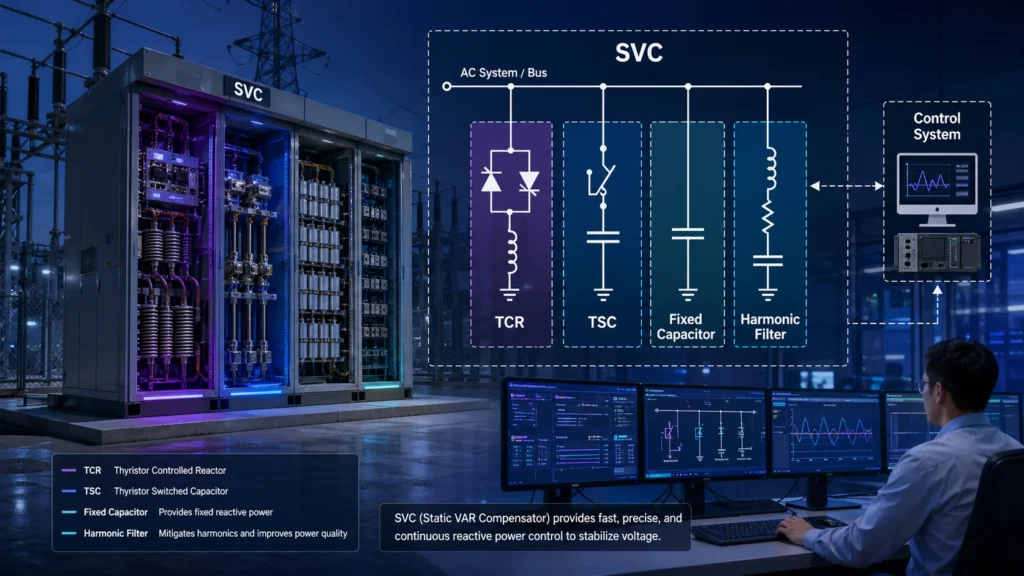
A thyristor-controlled reactor is often used as a key branch in a Static VAR Compensator, also known as an SVC.
It is important to understand that a TCR and an SVC are not the same thing.
A TCR is a controllable reactor branch. An SVC is a complete reactive power compensation system that may include TCRs, thyristor-switched capacitors, fixed capacitors, harmonic filters, transformers, protection equipment, and a control system.
The TCR is one of the most important controllable elements inside the SVC. It gives the SVC the ability to absorb reactive power continuously and respond quickly to system voltage changes.
A clear way to explain the relationship is:
A TCR is a controllable inductive component, while an SVC is a complete power compensation system that may use one or more TCR branches to regulate voltage and reactive power.
This distinction matters because many buyers and engineers search for “thyristor-controlled reactor” when they are actually trying to understand SVC operation, power quality compensation, or dynamic voltage regulation.
FC-TCR Configuration
One common arrangement is the fixed capacitor thyristor-controlled reactor, usually called FC-TCR.
In this configuration, the fixed capacitor supplies capacitive reactive power, the TCR absorbs variable inductive reactive power, the control system adjusts the TCR firing angle, and the net reactive power output is controlled dynamically.
This structure allows the system to provide smooth reactive power compensation. The fixed capacitor creates a capacitive base, while the TCR subtracts a controlled amount of inductive reactive power.
The FC-TCR arrangement is widely used because it is relatively simple, mature, and effective for many industrial and utility applications. However, harmonic filtering is usually required because the TCR current waveform contains harmonic components.
TSC-TCR Configuration
Another common arrangement combines a thyristor-switched capacitor, or TSC, with a thyristor-controlled reactor.
A TSC provides fast switching of capacitor banks. It supplies capacitive reactive power in steps. The TCR provides smooth control by absorbing variable inductive reactive power.
Together, they offer a wider and more flexible compensation range.
The TSC handles larger stepped changes in capacitive reactive power, while the TCR fine-tunes the output continuously. This combination is useful when a system needs both fast capacitor switching and smooth dynamic regulation.
In many SVC systems, TSC and TCR branches work together under a coordinated control system.
Main Components of a Thyristor-Controlled Reactor System
A practical TCR installation is more than a reactor and two thyristors. In medium-voltage and high-voltage applications, a TCR system includes several important components.
Reactor
The reactor is the inductive element that determines the maximum reactive power absorption capability of the TCR.
Thyristor Valve
The thyristor valve controls current flow through the reactor and may contain multiple series-connected thyristors in high-voltage systems.
Control System
The control system measures voltage, current, and reactive power, then calculates the firing angle and sends gate pulses.
Reactor
The reactor is the inductive element that determines the maximum reactive power absorption capability of the TCR.
In high-power applications, air-core reactors are commonly used because they avoid magnetic saturation and can handle large currents. The reactor must be designed for thermal stress, insulation requirements, short-circuit withstand capability, electromagnetic field effects, and environmental conditions.
Important reactor parameters include rated voltage, rated current, inductance, MVAr rating, insulation level, temperature rise, short-time current withstand, and installation environment.
The reactor is physically large in high-voltage systems, so layout, clearance, noise, magnetic field exposure, and cooling must be considered.
Thyristor Valve
The thyristor valve controls current flow through the reactor. In high-voltage systems, one pair of thyristors is not enough. Multiple thyristors are connected in series to handle the required voltage level.
The thyristor valve may include series-connected thyristors, anti-parallel valve arrangement, snubber circuits, voltage grading components, gate trigger units, optical or electrical firing signal transmission, cooling plates or heat sinks, and monitoring circuits.
For component-level reference, MOZ Electronics also maintains product and category pages for SCRs and broader thyristor-related components, which are relevant when studying the semiconductor switching devices used in controlled rectification and AC power control.
The thyristor valve must be protected against overvoltage, overcurrent, thermal stress, and firing failure. In large systems, valve cooling can be a major part of the design.
Control System
The control system is the brain of the TCR. It measures electrical parameters such as voltage, current, reactive power, and system frequency. Based on these measurements, it calculates the required firing angle and sends synchronized gate pulses to the thyristors.
A good TCR control system must provide accurate voltage measurement, fast reactive power response, stable firing angle control, synchronization with the AC waveform, protection logic, communication with higher-level control systems, and event recording.
In SVC systems, the TCR control is usually coordinated with capacitor branches, harmonic filters, and protection systems.
Harmonic Filters
Because a TCR uses phase-controlled conduction, it produces harmonic currents. Harmonic filters are therefore a critical part of many TCR and SVC installations.
Filters may be tuned to specific harmonic orders such as the 5th, 7th, 11th, or 13th, depending on the system design and harmonic study results.
In some systems, the filters also provide capacitive reactive power, so they serve two functions: reducing harmonic distortion and contributing to reactive power compensation.
Ignoring harmonic filtering is one of the most common mistakes in TCR system design. A TCR should be evaluated as part of a complete electrical compensation system, not only as a reactor-and-thyristor branch.
Harmonics in Thyristor-Controlled Reactors
Harmonics are one of the biggest technical issues associated with thyristor-controlled reactors.
A TCR generates harmonics because the reactor current is not always a full sinusoidal waveform. When the thyristors are fired at a delayed angle, current flows only during part of the AC half cycle. This creates a chopped or discontinuous current waveform.
Any non-sinusoidal waveform can be mathematically decomposed into a fundamental component plus harmonic components. These harmonic currents can flow into the power system and cause voltage distortion if they are not properly filtered.
Why Does a TCR Generate Harmonics?
A fixed reactor connected directly to an AC bus would draw a sinusoidal current, assuming the voltage is sinusoidal and the reactor is linear.
A TCR is different because the thyristors control when current begins to flow. When firing is delayed, the reactor current does not follow the full sine wave. The result is a distorted current waveform.
The more the conduction is controlled, the more harmonic content may appear.
A TCR provides fast and continuous reactive power control, but it produces harmonic currents that must be managed with proper system design and filtering.
Common Harmonic Orders
The exact harmonic spectrum depends on the firing angle, system configuration, and connection method.
Common harmonic concerns include 3rd harmonic and other triplen harmonics, 5th harmonic, 7th harmonic, 11th harmonic, 13th harmonic, and higher-order harmonic components.
In three-phase systems, delta connection can help contain some triplen harmonics within the delta loop. However, non-triplen harmonics such as the 5th and 7th often still require tuned filters.
This is why TCR-based SVC systems are rarely designed without a harmonic study.
How Engineers Reduce TCR Harmonics
Engineers use several methods to reduce or manage TCR harmonics, including delta-connected TCR branches, tuned harmonic filters, high-pass filters, multi-branch compensation structures, proper firing angle control, splitting reactor capacity into multiple branches, system-level harmonic simulation, and compliance checks against power quality standards.
The key point is that harmonics are not an optional detail. They are part of the core engineering design of a thyristor-controlled reactor system.
Applications of Thyristor-Controlled Reactors
Thyristor-controlled reactors are used wherever dynamic reactive power absorption and voltage control are needed.
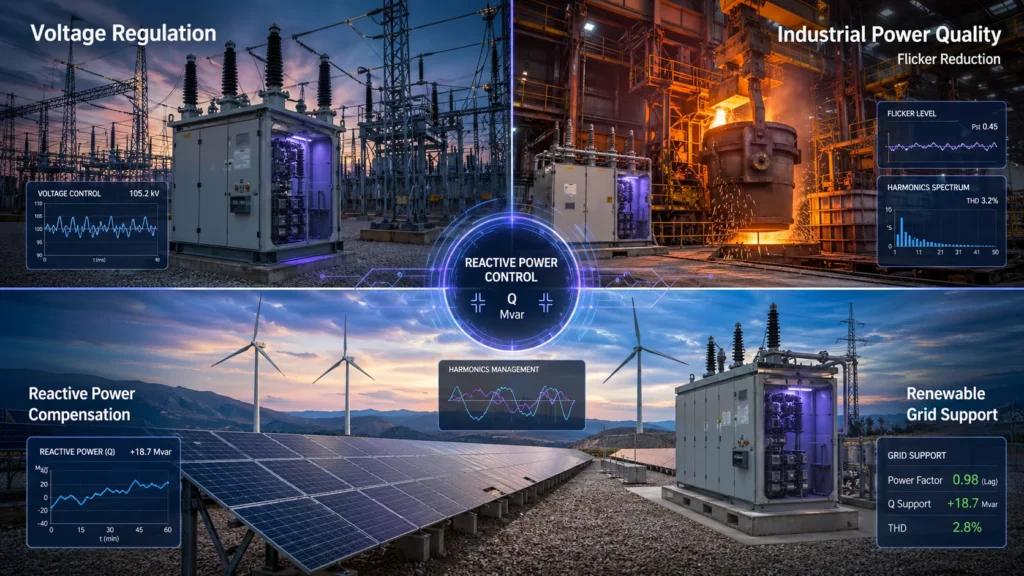
| Application | Why TCR Is Used | Typical Benefit |
|---|---|---|
| Transmission substations | Absorbs excess reactive power | Voltage regulation and stability |
| Electric arc furnaces | Responds to fast load changes | Flicker reduction and power quality improvement |
| Rolling mills | Compensates dynamic industrial loads | More stable plant voltage |
| Renewable grid connection | Supports voltage control at weak grid points | Improved grid integration |
| Power factor systems | Works with capacitors to control net reactive power | Dynamic power factor correction |
Transmission Voltage Regulation
In transmission systems, voltage can rise under light-load conditions, especially on long lines. This happens because transmission lines produce capacitive charging reactive power.
A TCR can absorb reactive power to help control the voltage level. When installed as part of an SVC, it can dynamically regulate bus voltage and improve system stability.
Transmission applications may include high-voltage substations, long transmission corridors, weak grid nodes, grid interconnection points, and voltage stability support systems.
Industrial Power Quality
TCR-based compensation systems are widely used in heavy industrial environments.
Typical industrial applications include electric arc furnaces, steel rolling mills, mining equipment, large motor drives, welding systems, crushers and mills, and rapidly changing industrial loads.
These loads can create voltage flicker, poor power factor, harmonic distortion, and voltage instability. A TCR-based SVC can respond quickly to changing reactive power demand and help stabilize the supply voltage.
Renewable Energy Integration
Renewable energy systems, especially wind farms and solar plants connected to weak grids, may require dynamic voltage support. A TCR-based SVC can help regulate voltage at the point of common coupling by controlling reactive power.
However, in some renewable applications, a STATCOM may be preferred because of its faster converter-based response and better performance at low voltage. The choice between TCR-based SVC and STATCOM depends on system requirements, cost, response speed, grid strength, and compensation range.
Power Factor Correction
A TCR alone mainly absorbs inductive reactive power, so it is not a complete power factor correction solution by itself.
However, when combined with capacitors, it can form a dynamic power factor correction system. The capacitors supply reactive power, while the TCR controls the net compensation by absorbing part of it when necessary.
This is useful in facilities where reactive power demand changes rapidly and fixed capacitor banks are not enough.
TCR vs TSC vs TSR vs STATCOM
TCR is often compared with other reactive power compensation technologies. Understanding the difference helps engineers choose the right solution.
| Device | Main Function | Control Method | Strength | Limitation |
|---|---|---|---|---|
| TCR | Absorbs inductive reactive power | Continuous firing angle control | Smooth and fast reactive power absorption | Generates harmonics |
| TSC | Supplies capacitive reactive power | Thyristor switching | Fast capacitor switching with low switching transients | Step-based, not continuously variable |
| TSR | Switches reactor on or off | Thyristor switching | Lower harmonic generation than phase-controlled TCR | No smooth continuous control |
| STATCOM | Supplies or absorbs reactive current | Power converter control | Very fast response and strong weak-grid performance | Higher cost and complexity |
A TCR is best when continuous inductive reactive power control is needed.
A TSC is best when fast capacitive compensation in steps is needed.
A TSR is useful when a reactor branch only needs to be switched on or off without phase control.
A STATCOM is often preferred when very fast dynamic response, compact design, and strong low-voltage performance are required, but it usually comes with higher cost and more complex power electronics.
For many applications, a TCR-based SVC remains attractive because it is mature, proven, scalable, and cost-effective for high-power reactive compensation.
Advantages of Thyristor-Controlled Reactors
Fast Response
Because the TCR is controlled electronically, it responds much faster than mechanically switched reactors or capacitor banks.
Continuous Control
Unlike step-switched devices, a TCR can continuously vary its reactive power absorption within its operating range.
Mature Technology
TCR technology has been used for decades in utility and industrial power systems, making its behavior well understood.
High-Power Suitability
TCRs can be built for medium-voltage and high-voltage applications, including large industrial plants and transmission systems.
When combined with capacitors and harmonic filters, TCRs provide dynamic reactive power control for SVC systems. This makes them useful for voltage regulation, flicker mitigation, and power quality improvement.
Limitations of Thyristor-Controlled Reactors
Despite their advantages, TCRs also have limitations.
Harmonic Generation
The most important limitation is harmonic current generation. Because the TCR uses phase angle control, current waveforms become non-sinusoidal. Harmonic filters are usually required.
Mainly Inductive Control
A TCR absorbs reactive power. It does not supply capacitive reactive power by itself. For full compensation, it is usually combined with capacitors.
Large Physical Size
High-power reactors, thyristor valves, filters, and auxiliary equipment can occupy significant space. This must be considered in substation or plant layout.
Cooling and Protection Requirements
Thyristor valves generate heat and require proper cooling. Protection systems must handle faults, overcurrent, overvoltage, thermal stress, and control failures.
Less Flexible Than STATCOM in Some Applications
Compared with STATCOM technology, TCR-based systems may have slower dynamic performance and weaker low-voltage current support. However, they may still be more economical in many high-power applications.
How to Select or Specify a Thyristor-Controlled Reactor
Selecting a thyristor-controlled reactor is not only about choosing an MVAr rating. A TCR must be specified as part of a complete electrical system.
| Parameter | Why It Matters |
|---|---|
| System voltage | Determines insulation level, valve design, and reactor rating |
| Rated MVAr | Defines maximum reactive power absorption |
| Frequency | Must match 50 Hz or 60 Hz system operation |
| Reactor current rating | Determines thermal and electrical capacity |
| Firing angle range | Affects controllable reactive power range |
| Harmonic performance | Determines filter requirements |
| Cooling method | Important for thyristor valve reliability |
| Control system | Determines response speed and stability |
| Protection functions | Required for safe operation |
| Installation environment | Affects insulation, cooling, enclosure, and layout |
| Standards and testing | Important for utility and industrial acceptance |
A good specification should include both electrical and system-level requirements.
Questions to Ask Before Buying or Specifying a TCR
Before selecting a TCR or TCR-based SVC system, engineers and procurement teams should ask:
- What is the required reactive power range?
- Is the TCR part of an FC-TCR, TSC-TCR, or full SVC system?
- What is the system voltage and short-circuit level?
- What harmonic limits must be met?
- Are harmonic filters included in the scope?
- What cooling method is used for the thyristor valve?
- What protection functions are included?
- Is a harmonic study required before installation?
- What control response time is needed?
- What commissioning and maintenance support does the supplier provide?
These questions help avoid the common mistake of treating the TCR as a simple standalone component.
In real projects, a thyristor-controlled reactor is often purchased as part of a complete engineered package, not as an isolated device. For broader sourcing strategy, engineers and buyers can also review this guide to electronic components and parts suppliers, especially when comparing authorized, independent, and RFQ-based sourcing options.
Common Mistakes in TCR Projects
Ignoring Harmonics
This is the most serious mistake. A TCR will generate harmonics under phase-controlled operation. Filters and harmonic studies should be considered from the beginning.
Comparing Only MVAr Ratings
Two TCR systems with the same MVAr rating may differ significantly in harmonic performance, protection design, cooling method, control stability, and reliability.
Treating TCR as a Complete SVC
A TCR is only one branch. A complete SVC may require capacitors, filters, transformers, switchgear, protection, and control systems.
Underestimating Thermal Design
Thyristor valves and reactors generate heat. Cooling and temperature monitoring are essential for long-term reliability.
Choosing the Wrong Technology
A TCR-based system is not always the best option. In some weak-grid or ultra-fast response applications, a STATCOM may be more suitable. In simpler applications, mechanically switched capacitors or reactors may be enough.
For maintenance, replacement, or older industrial power systems, some semiconductor switching parts may become difficult to source over time. In those cases, obsolete electronic components sourcing can become part of the long-term support strategy.
Related Semiconductor Switching Components
A thyristor-controlled reactor belongs to the wider engineering world of AC power control and semiconductor switching. While high-voltage TCR valves are engineered systems rather than simple board-level parts, the basic switching principles are related to thyristors, SCRs, TRIACs, and solid-state switching devices.
Thyristors
Browse thyristor-related semiconductor components used in controlled switching and power control applications.
SCRs
Explore silicon controlled rectifiers, a key thyristor device type used in controlled rectification and switching.
Solid State Relay SSR
Learn about semiconductor-based switching devices used for AC and DC load control without mechanical contacts.
FAQ About Thyristor-Controlled Reactors
What is a thyristor-controlled reactor used for?
A thyristor-controlled reactor is used to absorb and control inductive reactive power in AC power systems. It is commonly used for voltage regulation, power factor control, flicker reduction, and dynamic reactive power compensation in SVC systems.
Is a TCR the same as an SVC?
No. A TCR is a controllable reactor branch. An SVC is a complete Static VAR Compensator system that may include TCRs, thyristor-switched capacitors, fixed capacitors, harmonic filters, transformers, protection equipment, and a control system.
How does a thyristor-controlled reactor work?
A TCR works by delaying the firing angle of anti-parallel thyristors connected in series with a reactor. By changing the firing angle, the control system changes the reactor current and adjusts the amount of reactive power absorbed.
Why does a TCR generate harmonics?
A TCR generates harmonics because the thyristors conduct only during part of the AC waveform when firing is delayed. This creates a non-sinusoidal current waveform containing harmonic components.
What is the difference between TCR and TSC?
A TCR controls inductive reactive power by varying reactor current. A TSC switches capacitor banks on or off using thyristors to supply capacitive reactive power. TCR provides continuous control, while TSC provides stepped capacitive compensation.
Can a TCR improve power factor?
A TCR alone absorbs reactive power, so it is not usually a complete power factor correction solution by itself. However, when combined with capacitors in an SVC or FC-TCR system, it can help dynamically control power factor.
Where are thyristor-controlled reactors commonly installed?
TCRs are commonly installed in transmission substations, industrial plants, steel mills, arc furnace facilities, rolling mills, mining operations, and renewable energy grid connection systems.
What is the main disadvantage of a TCR?
The main disadvantage of a TCR is harmonic generation. Because it uses phase angle control, the reactor current is distorted and harmonic filters are usually required.
Conclusion
A thyristor-controlled reactor is a mature and important technology for dynamic reactive power control. By using thyristor firing angle control, it can continuously adjust reactor current and absorb variable inductive reactive power.
In modern power systems, TCRs are most commonly used as part of Static VAR Compensators. They help regulate voltage, improve power quality, reduce flicker, and support industrial or transmission networks with rapidly changing reactive power conditions.
However, a TCR should not be selected only by voltage and MVAr rating. Harmonic performance, filter design, control response, cooling, protection, installation environment, and system-level studies are all important.
For engineers and procurement teams, the best way to evaluate a thyristor-controlled reactor is to treat it as part of a complete reactive power compensation system. When properly designed and applied, a TCR-based solution can provide reliable, fast, and cost-effective voltage and reactive power control for demanding electrical networks.