This guide explains what CCS means, why it was introduced, how it compares with NLDM and ECSM, and where it fits in the practical IC design flow.
What Is a Composite Current Source (CCS)?
A Composite Current Source is a current-based timing model used to describe the electrical behavior of standard cells in digital integrated circuits. Standard cells such as inverters, NAND gates, NOR gates, flip-flops, buffers, and multiplexers are characterized by library vendors or foundries, and their timing data is stored in library files used by synthesis, place-and-route, and static timing analysis tools.
In a traditional digital IC timing flow, a design tool does not simulate every transistor inside every cell using SPICE during every timing run. That would be too slow for a large SoC. Instead, the tool uses pre-characterized library models. These models describe how each cell behaves under different input slew rates, output loads, voltages, temperatures, and process corners.
CCS is one of these advanced models. Its key idea is to model the cell output driver as a current source whose behavior changes over time and voltage. This helps the timing tool calculate the output waveform more realistically than a simple table of delay and output transition values.
For component sourcing readers, this distinction is important: CCS is not a part number, package, datasheet parameter, or purchasable electronic component. It is a modeling technology used behind the scenes by chip designers, EDA tools, foundries, and library characterization teams.
Why CCS Was Introduced: The Limits of NLDM
Before CCS became common in advanced IC design flows, many timing libraries relied on NLDM, or Non-Linear Delay Model. NLDM represents timing behavior mainly through lookup tables. These tables typically use input transition time and output load capacitance as indexes, and then return values such as cell delay and output slew.
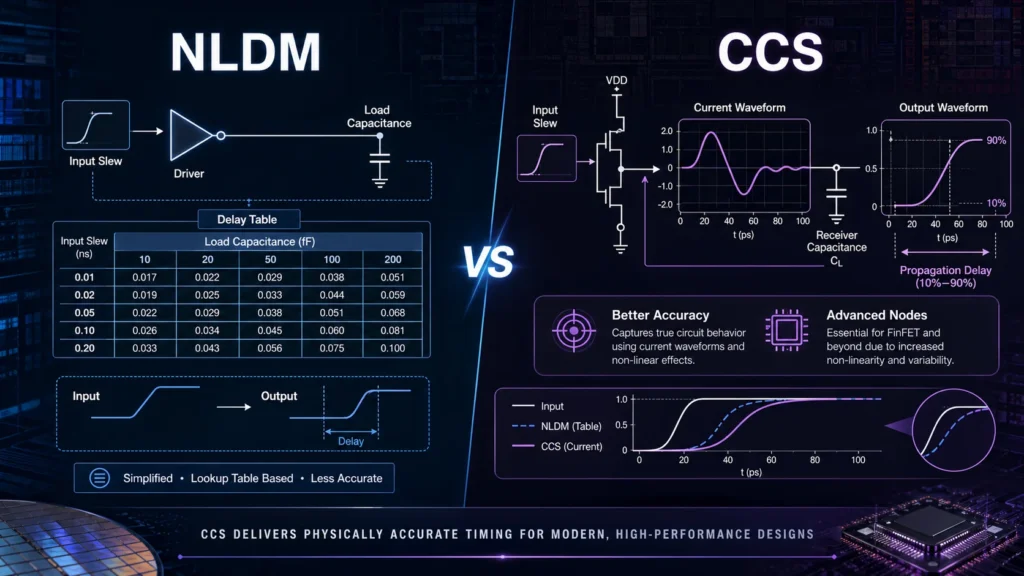
NLDM is simple, fast, and historically very useful. For older technology nodes and less complex interconnect conditions, it can provide acceptable accuracy. The problem is that modern IC designs no longer behave like simple capacitive-load problems. As process nodes shrink, interconnect resistance becomes more important, waveforms become less ideal, and receiver input behavior becomes more nonlinear.
In advanced nodes, the load seen by a driver is not just a single lumped capacitance. It can include distributed RC interconnect, multiple receiver pins, coupling effects, and dynamic input capacitance. The waveform at the receiver may be distorted by the wire, and the effective input capacitance may change during the transition.
One important effect is the Miller effect. In simple terms, the capacitance between input and output nodes inside a receiving gate can make the effective input capacitance change while the signal is switching. A single fixed input capacitance value is often not enough to model this behavior accurately. CCS receiver modeling adds more granularity than NLDM and usually divides receiver capacitance into C1 and C2 regions to better reflect nonlinear capacitance behavior.
These limitations are why current-source-based models such as CCS and ECSM became important. Instead of reducing everything to delay and slew tables, they provide a more physical way to calculate the waveform and timing behavior of a cell under real loading conditions.
How the CCS Timing Model Works
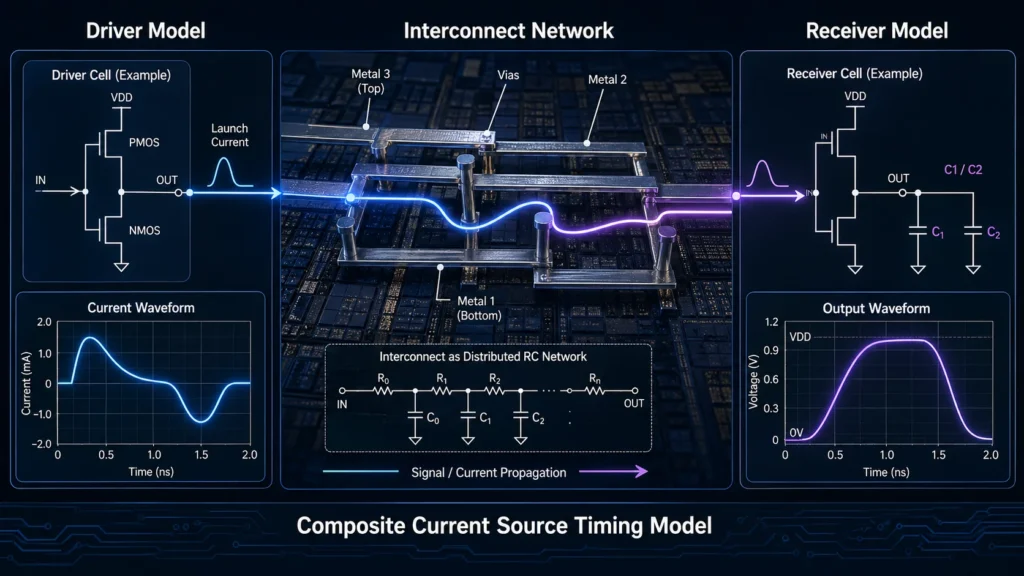
A CCS timing model can be understood through three major parts: the driver model, the receiver model, and the interconnect or reduced-order network model.
CCS Driver Model
The CCS driver model describes how the output stage of a standard cell drives current into the load during a transition. Instead of treating the driver as a simple resistor or using only a delay table, CCS represents the driver with current waveforms that depend on the switching condition.
In practice, the current delivered by a cell driver is affected by many factors, including input transition time, output voltage, output load, side input states, power supply voltage, temperature, and process variation. A NAND gate, for example, may behave differently depending on which input is switching and what logic states are present on the other inputs.
CCS captures this behavior by storing current waveform information in the library. During timing analysis, the STA tool uses that current information together with the interconnect model to calculate the output voltage waveform. This waveform can then be used to estimate delay, slew, noise behavior, and downstream timing more accurately.
CCS Receiver Model
The CCS receiver model describes how the input pin of the receiving cell behaves electrically. In a simplified model, the receiver input might be represented as a single capacitance. However, real transistor input behavior is more complex.
CCS commonly models receiver capacitance using two values, often called C1 and C2. C1 applies before the waveform reaches a delay threshold, while C2 applies after that threshold. This split helps the model account for nonlinear input capacitance and the Miller effect.
This matters because the load seen by the driver is not constant during a transition. If the receiver input capacitance changes during the switching event, then a simple fixed-capacitance approximation may create errors in net delay, output slew, and timing propagation.
Reduced-Order Network Model
Between the driving cell and the receiving cell is the interconnect network. In a real chip, this network may include long wires, branching nets, coupling capacitance, shielding, vias, and multiple sinks. Modeling the full interconnect with transistor-level simulation would be too expensive during full-chip timing analysis.
A reduced-order network model simplifies the RC interconnect while preserving the important behavior needed for timing calculation. The goal is to keep enough accuracy to model waveform propagation, while keeping analysis efficient enough for real design closure.
This is one of the reasons CCS is useful in modern timing flows: it allows tools to combine a realistic current-based driver model, a more accurate receiver capacitance model, and an efficient interconnect representation.
CCS vs NLDM vs ECSM
CCS is often discussed together with two other timing model families: NLDM and ECSM. Each model exists because IC design tools need a practical balance between accuracy, runtime, library size, and tool compatibility.
| Model | Full Name | Main Idea | Strength | Limitation |
|---|---|---|---|---|
| NLDM | Non-Linear Delay Model | Uses delay and slew lookup tables indexed by input transition and output load. | Simple, fast, and widely supported. | Less accurate for advanced nodes, nonlinear waveforms, and complex interconnect. |
| CCS | Composite Current Source | Uses current waveform and receiver capacitance modeling. | Higher accuracy for waveform-based timing, noise, and advanced-node effects. | Larger library data and more characterization complexity. |
| ECSM | Effective Current Source Model | Another current-source-based timing model used in advanced EDA flows. | Also improves accuracy compared with basic table-based delay modeling. | Tool ecosystem, format, and implementation details differ from CCS. |
The simplest way to understand the difference is this: NLDM gives the tool a pre-characterized delay and output slew result, while CCS gives the tool a more detailed electrical model from which the waveform can be calculated. ECSM has similar goals to CCS, but is associated with a different modeling ecosystem and tool history.
Why CCS Improves Timing Accuracy
The main reason CCS improves timing accuracy is that it preserves more waveform information. Digital timing is not only about when a signal crosses a threshold. The shape of the signal also matters. A slow, distorted, non-monotonic, or RC-degraded waveform can affect downstream cells differently from an ideal ramp.
CCS helps timing tools estimate this behavior more accurately because it models how the driver current changes during the transition. When combined with receiver capacitance and interconnect modeling, the tool can calculate a more realistic output waveform.
This improved waveform modeling is valuable in several situations:
- Advanced process nodes, where transistor and interconnect behavior becomes more nonlinear.
- Long or resistive interconnects, where waveform distortion is more significant.
- Multiple receiver loads, where the net cannot be reduced to a simple capacitance.
- Signal integrity analysis, where noise propagation and driver weakening matter.
- Low-voltage designs, where timing margins are smaller and voltage sensitivity is higher.
- Signoff timing, where pessimism or optimism can affect tapeout confidence.
Where CCS Is Used in the IC Design Flow
CCS usually appears inside a digital IC design flow rather than at the board-level component selection stage. It is mainly used in standard cell libraries and consumed by EDA tools during timing analysis.
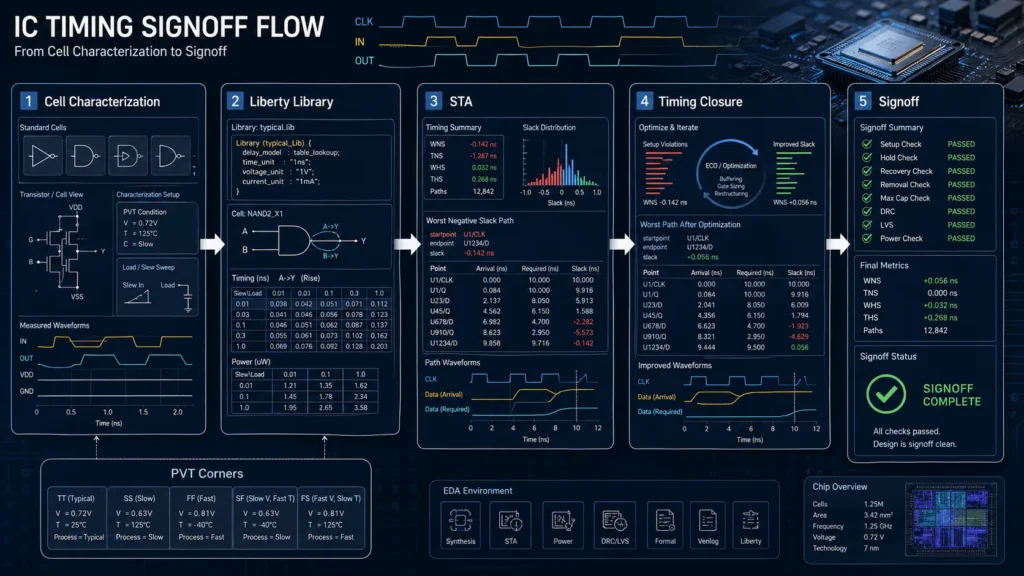
A typical flow looks like this:
- Library characterization: A foundry, IP vendor, or library team simulates standard cells across input slews, output loads, logic states, voltages, temperatures, and process corners.
- Library model generation: The resulting timing, power, and capacitance data is stored in Liberty library files.
- EDA tool consumption: Synthesis, place-and-route, and static timing analysis tools read these library files.
- Timing closure: Engineers use timing reports to fix setup violations, hold violations, excessive slew, and other signoff issues.
- Signoff: Final timing verification is performed across required PVT corners and operating modes.
For engineers who mainly work with component sourcing, CCS is different from ordinary circuit board components. It is not a part you purchase, but a modeling format used inside IC design, standard cell libraries, and EDA verification flows.
CCS Characterization Challenges
CCS improves accuracy, but that accuracy is not free. A CCS library requires more detailed characterization than a simple NLDM library. The library team must generate current waveform data, receiver capacitance data, and related information across many combinations of operating conditions.
Characterization can involve many SPICE transient simulations. The number of required simulations grows with the number of cells, timing arcs, input transition values, output loads, side input states, voltage corners, temperature corners, and process corners. For a large standard cell library, this becomes a major computational task.
CCS libraries can also increase data size. More waveform and current data means more information stored in the library. Larger libraries can affect storage, parsing time, characterization flow complexity, and tool efficiency.
Modern research continues to explore ways to reduce CCS characterization cost while preserving accuracy. The main direction is to reduce unnecessary SPICE simulation, compress waveform data, improve interpolation, and maintain enough accuracy across PVT corners.
Common Misunderstandings About Composite Current Source
CCS Is Not a Physical Current Source Component
In this context, CCS is not a discrete current source, current regulator diode, current mirror, power supply module, or IC part number. It is a timing model used in semiconductor design.
CCS Is Not the Same as an Analog Current Mirror
Analog circuits often use current mirrors, Wilson current sources, or cascode current sources. Those are real circuit topologies. CCS, in digital timing analysis, is a model used to represent switching behavior of standard cells.
CCS Does Not Replace SPICE
CCS is derived from detailed characterization, often involving SPICE simulations. It allows EDA tools to use pre-characterized behavior efficiently during large-scale timing analysis. SPICE is still important for cell characterization, circuit verification, and detailed transistor-level analysis.
CCS Is Not Always Required for Every Design
For older nodes, educational designs, early architectural estimates, or simple timing exploration, NLDM may still be acceptable. CCS becomes more valuable when waveform accuracy, advanced-node effects, interconnect resistance, signal integrity, and signoff confidence become important.
When Should Engineers Care About CCS?
Engineers should care about CCS when they are involved in ASIC design, SoC implementation, standard cell library development, library characterization, physical design, or static timing analysis. If you read timing reports, compare library views, debug setup or hold violations, or work with Liberty timing models, CCS is a concept worth understanding.
CCS is also relevant when evaluating the quality of a standard cell library. A library with only simple NLDM data may be easier to parse and smaller in size, but may not provide the accuracy needed for advanced-node signoff. A library with CCS data may support more accurate waveform-based timing analysis, especially in complex loading conditions.
For procurement teams and electronics sourcing professionals, CCS is usually not a direct purchasing parameter. However, understanding the term can prevent confusion when reading semiconductor design documents, foundry library notes, ASIC project requirements, or EDA-related technical material.
FAQ About Composite Current Source
Is Composite Current Source the same as a current mirror?
No. A current mirror is an analog circuit topology used to copy or bias current. Composite Current Source, in the context of IC timing analysis, is a library timing model used to describe standard cell switching behavior.
Why is CCS more accurate than NLDM?
CCS is usually more accurate because it models driver current waveforms and receiver capacitance behavior instead of relying only on precomputed delay and slew lookup tables. This helps timing tools calculate more realistic waveforms under complex loading conditions.
Is CCS used for timing, power, or noise?
CCS is most commonly discussed as a timing model, but CCS technology can also be associated with noise, power, and variation modeling in advanced library flows.
Does every Liberty file use CCS?
No. A Liberty file may contain NLDM, CCS, ECSM-related information, power data, constraint data, or other modeling information depending on the library vendor, process node, tool flow, and design requirements.
Is CCS important for advanced-node designs?
Yes. CCS becomes more valuable as waveform distortion, interconnect resistance, nonlinear receiver behavior, Miller effect, voltage sensitivity, and signoff margin requirements become more important.
Is CCS a component parameter I should check when buying ICs?
Usually no. If you are buying microcontrollers, logic ICs, analog ICs, connectors, sensors, or passive components, CCS is not normally a procurement specification. It is mainly relevant to chip design and EDA timing analysis.
Conclusion
Composite Current Source, or CCS, is an advanced current-based timing model used in digital IC design. It was introduced to overcome the limitations of simpler table-based delay models such as NLDM, especially as process nodes became smaller and waveform behavior became more complex.
By modeling driver current waveforms, receiver capacitance behavior, and interconnect effects, CCS helps static timing analysis tools estimate delay, slew, noise, and signal behavior more accurately. This makes it valuable for standard cell libraries, advanced-node SoC design, physical implementation, and signoff timing analysis.
For electronics sourcing readers, the most important point is that CCS is not a physical current source component. It is a semiconductor timing model used inside EDA flows. If you are working with ASIC design teams, foundry library files, Liberty models, or timing closure documentation, understanding CCS will help you read technical requirements more confidently.