
Embedded systems are the functional core of modern electronic products. From automotive control units and industrial automation hardware to medical instruments, smart home devices, and connected consumer products, these purpose-built computing platforms allow equipment to sense, process, communicate, and respond in real time.
For OEMs, design engineers, and procurement teams, embedded systems are more than a technical concept. They directly affect product performance, certification strategy, software development complexity, lifecycle planning, and supply-chain stability. Choosing the right embedded platform often means balancing computing power, memory, interfaces, power efficiency, software ecosystem maturity, and long-term component availability.
An embedded system is a dedicated hardware-software platform built to perform a specific function inside a larger device. It is widely used in automotive electronics, industrial automation, medical devices, consumer products, and IoT equipment because it offers compact size, high reliability, low power consumption, and efficient real-time control.
A typical embedded system includes a microcontroller or processor, memory, firmware, sensors, communication interfaces, and output control circuits. As products become smarter and more connected, embedded systems are increasingly expected to support edge AI, wireless communication, security, and long lifecycle performance.
| Industry | Prevalence of Embedded Systems | Typical Application Areas |
|---|---|---|
| Consumer Electronics | High | Smartphones, wearables, smart TVs, home appliances, smart speakers |
| Automotive | High | ECUs, ADAS, infotainment, body control, BMS, digital clusters |
| Healthcare | High | Patient monitoring, infusion pumps, diagnostics, portable medical devices |
| Industrial Automation | High | Robotics, motor drives, industrial control, HMI, sensor nodes, gateways |
Embedded systems are specialized computing platforms designed for dedicated tasks inside larger devices. They are essential in automotive, industrial, medical, consumer, and IoT applications because they combine compact design, efficient control, and reliable performance.
Their value comes from tight hardware-software integration, deterministic response, and long-term operational stability. As edge intelligence, wireless connectivity, and AI-enabled electronics continue to expand, embedded systems are becoming even more important in next-generation product design.
What Is an Embedded System?
An embedded system is a combination of hardware and software designed to perform a specific task within a larger electronic or electromechanical product. Unlike a general-purpose computer, which is built to support many different applications, an embedded system is optimized for one primary function such as controlling a motor, monitoring a sensor, managing a display, or processing data from a connected module.
In most products, the user does not interact with the embedded system directly. It operates in the background, managing the logic that makes the device work correctly, efficiently, and safely. This is why embedded systems are foundational in modern electronics, especially where space, power, cost, and reliability matter.
| Aspect | Embedded System | General-Purpose Computer |
|---|---|---|
| Primary Purpose | Dedicated function or narrow task set | Runs many applications across broad use cases |
| Power Consumption | Usually optimized for low power | Typically higher power usage |
| Size | Compact and integrated into end equipment | Larger standalone computing platform |
| User Interaction | Often minimal or invisible | Direct user interaction through a full interface |
| Design Priority | Reliability, efficiency, real-time behavior | Flexibility and multi-purpose computing |
Why Embedded Systems Matter in Modern Electronics
Embedded systems matter because they make electronic products responsive, intelligent, and application-specific. They collect input from sensors, process information with defined logic, and generate the right output at the right time. In a vehicle, that may mean managing safety functions in milliseconds. In a medical device, it may mean maintaining accurate monitoring and alarm behavior. In industrial equipment, it may mean stable control in harsh operating conditions.
High Efficiency
Embedded platforms are optimized for specific tasks, allowing strong performance without the overhead of a full computing environment.
Real-Time Control
Many embedded applications must react immediately to events, sensor changes, or communication signals.
Compact Integration
Their small footprint makes them ideal for tightly packaged products such as portable devices, appliances, and control modules.
Reliable Operation
Long-term stability is essential in automotive, industrial, medical, and infrastructure-related electronics.
Embedded Systems from a B2B and Sourcing Perspective
In commercial product development, embedded system selection is not only about technical suitability. It also influences procurement risk, compliance timelines, repair strategy, software maintenance, and long-term manufacturing continuity. For OEM and EMS teams, making the wrong MCU, MPU, memory, or wireless module decision too late in the development cycle can create avoidable redesigns, budget pressure, and supply disruption.
From a sourcing perspective, buyers often assess embedded platforms based on package availability, lifecycle support, software ecosystem strength, development tools, industrial or automotive qualification, and supplier continuity across regions. A component may look attractive from a performance standpoint but still introduce risk if lead times are unstable, documentation is weak, or ecosystem support is too limited for volume production.
What Engineers Usually Prioritize
Processing performance, peripheral integration, memory size, real-time behavior, thermal limits, security features, and toolchain maturity.
What Procurement Teams Usually Prioritize
Lifecycle longevity, second-source risk, qualification grade, pricing stability, lead-time predictability, and approved vendor status.
For industrial, automotive, and medical designs, documentation quality, lifecycle visibility, and long-term availability are often just as important as raw processing performance. Early alignment between engineering and sourcing teams can significantly reduce BOM risk and shorten the path to production.
Core Features of Embedded Systems
Although embedded systems vary by application, several common features define how they are designed and deployed. These characteristics shape electronic component selection, PCB design, firmware development, compliance planning, and system validation.
| Feature | Why It Matters |
|---|---|
| Real-Time Operation | Ensures correct response within strict timing constraints. |
| Compact Size | Supports integration into products with limited board space and enclosure volume. |
| Low Power Consumption | Critical for battery-powered and always-on devices. |
| High Reliability | Required for safety-sensitive and long-lifecycle systems. |
| Cost Sensitivity | Important for mass production and BOM control. |
| Environmental Robustness | Needed in products exposed to vibration, heat, dust, or moisture. |
Main Applications of Embedded Systems
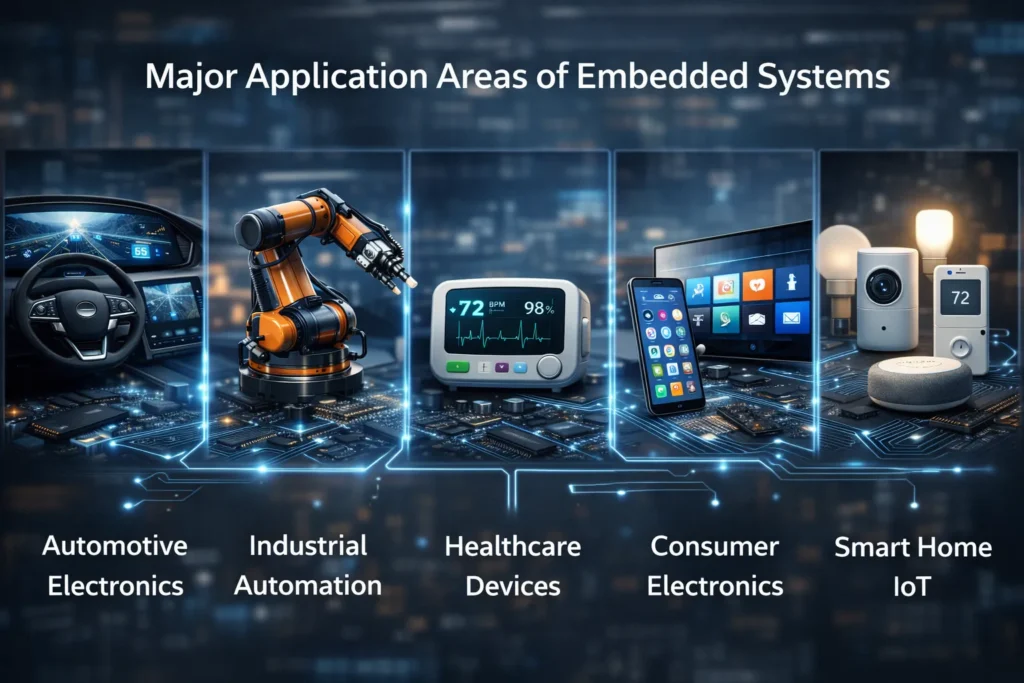
Embedded systems are used across nearly every electronics-driven industry. Their exact role varies by sector, but the core objective remains the same: deliver reliable, efficient, and intelligent control inside a dedicated application environment.
1. Automotive Electronics
Modern vehicles rely on a large number of embedded controllers to manage powertrain functions, braking, safety systems, body electronics, infotainment, ADAS, and battery management in electric vehicles. These platforms process real-time input from sensors, cameras, radar, and vehicle networks, helping improve safety, efficiency, and driver experience.
Common Automotive Applications
Engine control units, ABS, airbag control, body control modules, infotainment systems, ADAS, parking assistance, digital dashboards, and EV battery systems.
Design Priorities
Functional safety, deterministic response, thermal durability, EMC performance, and long-term reliability.
2. Consumer Electronics
Consumer devices use embedded systems to provide responsive user interaction, wireless connectivity, efficient power management, and compact form factor integration. Smartphones, wearables, smart speakers, home appliances, smart TVs, and personal gadgets all depend on embedded processors and firmware.
In this segment, design teams often prioritize cost-effective integration, low power consumption, firmware upgradability, and smooth user experience. Fast product cycles also make ecosystem support and component accessibility especially important.
3. Industrial Automation
Industrial embedded systems control machines, sensors, actuators, robotics platforms, gateways, HMI panels, and process-control equipment. They help automate operations, collect field data, increase repeatability, and support predictive maintenance and remote diagnostics.
Embedded control improves uptime, process consistency, and system visibility. In smart manufacturing environments, it also enables local data processing and better coordination between sensors, drives, machines, and supervisory systems.
4. Medical Devices
Medical electronics rely on embedded systems for precise control, safe monitoring, and stable operation. Typical examples include patient monitoring systems, infusion pumps, wearable health trackers, portable diagnostic tools, and imaging subsystems. In these applications, accuracy, traceability, validation, and fault tolerance are essential.
Even minor firmware issues can affect device performance or patient safety, which is why medical embedded design usually involves strict development controls, verification processes, and long-term support planning.
5. Smart Home and IoT Devices
Smart thermostats, smart locks, connected lighting, air-quality monitors, doorbells, and networked appliances all use embedded systems to combine sensing, local control, and communication. These products process commands locally while also interfacing with mobile apps, hubs, or cloud platforms.
As IoT adoption grows, embedded platforms must increasingly support stronger security, multiple connectivity standards, and better edge processing to reduce latency and improve device autonomy.
Common Embedded System Vendors and Representative Devices
The embedded ecosystem includes a wide range of semiconductor suppliers, each with strengths in different application classes. STMicroelectronics and NXP are widely used in industrial and automotive-adjacent designs. Microchip remains common in control-oriented and mixed-signal applications. Texas Instruments is frequently selected in low-power, industrial, and connectivity-focused systems. Infineon and Renesas are also well established in industrial and automotive projects, while Nordic Semiconductor and Espressif are highly visible in wireless and IoT product development.
Common MCU Vendors
STMicroelectronics, NXP, Microchip, Texas Instruments, Infineon, Renesas, Nordic Semiconductor, and Espressif.
Representative Popular Models
STM32F407, STM32H743, i.MX RT1060, LPC55S69, S32K144, ATSAMD21, PIC32MX795F512L, TM4C1294NCPDT, MSP430FR5969, nRF52840, and ESP32-S3.
How Embedded Systems Work
At a fundamental level, an embedded system follows a straightforward operational model: it receives input, processes the input according to programmed logic, and triggers an output. The input may come from a sensor, switch, communication bus, or software command. The output may control a motor, display, relay, alarm, LED, actuator, or another subsystem.
Input
Sensors, buttons, analog signals, communication messages, environmental measurements, or user commands.
Processing
A microcontroller or processor executes firmware logic, timing control, communication handling, and decision-making.
Output
Displays, motors, relays, wireless transmission, alarms, LEDs, actuators, or system-level control actions.
Watch: How Embedded Systems Work
For readers who want a faster visual explanation before going deeper into architecture, components, firmware, and communication protocols, this video offers a helpful introduction to how embedded systems operate in real-world electronic products.
Key Components of an Embedded System
Processor or Microcontroller
The processor is the core decision-making element of the system. In many cost-sensitive applications, a microcontroller is preferred because it integrates CPU, memory, and I/O functions on one chip. More advanced products may use microprocessors, DSPs, or SoCs for higher processing needs, richer operating systems, or advanced connectivity requirements.
Memory
Embedded systems use memory to store firmware, working variables, temporary data, configuration settings, and sometimes logs or user information. Common memory types include Flash, EEPROM, SRAM, and DRAM, depending on performance and storage requirements.
Sensors and Actuators
Sensors convert physical conditions such as motion, temperature, pressure, sound, or light into electronic signals. Actuators take processed decisions and produce physical action, such as moving a motor, opening a valve, activating a pump, or turning on an indicator.
Communication Interfaces
Embedded products often need to exchange data with peripherals, host controllers, networks, or cloud-connected modules. Common interfaces include UART, SPI, I2C, CAN, USB, Ethernet, Wi-Fi, and Bluetooth.
Power Management
Power design is especially important in embedded electronics. The system must regulate voltage, handle sleep states, protect against unstable supply conditions, and support efficient operation in battery-powered or always-on products.
Popular Embedded Processors and MCU Families
In practical embedded design, engineers rarely choose components based on CPU core alone. Selection usually depends on application type, peripheral requirements, software ecosystem, security features, qualification grade, and long-term sourcing strategy. The following processor and MCU families are widely used across industrial, automotive, consumer, and IoT applications.
The families listed below are representative examples commonly referenced in embedded design and sourcing discussions. Final device selection should always be based on project-specific requirements such as memory footprint, real-time demands, wireless needs, safety level, operating temperature, and lifecycle support.
| Manufacturer | Family / Series | Popular Models | Typical Positioning | Common Applications |
|---|---|---|---|---|
| STMicroelectronics | STM32F4 | STM32F407, STM32F429 | Mainstream 32-bit MCU | Industrial control, HMI, gateways, instrumentation |
| STMicroelectronics | STM32H7 | STM32H743, STM32H753 | High-performance Cortex-M MCU | Advanced control, edge processing, graphics, connected devices |
| NXP | i.MX RT | i.MX RT1060, i.MX RT1170 | Crossover MCU / high-performance real-time platform | Industrial HMI, motor control, edge gateways, smart devices |
| NXP | LPC5500 / LPC55S6x | LPC55S69 | General-purpose Cortex-M33 MCU | Industrial IoT, secure control, low-power applications |
| NXP | S32K | S32K144, S32K344 | Automotive MCU family | Body electronics, zonal control, automotive subsystems |
| Microchip | SAM D / SAM E | ATSAMD21, SAME54 | Low-power to mid-range Arm MCU | Consumer products, IoT nodes, portable devices, control systems |
| Microchip | PIC32MX | PIC32MX795F512L | 32-bit performance MCU | Embedded networking, industrial control, USB/CAN designs |
| Microchip | dsPIC33 | dsPIC33CK256MP508 | Digital signal controller | Motor control, power conversion, digital power applications |
| Texas Instruments | MSP430 | MSP430FR5969 | Ultra-low-power MCU | Metering, sensing, portable devices, battery-powered systems |
| Texas Instruments | Tiva C Series | TM4C1294NCPDT | Connectivity-focused Cortex-M4F MCU | Industrial Ethernet, control panels, connected systems |
| Texas Instruments | Sitara | AM62x | Application processor / MPU | Industrial HMI, Linux-based edge devices, gateways |
| Infineon | XMC Series | XMC4500, XMC4700 | Industrial MCU platform | Factory automation, motor drives, control systems |
| Renesas | RA Series | RA4M1, RA6M5 | Mainstream to high-performance MCU | Industrial automation, consumer electronics, HMI |
| Nordic Semiconductor | nRF52 / nRF53 | nRF52840, nRF5340 | Wireless embedded MCU | BLE devices, wearables, smart home, medical wearables |
| Espressif | ESP32 Series | ESP32, ESP32-S3, ESP32-C3 | Wi-Fi / Bluetooth connected MCU | IoT endpoints, smart home, displays, connected controllers |
For sourcing teams, these families differ not only in performance but also in ecosystem maturity, qualification options, supplier support, and lifecycle visibility. Some are favored for rapid development and broad community adoption, while others are preferred in industrial and automotive programs because of stronger documentation, longer lifecycle expectations, and qualification-oriented product lines.
In practice, high-volume product teams often evaluate more than one embedded platform during early design. This can improve supply resilience by creating alternate sourcing paths when lead times, package constraints, or regional availability become major concerns.
In today’s embedded market, STMicroelectronics is widely recognized for the STM32 ecosystem, especially mainstream STM32F4 devices and higher-performance STM32H7 products. NXP remains highly relevant in industrial and automotive applications with families such as i.MX RT, LPC55S6x, and S32K. Microchip is a frequent choice for control-heavy designs through SAM, PIC32, and dsPIC platforms, while Texas Instruments is often considered for low-power, industrial networking, and Linux-capable edge systems through MSP430, Tiva C, and Sitara families.
In wireless and connected product categories, Nordic Semiconductor’s nRF52840 and nRF5340, along with Espressif’s ESP32, ESP32-S3, and ESP32-C3, are commonly referenced because they combine connectivity, accessible development ecosystems, and strong adoption across smart home, wearable, and IoT designs.
Embedded Software and Firmware
Embedded software is closely tied to hardware. Unlike desktop software, it is developed to control dedicated peripherals and perform targeted functions with limited memory and processing overhead. In many designs, this software is called firmware because it resides close to the hardware layer and is stored in non-volatile memory.
| Aspect | Firmware / Embedded Software | PC Software |
|---|---|---|
| Hardware Control | Direct and hardware-specific | Mostly abstracted through the operating system |
| Memory Usage | Highly optimized and constrained | Usually larger and less constrained |
| Task Scope | Dedicated function | Broad and flexible application range |
| Performance Focus | Deterministic response and efficiency | User experience and application flexibility |
The Role of RTOS in Embedded Systems
Some embedded applications require predictable timing and coordinated multitasking. In those cases, a real-time operating system, or RTOS, helps manage task scheduling, interrupts, resource allocation, and system timing. RTOS platforms are particularly useful in industrial control, medical monitoring, automotive electronics, and other time-sensitive systems.
An RTOS supports deterministic system behavior. That means critical tasks can be executed with predictable timing, which is essential in designs where delayed response or missed events could compromise performance or safety.
Common Communication Protocols
Communication protocols determine how embedded systems exchange data with peripherals, memory devices, control networks, host systems, or internet-connected modules. The right protocol depends on required speed, wiring simplicity, noise tolerance, topology, and application environment.
| Protocol | Typical Use | Key Strength |
|---|---|---|
| UART | Point-to-point serial communication | Simple and easy to implement |
| SPI | Fast peripheral communication | High speed and low overhead |
| I2C | Connecting multiple peripherals on two wires | Board-level simplicity |
| CAN | Automotive and industrial networks | Robust error handling and reliability |
| Ethernet | Industrial networking and connected devices | High bandwidth and network integration |
Types of Embedded Systems
Embedded systems can be categorized in several ways depending on portability, connectivity, timing requirements, and computing capability.
Mobile Embedded Systems
These are used in portable devices such as wearables, handheld products, portable medical electronics, and battery-powered consumer products. Compact size and power efficiency are especially important in this category.
Standalone Embedded Systems
These systems operate independently without relying on continuous network connectivity. Examples include calculators, microwave ovens, simple control panels, and many household appliances.
Networked Embedded Systems
These connect through wired or wireless networks to support remote monitoring, data exchange, firmware updates, and system integration. They are widely used in IoT products, smart buildings, and industrial monitoring platforms.
Real-Time Embedded Systems
These systems must respond to events within strict timing limits. Hard real-time applications cannot miss deadlines, while soft real-time systems can tolerate limited delay but still require consistent timing behavior.
Challenges in Debugging Embedded Systems
Debugging embedded systems is often more difficult than debugging desktop software because engineers must deal with limited visibility, tight hardware-software coupling, and real-time constraints. Traditional debugging methods can alter timing behavior or fail to expose hardware-level issues.
Common Debugging Challenges
Limited logging resources, intermittent faults, peripheral interaction issues, timing-sensitive behavior, and failures triggered by environmental conditions.
Common Debugging Tools
JTAG or SWD debuggers, oscilloscopes, logic analyzers, protocol analyzers, emulators, and real-time trace tools.
For safety-critical products, debugging and validation are foundational to compliance, field reliability, and user protection. That is especially true in automotive, healthcare, industrial control, and infrastructure-related applications.
A Brief History of Embedded Systems
The roots of embedded systems can be traced to early mission-specific computing platforms used in aerospace and defense. As microprocessors and microcontrollers became more compact and cost-effective, embedded designs moved into commercial equipment, appliances, industrial machinery, and consumer electronics.
Over time, semiconductor integration levels increased, software tools improved, and communication standards became more capable. Today’s embedded systems often combine processing, memory, connectivity, security, analog functions, and power management in highly integrated architectures that support increasingly complex products.
Future Trends in Embedded Systems
The future of embedded systems is being shaped by edge AI, stronger connectivity, better security, and higher levels of hardware integration. Devices are expected to become smaller, faster, more autonomous, and more capable of processing data locally without relying entirely on the cloud.
AI at the Edge
Embedded platforms are increasingly expected to process data locally for faster decision-making, lower latency, and reduced cloud dependence.
Stronger Connectivity
Wi-Fi, Bluetooth, LPWAN, cellular IoT, and industrial networking continue to expand the role of connected embedded products.
More Integrated Hardware
Advanced MCUs and SoCs combine more functions into smaller packages, reducing BOM complexity and saving board space.
Higher Security Requirements
Secure boot, encryption, authentication, and lifecycle update management are becoming essential as more devices connect to networks.
How to Choose the Right Embedded Platform
Choosing the right embedded platform involves much more than comparing clock speed or memory size. Engineers need to evaluate real-time requirements, peripheral integration, software support, wireless capability, security features, thermal conditions, and expected product lifetime. At the same time, sourcing teams need to consider lifecycle status, qualification grade, package options, lead-time exposure, and long-term supply resilience.
For that reason, successful embedded product development usually combines engineering validation with early sourcing strategy. When those two workflows are aligned from the beginning, teams are in a better position to reduce redesign risk, stabilize the BOM, and move from prototype to production more efficiently.
Conclusion
Embedded systems are the hidden intelligence behind modern electronics. They control machines, support medical equipment, enable smart consumer products, and drive innovation across automotive, industrial, and connected applications. Their importance continues to grow as products become more autonomous, data-driven, and networked.
For engineers, OEMs, and procurement teams, understanding embedded systems means understanding how modern products are truly built—from processor architecture and firmware design to communication protocols, real-time control, lifecycle planning, and sourcing strategy. As the electronics market evolves, embedded systems will remain central to next-generation product development.
Read More: Microcontrollers vs Microprocessors
Compare MCU and MPU architectures, performance profiles, and common application scenarios in embedded design.
Related Guide: DDR4 vs DDR5 Sourcing Guide
Explore memory selection considerations that matter in performance-driven electronic system design and sourcing.
FAQ
What is the main purpose of an embedded system?
The main purpose of an embedded system is to perform a dedicated function inside a larger product or machine. It is designed for efficiency, reliability, and application-specific control.
Where are embedded systems commonly used?
Embedded systems are widely used in automotive electronics, industrial automation, consumer electronics, medical devices, smart home products, IoT hardware, telecommunications equipment, and many infrastructure-related applications.
What is the difference between firmware and embedded software?
Firmware usually refers to low-level code stored in non-volatile memory that directly controls hardware. Embedded software can include broader application logic, communication handling, and device-level functional management.
Do all embedded systems use an RTOS?
No. Many simple embedded systems run on bare-metal firmware without an RTOS. An RTOS is more common when the design requires multitasking, deterministic timing, or more advanced coordination between tasks and peripherals.
Why are embedded systems important in IoT devices?
Embedded systems provide the local processing, sensor interfacing, communication control, and power management that make IoT devices practical, responsive, and intelligent.
What should B2B buyers consider when sourcing embedded platforms?
B2B buyers should consider lifecycle support, package availability, qualification grade, documentation quality, software ecosystem maturity, second-source risk, and lead-time stability in addition to raw performance specifications.