
Semiconductor Sourcing Guide
Integrated circuit identification and pricing sound simple until you are holding a tiny chip with a short top marking, several possible matches, and no certainty about which listing is safe to buy. In real projects, this happens every day. A repair technician may need to replace a damaged regulator on an industrial board. A purchaser may be asked to quote a logic IC quickly but only has a partial part number. An engineer may find ten listings for what appears to be the same device, only to realize later that the package, temperature grade, or packing style is different.
This article is designed to solve that real-world problem. Instead of staying at the level of broad definitions, it shows how to identify a specific IC step by step, how to avoid common sourcing mistakes, and how to compare price and availability in a way that actually helps with purchasing, repair, and design decisions.
What Integrated Circuit Identification Really Means
Integrated circuit identification is the process of confirming the exact identity of a chip before you buy, replace, or cross-reference it. In practice, this means more than reading the text on the package. A reliable identification usually combines five things:
- the visible top marking on the chip,
- the manufacturer name or logo,
- the package type and pin count,
- the electrical role of the device in the circuit,
- and the datasheet that confirms the full part number.
The reason this matters is simple: two chips can look similar but still have different pinouts, voltage ranges, memory sizes, temperature grades, or package suffixes. If you quote or replace the wrong variant, the problem may not be obvious until assembly fails or the repaired board still does not work.
How to Identify a Specific IC Chip Step by Step
The fastest way to identify an IC is to follow a structured workflow instead of searching random codes one by one. In real sourcing work, this prevents false matches and bad quotes.
| Step | What to Check | Why It Matters | Real Benefit |
|---|---|---|---|
| 1 | Top marking | Gives you the first searchable clue | Helps narrow the part family quickly |
| 2 | Brand or logo | Reduces duplicate or misleading matches | Prevents quoting the wrong manufacturer |
| 3 | Package and pin count | Separates similar variants | Avoids footprint and assembly mistakes |
| 4 | Datasheet confirmation | Verifies pinout, voltage, and function | Turns a guess into a qualified match |
| 5 | Price and supply review | Confirms source, MOQ, and lead time | Produces a quote you can actually use |
Step 1: Read the Top Marking Carefully
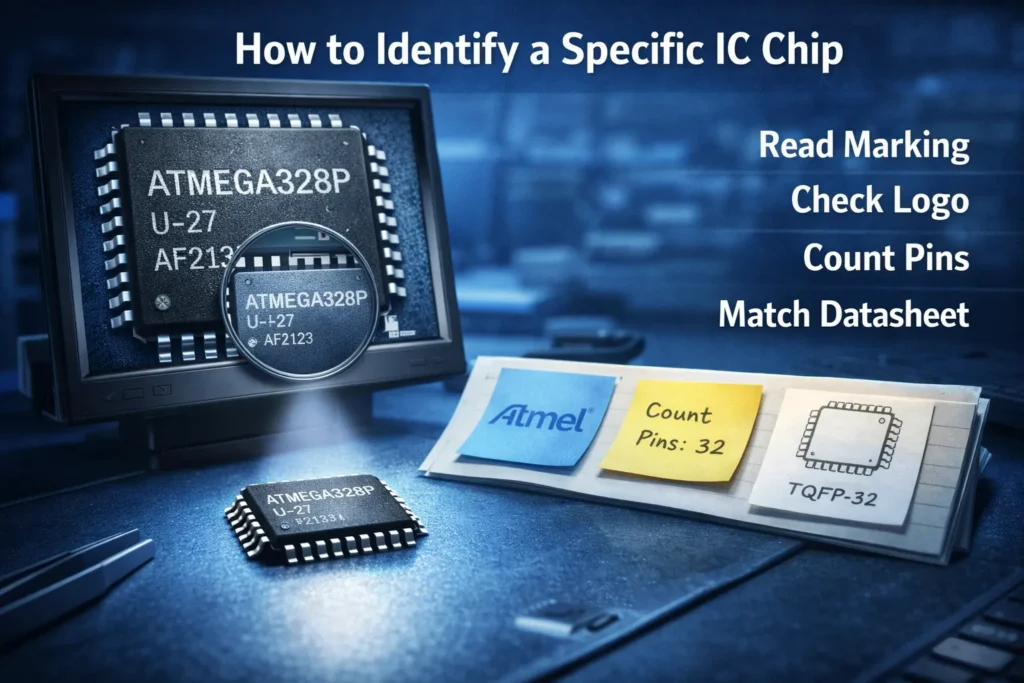
Start with the longest readable text printed or laser-etched on the package. On larger ICs, this may be close to the full part number. On smaller devices, it may only be a shortened marking code. Take a clear photo, use angled lighting, and zoom in if needed. A better image often saves more time than a second search attempt.
Step 2: Identify the Manufacturer
The manufacturer logo or prefix is one of the most valuable clues. A short marking may not be unique across the entire market, but it becomes much easier to interpret when you know whether the chip came from Texas Instruments, STMicroelectronics, Analog Devices, Microchip, NXP, onsemi, Infineon, or another brand.
Step 3: Confirm Package Type and Pin Count
Count the pins and identify the package family before assuming you found the right match. Package information filters out many wrong results. It also matters directly for price comparison, because the same device family can be sold in multiple packages with very different commercial conditions.
Step 4: Check the Datasheet
Once you have a likely match, verify it in the datasheet. Confirm the function, supply range, package drawing, and pin assignment. Never stop at a search result title. A correct-looking result is still only a candidate until the datasheet confirms it.
Step 5: Compare Source and Price
Only after the part is confirmed should you compare pricing and availability. Otherwise, you may spend time comparing quotes for the wrong chip, the wrong package, or the wrong orderable suffix.
Real Example: Identifying an LM358 on a Sensor Board
Suppose you are inspecting a small control board and find an 8-pin SOIC chip marked LM358 placed near a sensor connector, several resistors, and an analog signal path. Even before opening the datasheet, the location suggests the device may be an operational amplifier used for signal conditioning.
After checking the datasheet, you confirm that LM358 is a dual op-amp commonly used in low-cost analog circuits. In this case, the identification is supported by three things at once: the marking, the package, and the circuit role. This is a practical example of why IC identification works better when you verify what the chip is doing on the board instead of searching the printed text alone.
How to Read IC Markings Without Getting Misled
One of the biggest mistakes in IC sourcing is assuming that the text visible on top of the package is always the full orderable part number. In many cases, especially on small SMD parts, it is not. It may be a shortened marking, a family code, a production identifier, or a partial device reference.
Part Number vs Top Marking
A full part number is the complete manufacturer ordering code. A top marking is the abbreviated text printed on the package. They are related, but they are not always the same. This distinction becomes especially important when you are quoting regulators, logic ICs, interface devices, or microcontrollers.
Date Code and Lot Code Are Not the Same as the Part Number
Many chips include additional information such as date code, assembly trace code, or lot code. These are useful for traceability, but they are not what you should use for pricing or replacement searches. If a buyer confuses trace data with the actual device number, the search can go in the wrong direction immediately.
Why Small SMD Packages Create More Confusion
For small packages such as SOT-23, DFN, QFN, or tiny regulators, the visible code may be only two or three characters. That means you often need to use package type, logo, and board function together. Searching the short code alone may return several unrelated devices.
Real Example: Why MCU Markings Can Mislead You
Microcontrollers are a good example of why top marking alone is often not enough. On many STM32, NXP, or Microchip devices, the visible package text may be shorter than the full orderable part number. Two chips can belong to the same family while differing in flash size, package, temperature grade, or peripheral set.
In real sourcing work, this means you should not quote or replace a microcontroller based only on a family-level marking. The safer process is to confirm the full device number from the BOM, board file, firmware documentation, or the manufacturer datasheet before placing an order.
Common IC Package Types You Should Be Able to Recognize
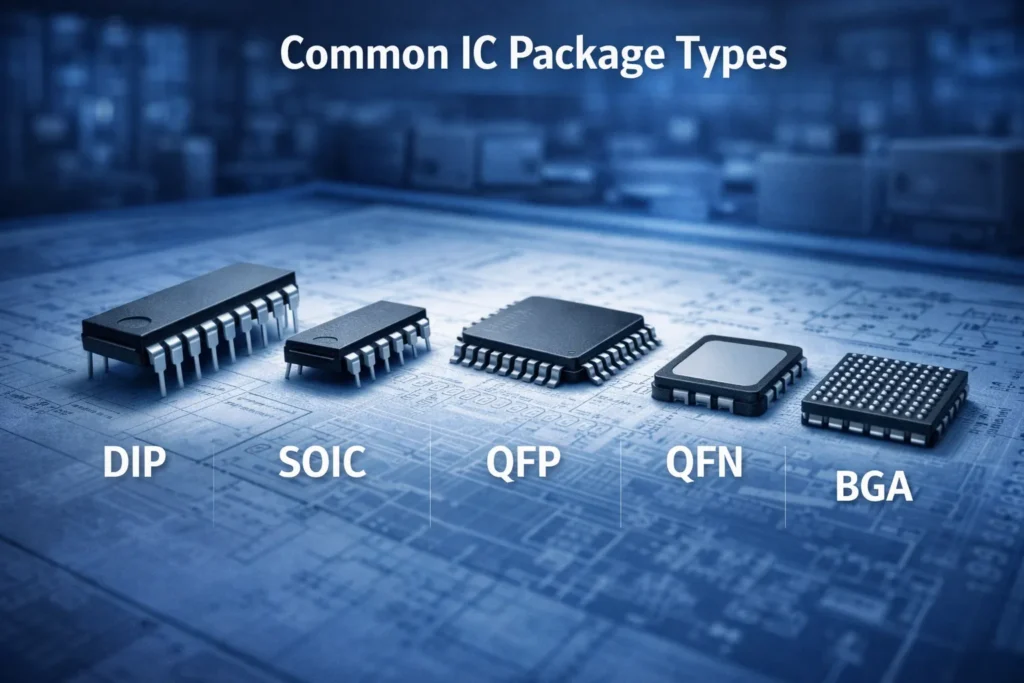
Package recognition is not just a technical detail. It affects assembly compatibility, repair feasibility, and quote accuracy. When buyers compare only the family name without checking the package, mistakes happen quickly. Here is a detailed article about IC Package knowledge.
DIP
Through-hole package used in prototyping, education, legacy boards, and some repair work. Easy to handle, easy to identify.
SOIC / SOP
Common surface-mount package for analog, logic, and interface ICs. Frequently seen in industrial and consumer designs.
TSSOP
Smaller and thinner than SOIC. Often chosen when board space matters but a simple leaded package is still desired.
QFP / TQFP
Flat package with leads on four sides, common for MCUs, DSPs, and larger logic devices.
QFN / DFN
Compact leadless package with good thermal performance and small footprint, but harder to inspect visually.
BGA
Ball grid array package used for higher pin-count and more advanced digital devices, often requiring more specialized assembly and rework capability.
When comparing quotes, the package should always be treated as part of the identity of the device. “Close enough” is not good enough in production.
How to Find the Price of an IC Chip the Right Way
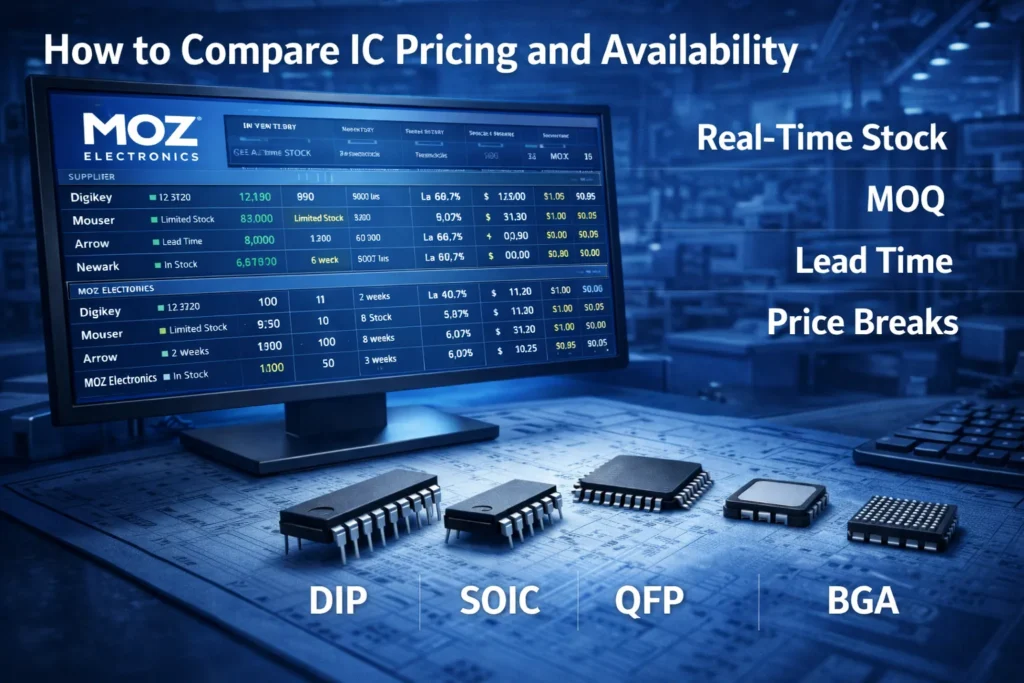
In real sourcing work, pricing is not just about finding the lowest number on a search page. A useful comparison checks whether the supplier is offering the same manufacturer, the same package, the same packing method, and the same supply status. For example, a reel price may look lower than a cut-tape price, but it may also require a much higher minimum order quantity. Likewise, a low unit price is less helpful if the lead time is too long for your build schedule.
Once the part number is confirmed, pricing becomes a sourcing problem rather than an identification problem. At this stage, the goal is not simply to find the lowest number on a search page. The goal is to find a usable commercial offer for the exact part you need.
Search the Exact Orderable Part Number
Search the full manufacturer part number whenever possible. Searching only the family name may mix different packages, temperature grades, or delivery formats. An exact search gives you more accurate price and stock results.
Compare Prices at the Quantity You Actually Need
IC pricing changes with quantity. A part that looks expensive at Qty 1 may be competitive at Qty 500 or Qty 1000. For production purchasing, price breaks matter more than single-piece visibility.
Check MOQ, Lead Time, and Packing Method
Low unit price does not always mean low project cost. If the supplier requires a high MOQ, ships only on reel, or cannot deliver in time for the build, that offer may be commercially worse than a slightly higher but immediately usable source.
Do Not Ignore Source Quality
If traceability matters, the best offer is not always the cheapest one. Quality-sensitive applications may need authorized distribution, while less critical use cases may allow more sourcing flexibility. The point is to compare like with like.
Real Example: Why a 74HC04 Quote Can Be Misleading
A common sourcing mistake happens with logic ICs such as 74HC04. A buyer searches for 74HC04 and quickly finds several low-cost offers. At first glance, the listings look interchangeable. But one listing is for a DIP package used in prototyping, another is for SOIC used in SMT assembly, and another may include a different package suffix or packing method.
If the package is not confirmed before quoting, the team may approve a price that cannot actually be used on the production PCB. This is one of the most common sourcing mistakes with logic ICs: comparing family-level prices instead of exact orderable parts.
What Really Affects IC Pricing
Many buyers assume IC pricing behaves like a simple commodity market, but in practice a quote can change for reasons that are easy to overlook. Understanding those reasons helps you compare offers more intelligently.
Manufacturer and Brand
Brand matters. Even when two devices look similar by function, the market may price them differently based on reputation, availability, qualification, and support ecosystem.
Package Type
A DIP package for lab use, a QFN package for compact production, and an automotive-grade package for demanding environments do not carry the same cost structure.
Temperature Grade and Qualification
Commercial, industrial, automotive, and specialty-grade parts can differ significantly in price even when the electrical function looks similar.
Packing Method
Cut tape, reel, tube, and tray options influence handling, MOQ, automation compatibility, and final cost. This is one reason identical-looking search results may not be commercially identical.
Lifecycle Status
Active parts are easier to price consistently. NRND, obsolete, or allocated parts can show sharp price swings or limited availability.
Supply Chain Conditions
Lead-time pressure, wafer constraints, regional demand, and inventory concentration can all push pricing up even when the part itself has not changed.
Real Example: Why AMS1117 Prices Vary So Much
Take AMS1117 as an example. Many buyers think of it as a simple low-cost regulator family and expect all offers to be roughly the same. In practice, price can change depending on the voltage version, package type, brand, packing format, and source channel.
For instance, AMS1117-3.3 and AMS1117-5.0 in SOT-223 are widely available from multiple brands, yet quoted prices can still differ significantly depending on whether the offer is for cut tape, reel packaging, branded stock, or lower-cost generic supply. That is why what looks like the “same chip” is often not the same commercial offer in real purchasing work.
How to Identify an Unmarked or Hard-to-Read Chip
Repair work is where IC identification becomes most practical. Burned, scratched, or partially marked chips are common on industrial, automotive, and maintenance boards. In these situations, package text alone is usually not enough.
Use Board Context, Not Just Package Text
If the marking is incomplete, ask what the chip is likely doing on the board. Is it near an inductor and diode? It may be a regulator or controller. Is it near a communication connector and protection network? It may be a transceiver. Is it close to sensor inputs and resistor networks? It may be an amplifier or signal-conditioning IC.
Trace the Surrounding Components
The nearest passive parts often reveal the chip’s role. Feedback dividers suggest power regulation. Crystal connections suggest timing or processing. Termination resistors suggest communications. Pull-ups and bus routing suggest logic or interface behavior.
Measure Before You Guess
Body size, pin count, package family, and pad arrangement can eliminate many wrong candidates. Even when you cannot prove the exact part immediately, you can usually narrow the search dramatically.
Real Example: Partial Marking on an Industrial Control Board
Imagine a damaged 16-pin IC on an industrial control board with only a few readable characters left. If the chip is located next to an RS-485 connector, bias resistors, and protection components, it may be a communication transceiver. If it is near an inductor, diode, and feedback divider, it is more likely a switching regulator controller.
In this kind of repair scenario, package shape and board function often matter more than the incomplete top marking. This is why experienced technicians do not start with blind online searching alone. They start by asking what role the chip is likely playing in the circuit.
Authorized vs Independent Sources: Which One Should You Use?
Not every sourcing case requires the same channel. The best source depends on the part itself, how urgent the requirement is, and how much supply-chain risk the project can tolerate. If you want a broader overview of sourcing channels, including authorized distributors, independent suppliers, and lower-cost volume platforms, see our guide to electronic components and parts suppliers.
Authorized Distribution
Authorized distribution is usually the best choice for production builds, high-traceability demand, regulated industries, and long-term supply planning. It reduces sourcing risk and often provides the most reliable information on lifecycle status, factory lead time, and official packaging options. If the project will go into repeat manufacturing, this channel is often worth the premium.
Independent Sourcing
Independent sourcing becomes useful when a part is obsolete, allocated, discontinued, or simply difficult to find through mainstream authorized distribution. In these cases, the value is not just availability, but access to hard-to-find inventory and shortage support. However, documentation, inspection controls, and supplier credibility become far more important than they would be in a standard authorized purchase.
When Traceability Matters More Than Price
If the project involves industrial uptime, customer warranty exposure, field service risk, or strict quality systems, a slightly higher price from a stronger source may be the better business decision. In other words, the cheapest offer is not always the lowest-cost decision once rework, returns, or line-down risk are taken into account.
Practical Buying Tips Before You Place an IC Order
- Always quote the full manufacturer part number, not just the visible top marking.
- Confirm package type before comparing prices.
- Check whether the stock is immediately available or tied to lead time.
- Compare quotes at your real required quantity, not only at Qty 1.
- Confirm whether the source is authorized if traceability matters.
- Ask whether alternates are truly form-fit-function compatible or only similar by description.
- Review packing format if your assembly process requires reel, tray, or cut tape.
- Be cautious when the offered price looks dramatically lower than the rest of the market.
Integrated Circuit Identification and Pricing Checklist
Common Mistakes That Cause Wrong Quotes or Wrong Replacements
Searching only a short code
Short top markings often point to multiple possible devices. Package and brand must also be confirmed.
Ignoring package suffix
The same family name can exist in multiple footprints and packing styles. A low price is useless if the package is wrong.
Comparing only unit price
A quote can look cheap while still failing on MOQ, lead time, source quality, or traceability.
Assuming family-level compatibility
Two similar part names can differ in voltage, memory, pinout, or temperature grade.
Conclusion
Integrated circuit identification and pricing become much more reliable when you stop treating them as two separate tasks. First identify the chip correctly by combining top marking, manufacturer, package, datasheet, and board context. Then compare the commercial offer using exact part number, quantity, stock, lead time, and source quality.
That approach saves time, reduces sourcing mistakes, and produces quotes that are actually usable in purchasing, repair, and production. Whether you are replacing an LM358 on a sensor board, checking the correct package for a 74HC04, reviewing AMS1117 price differences, or tracing a partially marked chip on an industrial controller, the same rule applies: verify first, compare second.
Need Help Identifying a Chip or Quoting a Hard-to-Find IC?
Send us the part number, top marking, package photo, or BOM line. We can help you verify the device and support your sourcing request.
Frequently Asked Questions
How do I identify a specific IC chip?
Start with the visible top marking, then confirm the manufacturer, package type, pin count, and datasheet. If the marking is incomplete, use board context and circuit function to narrow the possibilities.
What is the difference between a top marking and a full part number?
The top marking is the text printed on the package, often shortened for space. The full part number is the manufacturer’s complete orderable code used for accurate sourcing and replacement.
Why can the same IC show different prices on different websites?
Price differences can come from package type, quantity break, packing method, brand, lifecycle status, lead time, and source quality. Two offers may look similar but still not be commercially identical.
Can I replace a chip just because the family name looks similar?
No. Similar family names do not guarantee the same pinout, package, voltage range, memory size, or qualification level. Always confirm through the datasheet before replacing a part.
How can I identify a chip if the marking is burned or unreadable?
Use the package size, pin count, surrounding components, and likely board function to narrow the device class. Then compare likely candidates against the circuit and available documentation.
Should I always choose the cheapest supplier?
Not necessarily. The best source depends on whether you need traceability, immediate stock, low MOQ, strong lead-time reliability, or support for obsolete parts. The lowest visible price is not always the best business choice.
What details should I include when requesting an IC quote?
Include the full part number, required quantity, package preference, target price if available, date code requirements, and any acceptable alternates. A photo of the chip or board can also help when identification is uncertain.