
When choosing a sensor for automation, robotics, or industrial detection, one of the most common questions engineers and buyers ask is: Should I use a proximity sensor or a photoelectric sensor?
While both are widely used for non-contact object detection, they differ significantly in sensing technology, detection range, target material compatibility, and ideal application scenarios.
A proximity sensor generally detects nearby objects at short range using electromagnetic, capacitive, or ultrasonic principles, while a photoelectric sensor uses a beam of light to detect objects from much longer distances with higher flexibility.
In this guide, we’ll compare proximity sensors vs photoelectric sensors in detail—including working principles, pros and cons, industrial applications, proximity sensor pricing, and how to choose the right sensor for your project.
What Is a Proximity Sensor?
A proximity sensor is an electronic device that detects the presence of nearby objects without requiring physical contact. It works by generating a sensing field and monitoring changes caused when an object enters that field.
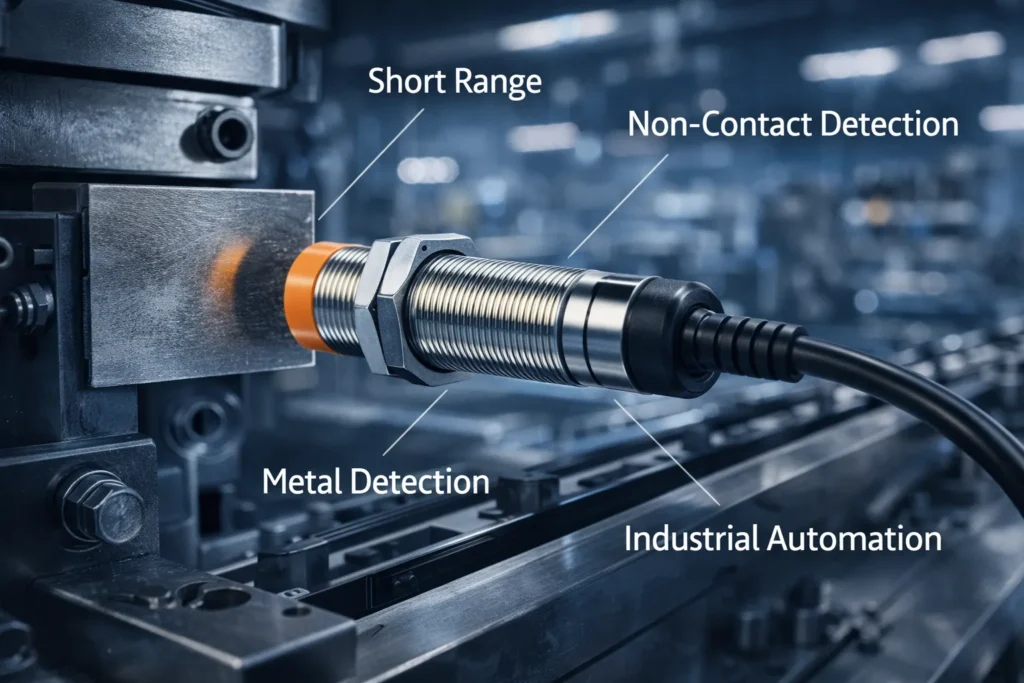
Proximity sensors are commonly used in:
- Industrial automation equipment
- Manufacturing lines
- Robotics systems
- Vehicle detection systems
- Consumer electronics
Most standard proximity sensors operate between 1 mm and 20 mm, depending on sensor type and target material.
Main Types of Proximity Sensors
Inductive Sensors
Detect metallic objects using electromagnetic fields.
Capacitive Sensors
Detect metal and non-metal objects using capacitance changes.
Ultrasonic Sensors
Use sound waves to detect object distance.
Magnetic Sensors
Detect magnets or magnetic fields, such as Omron Automation GLS-1 Magnetic Proximity Sensor.
What Is a Photoelectric Sensor?
A photoelectric sensor detects objects using emitted light beams, usually infrared or laser light. When the beam is interrupted, reflected, or altered by an object, the sensor detects the object’s presence.
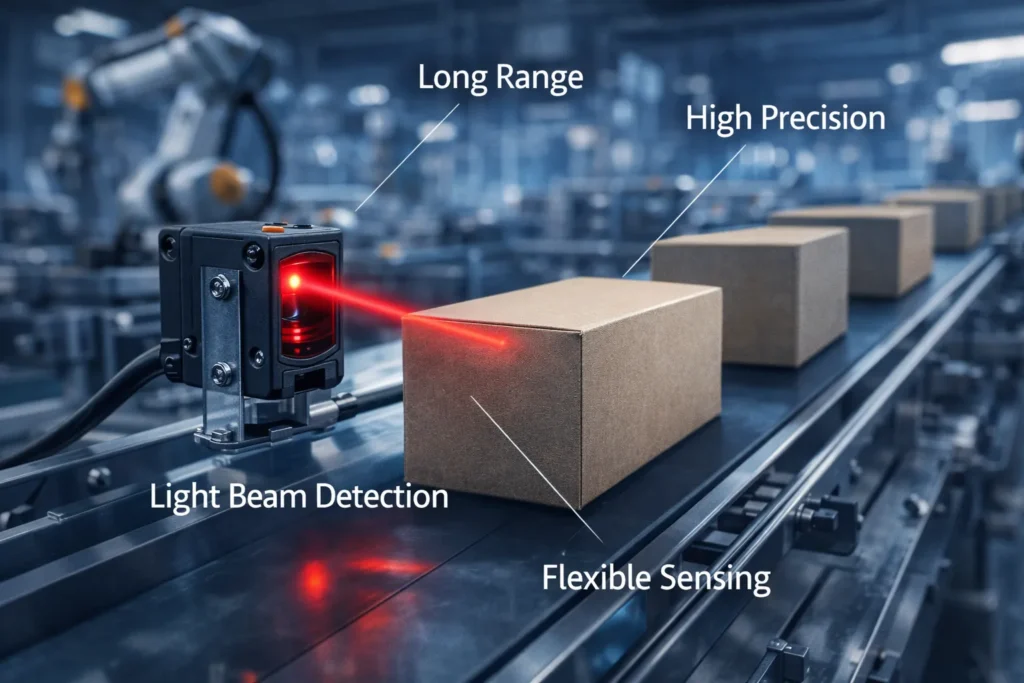
Photoelectric sensors are preferred when:
- Long detection range is required
- Objects vary in material
- High-speed detection is needed
- Precise positioning is important
Types of Photoelectric Sensors
Through-Beam
Separate transmitter and receiver.
Retro-Reflective
Uses reflector opposite the sensor.
Diffuse Reflective
Detects reflected light directly from target.
Proximity Sensor vs Photoelectric Sensor: Side-by-Side Comparison
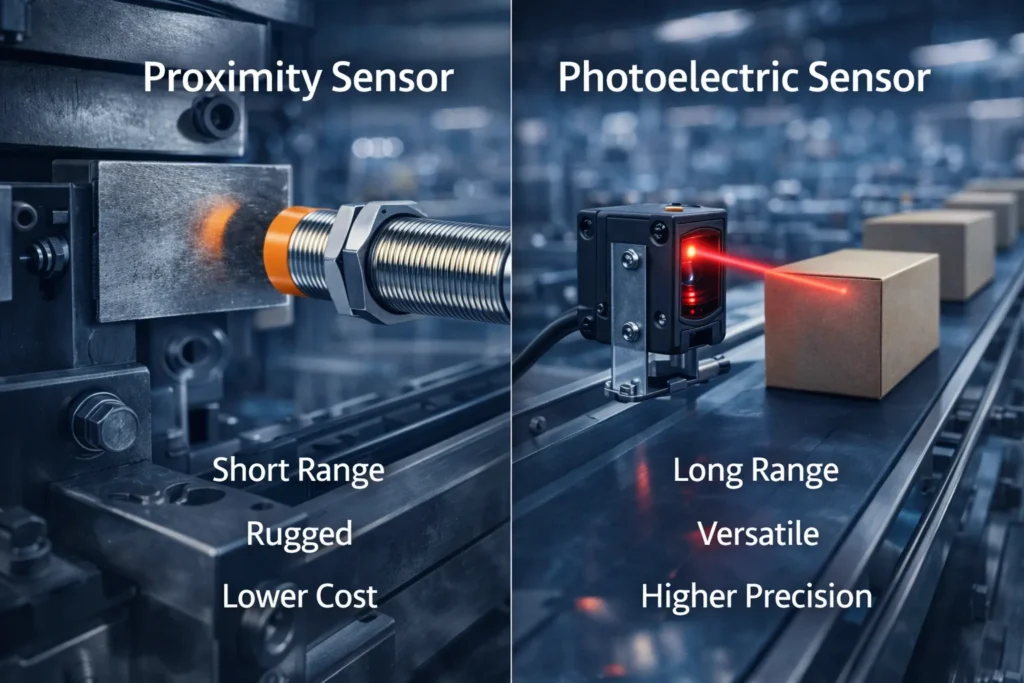
| Feature | Proximity Sensor | Photoelectric Sensor |
|---|---|---|
| Detection Method | Field / Sound / Capacitance | Light Beam |
| Detection Range | Short | Long |
| Material Detection | Depends on Type | Almost All Materials |
| Precision | Moderate | High |
| Cost | Usually Lower | Usually Higher |
| Dust Resistance | Excellent | Moderate |
| Environmental Sensitivity | Low | Higher |
Detection Range Comparison
The biggest difference between these two technologies is detection range.
| Sensor Type | Typical Detection Range | Maximum Range |
|---|---|---|
| Inductive Proximity | 1–10 mm | 20 mm |
| Capacitive Proximity | 2–15 mm | 25 mm |
| Photoelectric | 10 mm–5 m | 20+ m |
If your application requires detecting objects beyond 50 mm, photoelectric sensors are generally the better choice.
Advantages of Proximity Sensors
Highly Durable
Excellent for dusty, oily, and wet industrial environments.
Lower Cost
Generally cheaper than photoelectric alternatives.
Compact Design
Easy to install in tight spaces.
Minimal Maintenance
No optics to clean or recalibrate.
Advantages of Photoelectric Sensors
Long Detection Range
Ideal for large machinery and conveyor systems.
Universal Material Detection
Detects plastic, glass, metal, wood, and more.
Higher Precision
Excellent for positioning and alignment.
Fast Response
Suitable for high-speed production lines.
Limitations of Each Sensor Type
| Sensor | Main Limitation |
|---|---|
| Proximity Sensor | Limited sensing distance |
| Photoelectric Sensor | Can be affected by dust/light interference |
Industrial Use Cases: Which Sensor Should You Choose?
| Application | Recommended Sensor | Reason |
|---|---|---|
| Metal Part Detection | Proximity Sensor | Reliable and cost-effective |
| Conveyor Monitoring | Photoelectric Sensor | Long range |
| Packaging Machines | Photoelectric Sensor | Works on multiple materials |
| Machine Safety | Photoelectric Sensor | Wide-area detection |
| CNC Automation | Proximity Sensor | Dust/oil resistance |
Cost Comparison
Pricing is another deciding factor for OEM and industrial buyers.
| Sensor Type | Typical Price Range |
|---|---|
| Proximity Sensor | $5–$80 |
| Photoelectric Sensor | $20–$200+ |
Photoelectric sensors typically cost more because of their longer range and optical detection technology.
Need pricing details? Read our full guide:
How Much Does a Proximity Sensor Cost in 2026?
Final Verdict
Both proximity sensors and photoelectric sensors play critical roles in industrial automation, but they serve different purposes.
You need affordable, rugged, short-range detection in dirty or harsh environments.
You need long-range, versatile, high-precision detection across many object types.
Frequently Asked Questions
Is a photoelectric sensor better than a proximity sensor?
Not necessarily. Photoelectric sensors are better for long-range and versatile detection, while proximity sensors are better for short-range rugged applications.
Why use a proximity sensor instead of photoelectric?
Proximity sensors are cheaper, more durable, and better suited for harsh industrial environments.
Can proximity sensors detect plastic?
Only capacitive proximity sensors can reliably detect plastic and other non-metal materials.
Need Help Choosing the Right Sensor?
At MOZ Electronics, we supply a wide range of industrial sensors for OEM, automation, and wholesale applications.