
A DC cooling fan is usually better for broad airflow across open spaces, PCBs, and enclosures, while a blower fan is usually better for directed airflow, tighter spaces, and higher-resistance cooling paths. If your system needs general ventilation, start with an axial DC fan. If it needs focused airflow through a narrow channel, dense heatsink, or compact enclosure, a blower fan is often the better choice.
When buyers look for a cooling solution for electronics, they often start with a broad term like “thermal fan” or “cooling fan.” But once the application becomes more specific, the real question is usually this: Should you use a DC cooling fan or a blower fan?
Both are common choices for electronics cooling, but they do not solve the same airflow problem in the same way. A DC cooling fan is typically the better option for moving air across open areas, enclosures, and general heat-producing components. A blower fan is usually better when the design needs more focused airflow, higher static pressure, or cooling through a constrained path.
- DC cooling fans are usually best for broad airflow across open electronics layouts.
- Blower fans are usually best for directed airflow and higher-pressure cooling paths.
- The right choice depends on airflow direction, static pressure, space limits, and enclosure resistance.
- For open ventilation, an axial fan is often simpler and more cost-effective.
- For narrow ducts, compact devices, or dense heatsink zones, a blower fan often performs better.
- If you are comparing real product options, start from Thermal Management and then narrow into AC Fans.
That distinction matters for engineers, buyers, and sourcing teams. Choosing the wrong fan type can reduce thermal performance, increase noise, waste space, and create avoidable redesign work. The best choice depends on the enclosure shape, airflow resistance, cooling target, and available installation space.
Quick Answer
A DC cooling fan usually works best for general airflow and broad electronics cooling, while a blower fan is usually better for directed airflow, tighter spaces, and higher-resistance cooling paths. If the system has an open layout and needs steady airflow across a wider area, a DC axial fan is often the better fit. If the system needs air pushed through a narrow channel, compact assembly, or dense heatsink zone, a blower fan is often the stronger choice.
What Is a DC Cooling Fan?
Axial Fan Basics
A DC cooling fan is an electrically powered fan that uses direct current to move air through or across an electronic system. In most electronics applications, this usually refers to an axial fan, where air moves in the same general direction as the fan axis.
Axial fans are among the most common cooling components in electronics. They are widely used in enclosures, industrial cabinets, power supplies, telecom systems, embedded devices, and general PCB cooling.
Where DC Cooling Fans Work Best
A DC cooling fan is usually the better choice when the application needs:
- general ventilation
- airflow across multiple components
- enclosure cooling
- board-level air circulation
- lower-complexity airflow design
This makes DC fans a common fit for systems where the internal layout is not too restrictive and the cooling goal is broad heat removal rather than highly focused air delivery. For site navigation, the most relevant live entry point today is the AC Fans category, which already groups axial fans, centrifugal fans, blowers, and compact cooling fans.
What Is a Blower Fan?
How a Blower Fan Moves Air
A blower fan, often called a centrifugal blower, moves air differently from an axial fan. Instead of pulling air straight through and pushing it forward, a blower draws air in and redirects it outward through a side outlet.
This makes blower fans especially useful when the airflow path is more restrictive or needs to be controlled more precisely.
Where Blower Fans Work Best
Blower fans are often better at pushing air through:
- narrow ducts
- tight mechanical spaces
- heatsink fins with higher resistance
- enclosed pathways
- targeted cooling channels
Because of that, blower fans are frequently selected for compact electronic devices, directed cooling zones, and designs where airflow must turn or exit in a controlled direction. If you want a live product/category path on MOZ, the same AC Fans section is currently the strongest hub because it explicitly includes blower and centrifugal formats.
DC Cooling Fan vs Blower Fan: Key Differences
| Criterion | DC Cooling Fan | Blower Fan |
|---|---|---|
| Airflow pattern | Broad, straight-through airflow | Focused, directional airflow |
| Best for | Open cooling areas | Tight spaces and ducts |
| Static pressure | Usually lower | Usually higher |
| Typical use | Enclosures, PCB cooling, general ventilation | Compact devices, narrow channels, targeted cooling |
| Noise profile | Often lower in open setups | Can be higher depending on pressure target |
| Buyer focus | Air volume | Pressure and airflow control |
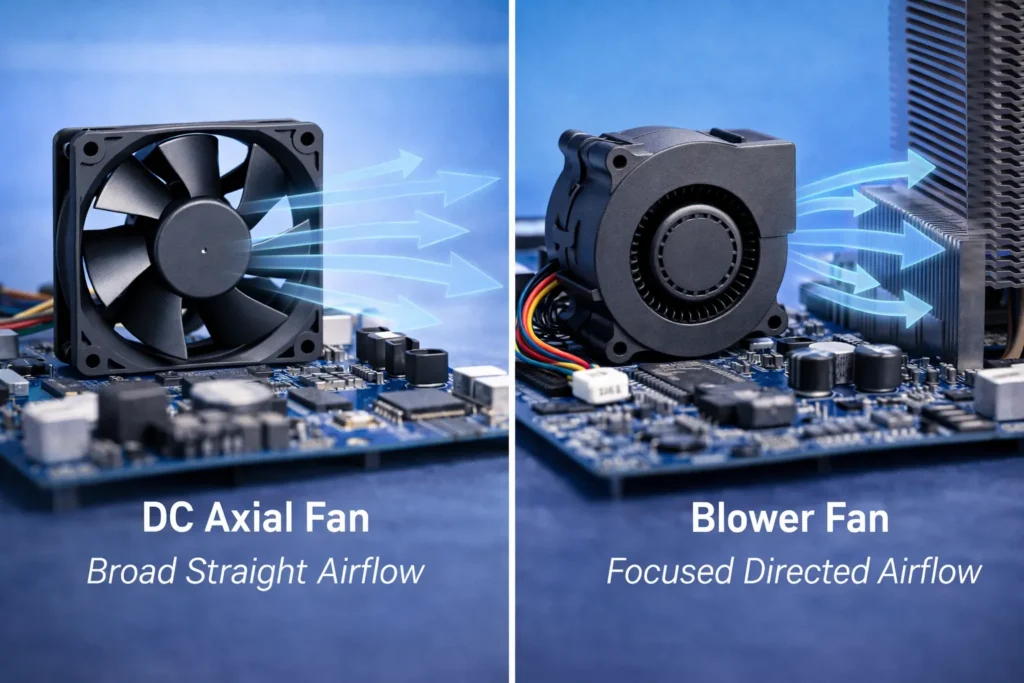
Airflow Volume
In open conditions, a DC cooling fan often delivers higher apparent airflow. That makes it attractive for enclosure ventilation and general cooling. If the system simply needs a steady stream of air across components, an axial fan can often do the job efficiently.
A blower fan may move less total air in free air, but it often performs better once the airflow path becomes restricted.
Static Pressure
Static pressure is one of the biggest differences between the two. A blower fan is usually better at generating pressure, which allows it to keep pushing air through tighter or more resistant paths.
This is why buyers should never compare fans by airflow number alone. In many electronics systems, airflow resistance matters just as much as air volume.
Direction of Airflow
A DC cooling fan usually pushes air straight through. A blower fan redirects air and pushes it out in a more controlled direction. That makes blowers especially useful when the airflow must be aimed toward a specific hot component or passed through a defined route.
Size and Space Constraints
In flatter or more compact designs, a blower may integrate more easily because it can fit into a tighter footprint and send air in a deliberate direction. A DC axial fan may need more open intake and exhaust space to perform well.
Noise and Efficiency
Noise depends heavily on the exact design, speed, and system layout. In open setups, axial fans often produce lower perceived noise for the amount of airflow delivered. Blowers can become noisier when pressure demand is high, but in some constrained designs they may still be more effective overall because they match the airflow path better.
Which One Is Better for Electronics Cooling?

For Enclosures and Cabinets
For electronics enclosures, cabinets, and broader ventilation tasks, a DC cooling fan is often the better choice. It works well when the airflow path is relatively open and the goal is to reduce overall internal temperature.
For Heatsinks and Directed Cooling
If the airflow must be concentrated through a denser path or aimed at a specific thermal zone, a blower fan may be more effective. This is especially true when a design includes ducts, narrow channels, or tight thermal geometry.
For Compact Devices
Compact devices often benefit from blower fans because they allow more controlled airflow in small spaces. When there is limited room for open circulation, pressure and direction become more important than broad air volume.
For General Ventilation
When the job is general ventilation rather than precision cooling, DC cooling fans usually offer the simpler and more cost-effective answer.
If your layout is open, start with a DC cooling fan. If the airflow path is narrow, directional, or high-resistance, evaluate a blower fan first.
Key Specifications Buyers Should Compare
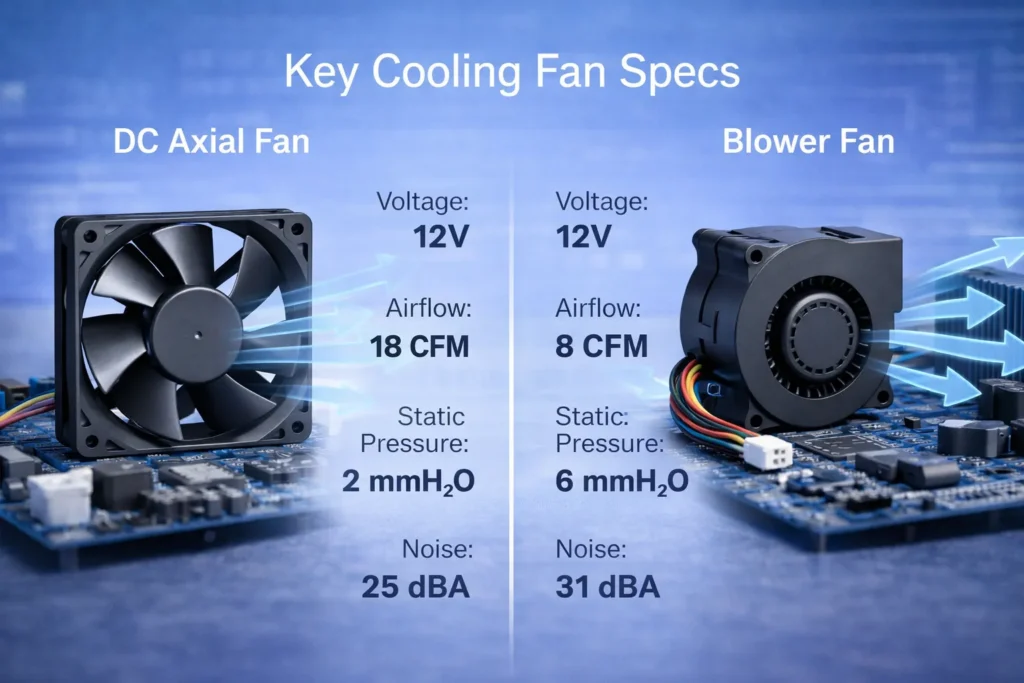
Voltage
Check that the fan matches the available system voltage and control architecture. Improper voltage selection can limit performance or complicate power design.
Airflow
Airflow matters, but only in context. A high airflow number is helpful only if the system allows that airflow to move effectively.
Static Pressure
This is especially important in restricted systems. If the fan must push air through dense fins, small vents, or a controlled path, static pressure may matter more than free-air airflow.
Bearing Type
Bearing design affects noise, lifetime, and reliability. For long-running or industrial applications, this can be a major factor.
Noise Level
Acoustic limits are important in consumer devices, office environments, and other noise-sensitive designs. Buyers should evaluate noise together with performance, not separately.
Operating Life
Long service life matters in industrial equipment, network hardware, embedded systems, and products with continuous duty cycles.
If you want a site-internal guide that already discusses assessing space and airflow requirements before procurement, link naturally here to how to choose the right AC axial fans. It is not the same as a DC-vs-blower guide, but it fits this buyer-education section well.
Common Fan Selection Mistakes
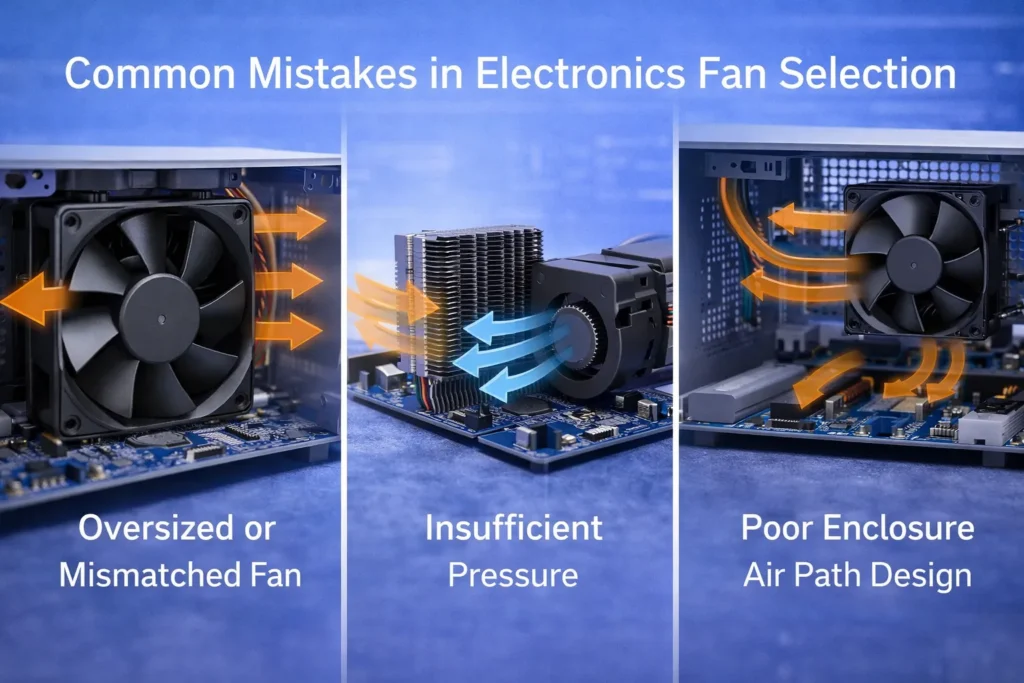
Choosing By Size Alone
A fan that physically fits is not automatically the right fan. Mechanical fit must be matched with airflow needs, pressure requirements, and thermal goals.
Ignoring Static Pressure
This is one of the most common mistakes in electronics cooling. A fan may look powerful on paper but still perform poorly in a restrictive design if the pressure capability is too low.
Overlooking Air Path Design
The fan is only one part of the cooling system. Intake space, exhaust space, enclosure geometry, and component placement all affect the final result.
Do not choose only by fan size or headline airflow. Match the fan type to the actual airflow path, pressure needs, and device layout.
How to Choose the Right Fan for Your Project
A strong fan selection process usually starts with the application, not the catalog. Ask these questions first:
- Does the system need broad airflow or targeted airflow?
- Is the airflow path open or restricted?
- Is the design space large enough for an axial fan?
- Does the system need high static pressure?
- Is noise a major constraint?
- Will the fan run continuously?
If the application needs general enclosure airflow, start with a DC cooling fan. If it needs concentrated airflow through a narrow or controlled path, start with a blower fan. If the system is more complex, compare both options in the context of the real mechanical layout.
For broader buyer navigation on MOZ, this is a natural place to link to Thermal Management, then drill into AC Fans. If you want one product-level example of integrated thermal hardware with PWM-managed airflow, you can also lightly reference the Raspberry Pi 5 case with PWM fan.
Final Buying Advice
A DC cooling fan and a blower fan are both valuable for electronics cooling, but they do different jobs. A DC cooling fan is usually the stronger option for open airflow and general ventilation. A blower fan is usually the better choice for directed airflow, compact devices, and higher-resistance cooling paths.
For buyers, the smartest approach is to stop thinking in broad terms like “thermal fan” and instead define the real cooling problem:
- open airflow or targeted airflow
- air volume or static pressure
- simple ventilation or constrained cooling path
Once that is clear, the right fan category becomes much easier to choose. If you want to continue into brand-level exploration, MOZ also has an ebm-papst catalog hub that already clusters axial and centrifugal/blower products.
Frequently Asked Questions
Is a blower fan better than a DC cooling fan?
Not always. A blower fan is better for directed airflow and higher static pressure, while a DC cooling fan is often better for general airflow and open cooling layouts.
What is the difference between an axial fan and a blower fan?
An axial fan moves air straight through, while a blower fan redirects air and pushes it out through a side outlet, usually with more pressure.
Which fan is better for a small enclosure?
That depends on the enclosure design. If airflow is restricted or needs to be directed, a blower fan may work better. If the enclosure is more open, a DC cooling fan may be enough.
Do blower fans have higher static pressure?
In many cases, yes. That is one reason they are often used in tighter airflow paths.
Are DC cooling fans quieter than blowers?
Often yes in open layouts, but actual noise depends on the specific design, speed, and airflow resistance.
How do I choose between airflow and static pressure?
If the system has an open path, airflow is often the main priority. If the path is restrictive, static pressure becomes more important.