
To read a potentiometer datasheet, start with the part type, resistance value, taper, tolerance, and power rating. Then check the mechanical details such as rotation angle, shaft style, mounting method, and dimensions. Finally, review life cycle, environmental limits, and part-number options so you can confirm the potentiometer fits both the electrical and mechanical requirements of your design.
A potentiometer datasheet can look deceptively simple. Compared with a microcontroller or a power IC, the document is usually shorter and the parameter list is smaller. That often leads beginners to believe there is not much to read. In reality, a potentiometer datasheet contains exactly the information that determines whether your control will feel smooth or noisy, whether it will survive the environment, and whether it will fit your panel, PCB, or enclosure.
If you have ever opened a datasheet and wondered what terms like total resistance, taper, electrical angle, mechanical travel, power rating, or cycle life really mean, this guide will walk you through them in a practical order. Instead of reading the document from top to bottom, you will learn how engineers actually interpret it when choosing a part for a real design.
Why the Datasheet Matters
A potentiometer is still a three-terminal variable resistor, but that simple description hides many design decisions. One part may be intended for audio volume control. Another may be designed for industrial position adjustment. Another may be a sealed heavy-duty panel component. Another may be a tiny trimmer for calibration only.

Two potentiometers can both say “10k” on the label and still behave very differently in real products. One may have a linear taper and another an audio taper. One may be rated for 0.2 W and 100,000 cycles, while another may support higher power or much longer life. One may fit your panel cutout; another may not. That is why the datasheet is not just paperwork. It is the only reliable way to confirm the device matches the job.
Do not choose a potentiometer by resistance value alone. A correct value with the wrong taper, wrong mechanical form, or wrong life rating can still produce a bad design.
Start With the Part Type
Before reading any numbers, identify what category of potentiometer you are looking at. Is it a rotary potentiometer, a slide potentiometer, a trimmer, or a digital potentiometer? This tells you how the part is meant to be used.
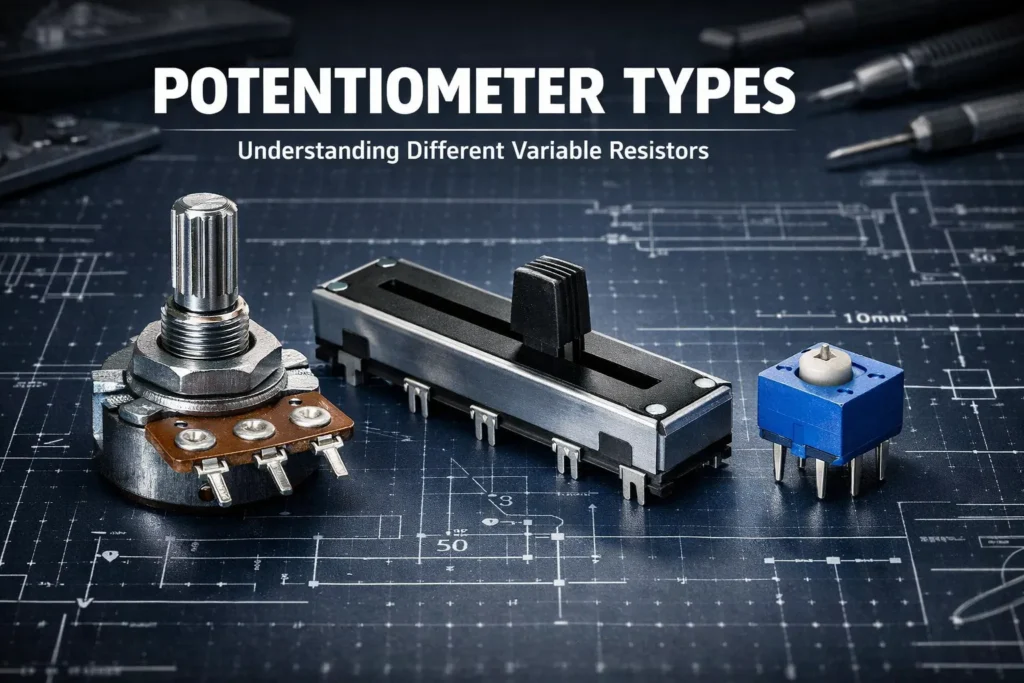
Rotary parts are common for knobs and front panels. Slide parts are common in mixers and user interfaces where travel should be visible. Trimmers are intended for occasional adjustment, usually during calibration, not for daily user interaction.
Digital potentiometers are electronically controlled and belong in a different design category entirely.
If you are still comparing form factors, it helps to review linear vs rotary potentiometers and the broader complete guide to potentiometers before narrowing down a specific datasheet.
Read the Resistance Value First
The first electrical parameter to confirm is the total resistance, sometimes called nominal resistance or end-to-end resistance. This is the resistance measured between the two outer terminals of the potentiometer.
Common values include 1k, 5k, 10k, 50k, 100k, and 1M. Your circuit determines which value makes sense. Lower values generally draw more current but are less sensitive to loading and leakage. Higher values reduce current consumption but can become more sensitive to noise and downstream input impedance.
In many practical circuits, 10k is the default starting point because it balances current draw and stability well. If you want a deeper resistance-value comparison, link this topic naturally to potentiometer values: 1k vs 5k vs 10k vs 50k vs 100k, and for a narrower comparison, to 10k vs 100k potentiometer.
| Datasheet Term | What It Means | Why It Matters |
|---|---|---|
| Total Resistance | Resistance between the two outer terminals | Sets current draw and interaction with the next circuit stage |
| Resistance Range | Available values in the part family | Shows whether the series offers the value you need |
| End-to-End Resistance | Another name for total resistance | Usually the same core parameter presented differently |
Understand Taper and Control Feel
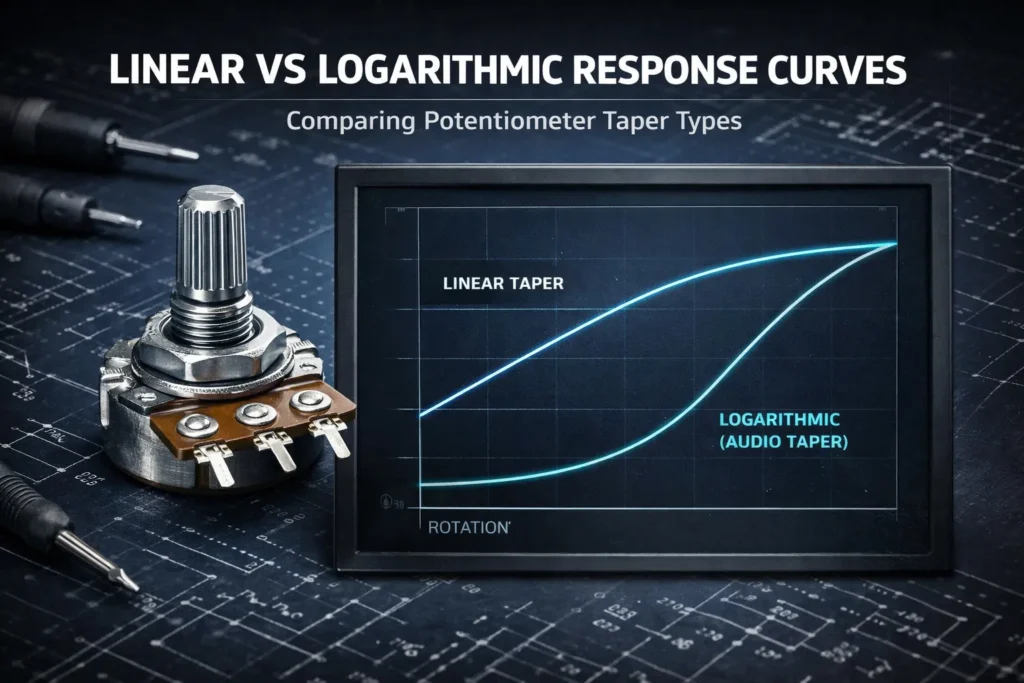
After the resistance value, the most important parameter is often taper. Taper describes how the resistance changes as the shaft or slider moves. The two most common types are linear and logarithmic (audio).
A linear taper changes output more proportionally across the travel. It is usually preferred in control circuits, bias settings, sensor adjustments, and microcontroller analog interfaces. An audio taper is designed so the change feels more natural to human hearing, which is why it is often used for volume controls.
This is one of the easiest ways to misread a datasheet. Designers sometimes see the correct resistance value and stop reading. Then the finished product feels wrong because the user response is too abrupt near one end of the rotation.
Always check whether the taper matches the application.
Use Linear Taper When
ADC input adjustment, voltage divider controls, calibration, industrial settings, embedded systems, and most general analog controls.
Use Audio/Log Taper When
Volume control, loudness adjustment, and human-perception-driven interfaces where equal shaft movement should not feel electrically linear.
Check Tolerance and End Resistance
The next line to read is resistance tolerance. For many panel potentiometers, a tolerance of ±20% is common. That may sound loose if you are used to fixed resistors, but for user controls it is often acceptable because the exact absolute value is less important than the function and range.
However, for precision adjustment, instrumentation, or matched-channel designs, tolerance matters much more. In those cases, also look for related specifications such as linearity, contact resistance variation, or end resistance. These parameters tell you how ideal the part behaves across the travel and near the ends of the resistive track.
Beginners often assume the wiper can reach a mathematically perfect zero or exactly the full end resistance. In reality, the datasheet may specify a non-zero end resistance or a contact variation figure. That becomes important in calibration, sensor scaling, and precision analog front ends.
Verify Power Rating and Voltage Limits
A potentiometer can overheat just like a resistor, so the power rating is critical. This is usually given in watts at a specified ambient temperature, often with a derating curve above that temperature. If your application dissipates more than the rated power, the track can drift, wear prematurely, or fail.
A simple mistake is to calculate only the total current through the divider and ignore the worst-case wiper position. In some circuits, certain positions cause more localized stress on part of the resistive element. The datasheet helps you verify whether the series is intended for light signal control, medium-duty panel control, or heavier-duty applications.
Also check for maximum operating voltage or limiting element voltage. A potentiometer may satisfy the wattage limit at one value and still violate the voltage limit in another use case. Read both.
Never size a potentiometer only by resistance. Confirm both power dissipation and voltage stress, especially in higher-voltage analog, industrial, or power-control circuits.
Mechanical Travel vs Electrical Angle
One of the most confusing parts of a potentiometer datasheet is the difference between mechanical travel and electrical angle. Mechanical travel is the physical rotation or slider movement available to the user. Electrical angle is the portion over which the wiper actively moves across the resistive element.
These values are not always identical. A rotary potentiometer might rotate close to 300 degrees mechanically, while the effective electrical angle is slightly less. The extra movement may exist for stops, tolerances, or mechanical construction.
If your knob scale, panel markings, or calibration routine assumes one-to-one electrical behavior, this detail matters.
This is also where multi-turn potentiometers differ from single-turn parts. If the datasheet says the part is multi-turn, read the number of turns, linearity, and intended adjustment style carefully. Those parts are often chosen for precision rather than quick user adjustment.
Review Dimensions, Shaft, and Mounting
Once the electrical specifications look right, switch to the mechanical drawing. This is where many otherwise-correct selections fail. The datasheet should show body size, shaft diameter, shaft length, bushing dimensions, terminal spacing, panel cutout requirements, and recommended mounting hardware.

Ask practical questions:
- Will the shaft fit the knob you plan to use?
- Does the panel thickness match the bushing length?
- Are the terminals solder lugs, PC pins, or wires?
- Does the adjustment orientation fit your enclosure layout?
- Is the potentiometer horizontal, vertical, side-adjust, top-adjust, or front-panel mount?
If the potentiometer is for a visible user control, shaft style and feel are not minor details. They affect the user experience just as much as the electrical characteristics do.
Look at Life Cycle and Environmental Ratings
A potentiometer that works on the bench may still fail too early in the field. That is why you should always read the mechanical life, rotational life, or cycle life entry in the datasheet.
For a calibration trimmer, a lower cycle count may be fine. For a front-panel knob used daily, higher life becomes much more important.
Then check the environmental limits: operating temperature, sealing, humidity, vibration, and IP rating if provided.
A part intended for indoor consumer electronics may be unsuitable for factory equipment, outdoor devices, or dusty control panels. If the application is harsh, “sealed” is not just a marketing word. It can determine long-term noise performance and reliability.
Material choice also matters. Carbon, conductive plastic, cermet, and wirewound constructions do not behave exactly the same. Each one trades off cost, feel, lifetime, precision, and power capability differently.
Decode the Part Number
Many datasheets include a part-number builder or ordering table. Do not skip it. This is where the manufacturer encodes resistance value, taper, shaft style, terminal style, packaging, sealing option, detents, gang count, and special features.
It is common to choose the right series but accidentally quote or order the wrong suffix. For example, the same family may offer different shaft lengths, different tapers, or different mounting orientations under very similar part numbers.
If you only read the front page and ignore the ordering code table, you can still end up with the wrong physical part.
This is especially important for procurement teams and sourcing engineers. A technically valid substitute may still be mechanically incompatible if the suffix does not match.
Why Is 10k Potentiometer So Common?
Useful supporting read when the datasheet offers multiple resistance values and you need a practical default.
Electronic Parts Directory
Helpful if your design may need a digital potentiometer or a broader component sourcing path.
Common Mistakes When Reading a Potentiometer Datasheet
Choosing Only by “10k”
Resistance value alone does not tell you taper, life, shaft form, mounting style, or environmental suitability.
Ignoring Taper
A correct resistance with the wrong taper can make the control feel unnatural or unusable.
Skipping the Mechanical Drawing
Many selection errors happen because the shaft, bushing, pin spacing, or mounting orientation is wrong.
Missing Life and Sealing Specs
A part that works electrically may still fail too early if the use environment is dusty, hot, or vibration-heavy.
Quick Engineer Checklist
- Confirm the potentiometer type: rotary, slide, trimmer, or digital.
- Check total resistance and available values.
- Verify taper: linear, audio/log, or special curve.
- Review tolerance, end resistance, and precision-related specs.
- Check power rating and any derating or voltage limits.
- Compare mechanical travel and electrical angle.
- Read the drawing for shaft, body, terminals, and mounting dimensions.
- Confirm life cycle and environmental suitability.
- Decode the ordering table before quoting or buying.
Final Answer
So, how do you read a potentiometer datasheet correctly?
Read it in the same order you would make a real engineering decision. First determine whether the part type matches the application. Then confirm resistance value, taper, and power rating. After that, verify tolerance, mechanical travel, dimensions, mounting details, and life cycle. Finally, decode the ordering code so the exact variant you purchase is the one you actually evaluated.
Once you get used to this sequence, potentiometer datasheets stop feeling vague. They become fast, practical selection tools that help you avoid wrong-fit parts, awkward control feel, and avoidable reliability issues.
FAQ
What is the most important spec in a potentiometer datasheet?
There is no single most important spec for every design, but resistance value, taper, and power rating are usually the first three to verify. After that, mechanical dimensions and life cycle often determine whether the part is truly suitable.
What does taper mean on a potentiometer datasheet?
Taper describes how resistance changes with shaft or slider movement. Linear taper is common for control circuits, while audio or logarithmic taper is often preferred for volume controls.
Why are mechanical travel and electrical angle different?
Mechanical travel is the total physical movement, while electrical angle is the active range over the resistive track. The two differ because of construction details, end stops, and tolerance allowances.
How do I know whether a potentiometer is suitable for daily use?
Check the mechanical or rotational life rating, material system, and sealing or environmental specifications. A calibration trimmer may be fine for occasional adjustment but unsuitable as a frequently used front-panel control.
Can I replace one 10k potentiometer with any other 10k potentiometer?
Not safely by default. The replacement may have a different taper, shaft style, size, power rating, cycle life, or mounting arrangement. Always compare the full datasheet, not just the resistance value.