
An ECT sensor (Engine Coolant Temperature Sensor) measures coolant temperature using an NTC thermistor. Beyond understanding how it works, selecting the right ECT sensor requires matching the resistance–temperature curve, mechanical design, and automotive-grade reliability to the ECU and engine environment.
What Is an ECT Sensor?
An ECT sensor is a temperature-sensing component installed in an engine’s coolant system. Its function is to continuously monitor coolant temperature and send this data to the Engine Control Unit (ECU).
From a system perspective, the ECT sensor acts as a key feedback element that allows the ECU to optimize engine performance under cold start, warm-up, and high-load conditions.
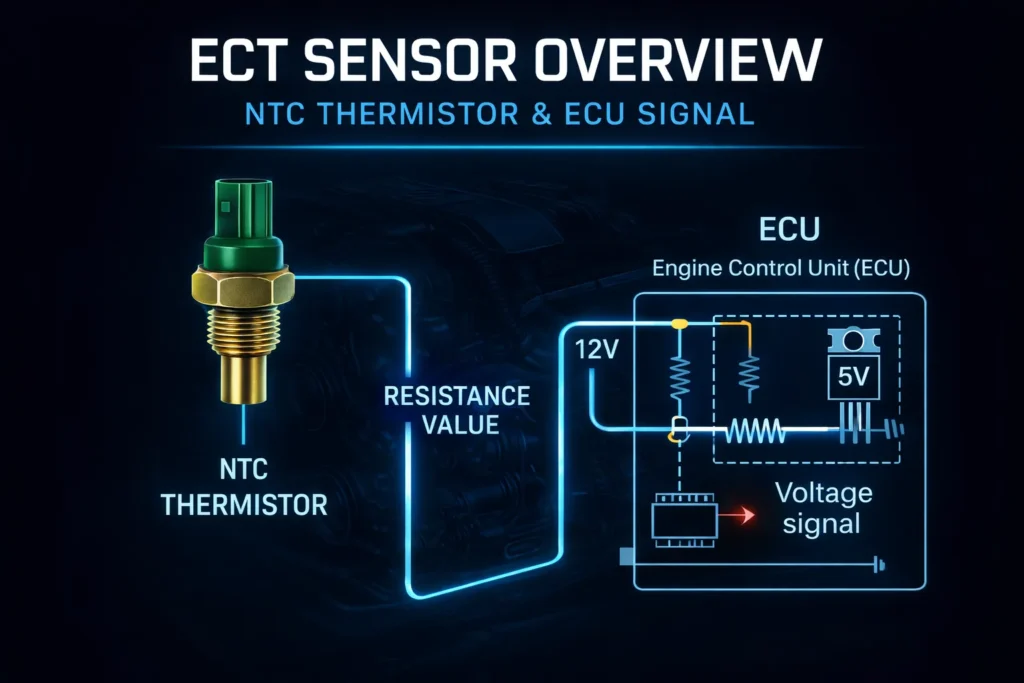
How an ECT Sensor Works (Technical Overview)
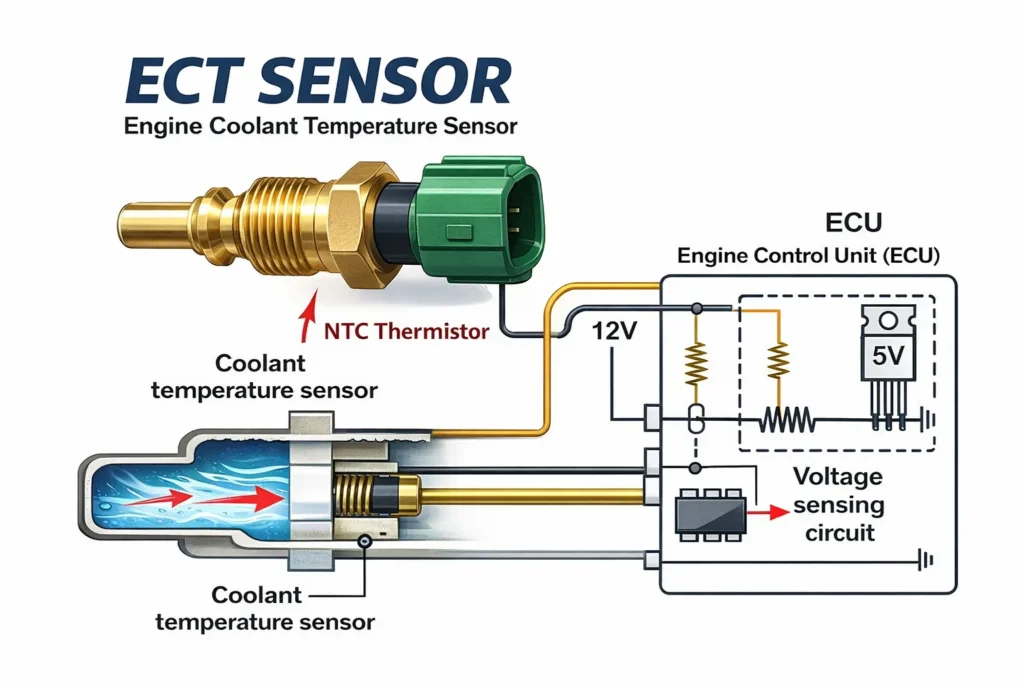
NTC Thermistor Principle
Most ECT sensors are based on NTC (Negative Temperature Coefficient) thermistors.
- As coolant temperature rises → thermistor resistance decreases
- As coolant temperature drops → resistance increases
The ECU applies a reference voltage and calculates temperature based on the resulting resistance.
This simple but robust analog signal method is why NTC-based ECT sensors dominate automotive applications.
Typical Resistance–Temperature Behavior
| Coolant Temperature | Approx. Resistance |
|---|---|
| -40°C | 40–50 kΩ |
| 0°C | 5–6 kΩ |
| 25°C | 2–3 kΩ |
| 80°C | 300–400 Ω |
| 120°C | <150 Ω |
This resistance curve must precisely match the ECU calibration.
Why the ECT Sensor Is Critical to Engine Control
From both a system and component perspective, ECT sensor data influences:
- Fuel injection during cold start
- Air–fuel ratio control
- Ignition timing
- Cooling fan activation
- Emissions compliance
An inaccurate ECT sensor signal can cause rich mixtures, overheating, or drivability issues—highlighting why sensor quality and selection matter.
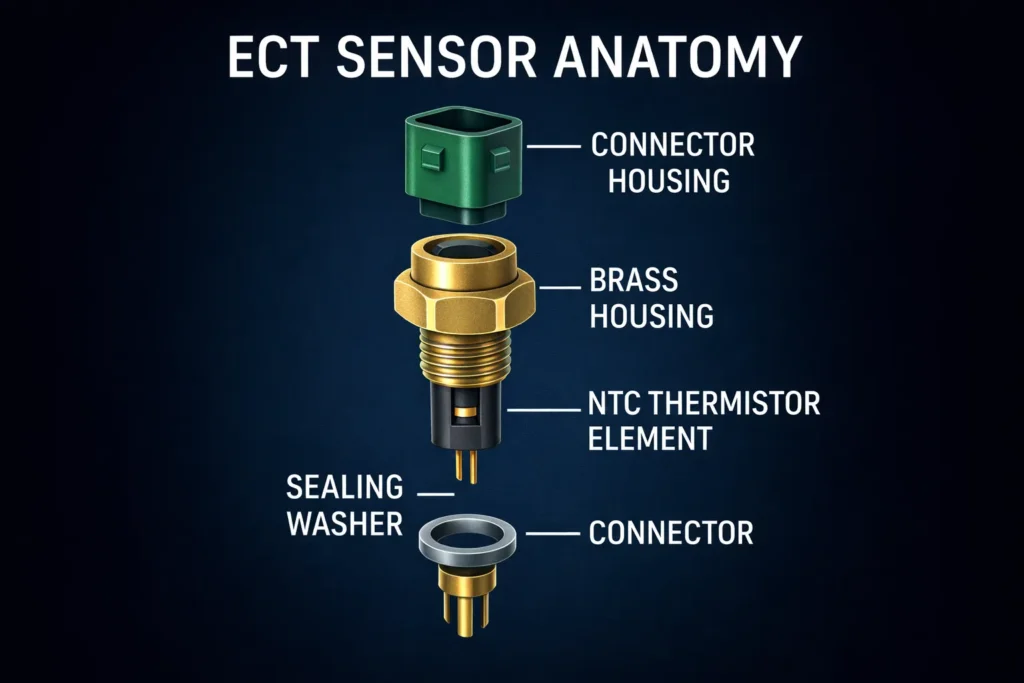
From Vehicle Part to Electronic Component
While often viewed as a “vehicle part,” an ECT sensor is fundamentally an electronic sensing component, consisting of:
- NTC thermistor element
- Metal housing (brass or stainless steel)
- Automotive-grade connector
- Sealing structure (O-ring or washer)
Understanding this structure is key when evaluating sensor performance and reliability.
Key Parameters When Selecting an ECT Sensor
1. Resistance–Temperature Curve (Most Important)
The R–T curve defines how resistance changes with temperature.
- Must match ECU software expectations
- Incorrect curve → incorrect fuel and fan control
📌 This is more critical than nominal resistance alone.
2. Nominal Resistance Value
Common automotive values:
- 2.2kΩ @ 25°C
- 2.7kΩ @ 25°C
- 10kΩ @ 25°C
Nominal resistance determines signal sensitivity in specific temperature ranges.
3. Accuracy and ToleranceRecommended automotive-grade targets:
- Resistance tolerance: ±1% to ±3%
- Temperature accuracy: ±1°C to ±2°C
Higher accuracy improves cold-start performance and emissions stability.
Mechanical & Environmental Selection Factors
Housing and Thread Design
| Feature | Typical Options |
|---|---|
| Housing material | Brass / Stainless steel |
| Thread size | M12 / M14 / M16 |
| Sealing | O-ring / Copper washer |
The housing must provide:
- Fast thermal transfer
- Coolant corrosion resistance
- Long-term mechanical stability
Connector & Protection Level
- 2-pin sealed automotive connectors are standard
- Required ingress protection: IP67 or higher
- Vibration resistance is mandatory for engine mounting
Automotive Reliability Requirements
An ECT sensor must withstand:
- Thermal cycling from -40°C to >125°C
- Continuous coolant exposure
- High vibration and engine shock
- Long service life (vehicle lifetime design)
These requirements distinguish automotive ECT sensors from generic temperature sensors.
ECT Sensor vs Generic Temperature Sensor
| Aspect | ECT Sensor | Generic Temp Sensor |
|---|---|---|
| Thermistor curve | ECU-specific | Generic |
| Packaging | Threaded metal housing | Probe / PCB |
| Sealing | Coolant-proof | Limited |
| Vibration rating | Automotive-grade | Industrial-grade |
| Application | Engine management | General sensing |
Common Selection Mistakes
- Focusing only on nominal resistance
- Ignoring ECU curve compatibility
- Using non-automotive thermistors
- Underestimating coolant chemical effects
- Choosing inadequate sealing solutions
ECT Typical Applications
ECT sensors are widely used in:
- Passenger and commercial vehicles
- Construction and agricultural machinery
- Generator and industrial engines
- Hybrid and auxiliary cooling systems
FAQ About ECT Sensor
Is an ECT sensor just an NTC thermistor?
No. It is a complete sensing assembly built around an NTC thermistor.
Can I replace an ECT sensor with a standard temperature sensor?
Not recommended. ECU calibration and durability requirements differ significantly.
What is the most critical selection parameter?
The resistance–temperature curve matched to the ECU.
Are custom ECT sensors available?
Yes. Many manufacturers support custom curves, housings, and connectors.
Conclusion
The ECT sensor sits at the intersection of engine system control and electronic component design. Understanding both how it works and how it is selected allows engineers, product designers, and sourcing teams to make better decisions.
By focusing on thermistor behavior, mechanical design, and automotive-grade reliability, the right ECT sensor ensures long-term engine performance and compliance.
Looking for automotive-grade ECT sensors or NTC thermistors with ECU-matched curves?
Explore our temperature sensing solutions designed for demanding engine environments.