
Proximity sensors are widely used in industrial automation, robotics, packaging lines, automotive systems, and consumer electronics because they can detect objects without physical contact. That makes them faster, cleaner, and more reliable than mechanical switches in many environments.
But how do proximity sensors actually work?
A proximity sensor works by emitting a sensing field or signal and detecting changes when an object enters that area. Depending on the sensor type, it may use an electromagnetic field, capacitance change, light beam, or sound wave to identify the presence of an object and trigger an output signal.
In this guide, we’ll explain the working principle of proximity sensors, compare the main sensor types, and show where each one is used in real industrial applications.
What Is a Proximity Sensor?
A proximity sensor is an electronic sensor designed to detect the presence, absence, or movement of an object without touching it. Instead of relying on physical contact, the sensor monitors a field, beam, or wave and responds when a target enters the sensing zone.
This non-contact detection method makes proximity sensors extremely useful in environments where traditional contact switches would wear out, get damaged, or become unreliable.
Why They Are Popular
They reduce mechanical wear, improve reliability, and enable high-speed automation without direct contact with the target object.
Where They Are Used
Proximity sensors are common in conveyors, CNC machines, robotics, packaging equipment, automotive assembly, and smart devices.
Basic Working Principle of a Proximity Sensor
Although different types of proximity sensors use different technologies, the basic detection logic is similar.
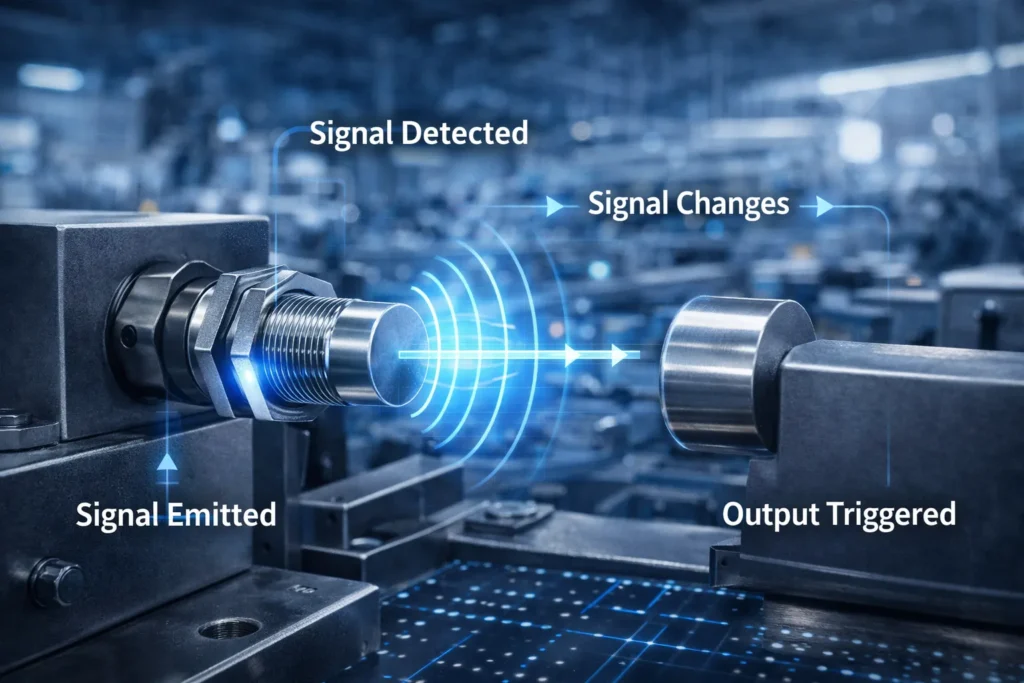
| Step | What Happens |
|---|---|
| 1 | The sensor emits a field, light, or sound signal. |
| 2 | An object enters the sensing area. |
| 3 | The returning signal or field condition changes. |
| 4 | The sensor detects that change and switches its output. |
In simple terms, the sensor is constantly “watching” its surroundings. When something enters the detection zone, the sensor notices the difference and sends an electrical signal to a controller, PLC, microcontroller, or machine interface.
A proximity sensor installed near a conveyor can detect when a metal part arrives at a certain position and then send a signal to stop, count, sort, or trigger another machine action.
How Inductive Proximity Sensors Work
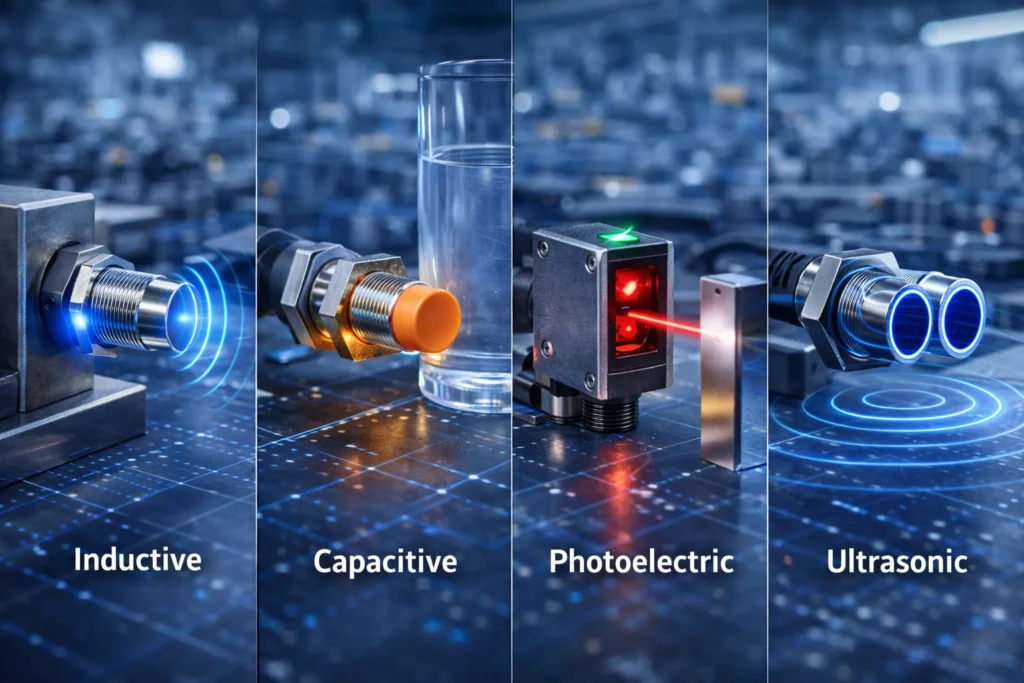
Inductive proximity sensors are the most common type used in industrial automation. They are designed primarily to detect metal objects.
An inductive sensor contains an oscillator circuit that creates an electromagnetic field at the sensing face. When a metal object enters that field, eddy currents are generated in the target. These currents reduce the strength of the oscillator, and the sensor detects that change.
Inductive Sensor Working Process
| Stage | Action |
|---|---|
| Field Generation | The sensor generates an electromagnetic field. |
| Target Entry | A metal object enters the sensing range. |
| Energy Loss | Eddy currents form in the metal target. |
| Signal Detection | The sensor detects reduced oscillation and switches output. |
Because this technology depends on interaction with conductive materials, inductive sensors are ideal for detecting:
- Steel parts
- Machine components
- Metal tools
- Gears and rotating elements
- Automotive body parts
Main Advantage
Inductive sensors are rugged, fast, and highly reliable in oily, dusty, and wet industrial environments.
Main Limitation
They typically detect only metallic objects and usually operate at short range.
How Capacitive Proximity Sensors Work
Capacitive proximity sensors work differently. Instead of using electromagnetic induction, they detect changes in capacitance caused by the presence of an object near the sensing surface.
The sensor and the target form part of a capacitive system. When an object approaches, the dielectric constant in the sensing area changes. The sensor measures that change and triggers an output when the threshold is reached.
Why Capacitive Sensors Are Useful
Unlike inductive sensors, capacitive sensors can detect both metal and non-metal materials, including:
- Plastic
- Glass
- Wood
- Powder
- Liquid
- Granular materials
Capacitive sensors are often used for liquid level detection through non-metal tank walls, as well as for detecting plastic packaging and bulk materials.
Main Advantage
They can detect many material types that inductive sensors cannot detect.
Main Limitation
They can be more sensitive to environmental conditions such as humidity, buildup, or material variation.
How Photoelectric Sensors Work
Photoelectric sensors detect objects using light, usually infrared or visible light. A transmitter emits a beam, and a receiver monitors how that beam changes when an object passes through or reflects it.
Because light can travel much farther than a localized electromagnetic field, photoelectric sensors usually offer much longer sensing distances than inductive or capacitive sensors.
Main Types of Photoelectric Detection
| Type | How It Works | Best For |
|---|---|---|
| Through-Beam | Separate transmitter and receiver; object blocks beam. | Long range and reliable detection |
| Retro-Reflective | Sensor sends beam to reflector; object interrupts return. | Medium-range detection |
| Diffuse Reflective | Beam reflects directly off target back to sensor. | Compact detection setups |
Photoelectric sensors are common in:
- Conveyor systems
- Package counting
- Bottle detection
- Object positioning
- Logistics and warehousing
Main Advantage
They can detect many different materials over much longer distances than standard proximity sensors.
Main Limitation
Dust, dirt, and reflective surface conditions can affect performance if not properly selected or maintained.
How Ultrasonic Sensors Work
Ultrasonic sensors work by emitting high-frequency sound waves and measuring the time it takes for the echo to return after bouncing off an object.
This is known as the time-of-flight principle. Because the speed of sound is known, the sensor can calculate the distance to the object.
Ultrasonic Sensor Working Sequence
| Step | Action |
|---|---|
| 1 | The sensor emits an ultrasonic pulse. |
| 2 | The sound wave travels to the target object. |
| 3 | The wave reflects back to the sensor. |
| 4 | The sensor calculates distance based on return time. |
Ultrasonic sensors are useful for:
- Distance measurement
- Tank level monitoring
- Robotics navigation
- Object detection in dark environments
- Detecting transparent or irregular objects
Ultrasonic sensors are often a strong choice when you need distance measurement or when optical systems may struggle with transparency, color, or lighting conditions.
Proximity Sensor Types Comparison Table
| Sensor Type | Detection Principle | Detects | Best For |
|---|---|---|---|
| Inductive | Electromagnetic field | Metal only | Industrial metal detection |
| Capacitive | Capacitance change | Metal and non-metal | Liquids, plastic, powder |
| Photoelectric | Light beam | Almost all materials | Long-range object detection |
| Ultrasonic | Sound wave echo | Distance and many material types | Measurement and flexible sensing |
Common Industrial Applications of Proximity Sensors
Proximity sensors are used across a wide range of industries because they improve automation speed, repeatability, and safety.
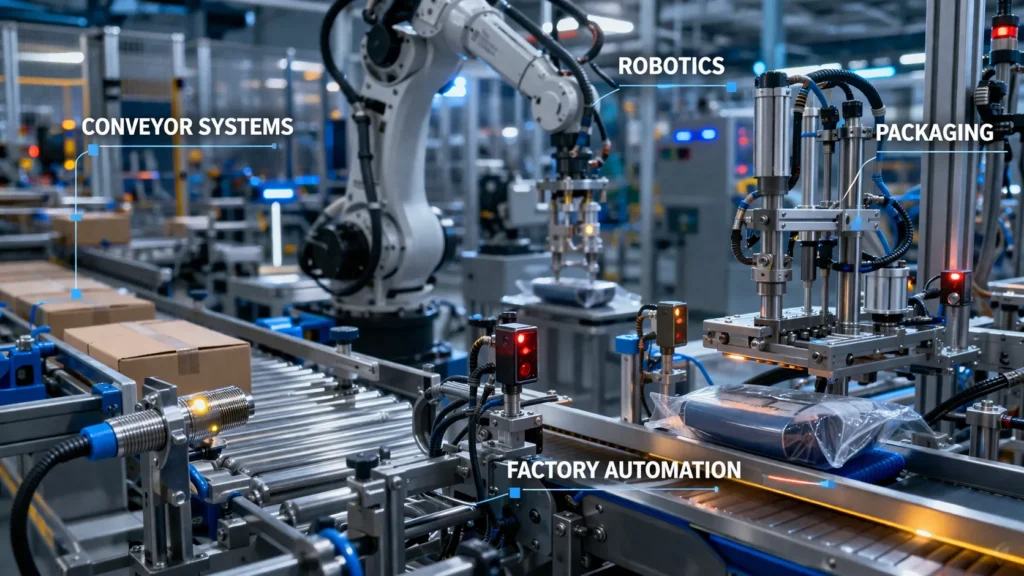
Conveyor Systems
Detect products, count objects, confirm position, and trigger sorting or stop/start actions.
Packaging Machinery
Verify carton position, bottle presence, cap alignment, or filling stage progression.
Robotics
Support part detection, position feedback, obstacle sensing, and automated pick-and-place processes.
Automotive Manufacturing
Detect metal body parts, confirm assembly positions, and support welding and transfer lines.
Liquid Level Detection
Capacitive and ultrasonic sensors are often used for tank monitoring and fill-level control.
Smart Equipment
Used in vending machines, consumer devices, access systems, and smart automation equipment.
Advantages of Proximity Sensors
There are several reasons why proximity sensors are preferred over mechanical switches in many applications.
- Non-contact detection: No physical wear on the sensor or the target.
- Fast response: Suitable for high-speed industrial automation.
- Reliable operation: Consistent performance in repetitive tasks.
- Low maintenance: Fewer moving parts means less wear and fewer failures.
- Flexible use: Different technologies support different target materials and distances.
For many machine builders, proximity sensors offer a better balance of speed, durability, and control integration than contact-based switching methods.
Limitations of Proximity Sensors
No sensor technology is perfect. The right selection depends on understanding the limits of each type.
| Limitation | What It Means |
|---|---|
| Short Range | Inductive and capacitive sensors usually operate over short distances. |
| Material Restrictions | Inductive sensors mainly detect metals, not plastic or glass. |
| Environmental Sensitivity | Some sensor types are affected by dust, moisture, or buildup. |
| Surface Influence | Reflectivity, size, and material properties can affect performance. |
| Cost Variation | High-end industrial and smart sensors can be significantly more expensive. |
How to Choose the Right Proximity Sensor Working Principle
Choosing the right sensor starts with the target material, distance, environment, and control requirements.
| If You Need To Detect… | Recommended Sensor Type | Why |
|---|---|---|
| Metal parts only | Inductive | Fast, rugged, cost-effective |
| Plastic, liquid, or powder | Capacitive | Detects non-metal materials |
| Objects at longer distance | Photoelectric | Light-based long-range detection |
| Distance or level measurement | Ultrasonic | Measures echo return time |
For industrial buyers, selection should also consider:
- Mounting space
- Required output type
- Operating voltage
- IP rating
- Response speed
- Brand reliability
- Availability for long-term supply
Related Reading
Best Proximity Sensors in 2026
Explore top sensor recommendations for industrial, DIY, and OEM use.
Browse Sensor Categories
Find more industrial sensing products for automation and electronic design.
Frequently Asked Questions
Do proximity sensors touch the object they detect?
No. Proximity sensors are designed for non-contact detection. They sense the presence of an object through a field, beam, or wave without physically touching it.
Can proximity sensors detect plastic?
Some can. Inductive sensors usually detect metal only, while capacitive, photoelectric, and ultrasonic sensors can detect plastic and other non-metal materials depending on the application.
What is the difference between inductive and capacitive proximity sensors?
Inductive sensors detect metal using electromagnetic fields, while capacitive sensors detect both metal and non-metal objects by measuring changes in capacitance.
Are proximity sensors accurate?
Yes. Proximity sensors can be very accurate when properly selected and installed. The actual accuracy depends on the sensor type, sensing distance, target material, and environment.
Need Help Choosing the Right Sensor?
MOZ Electronics supports engineers, OEM buyers, and industrial sourcing teams with proximity sensor selection, quotation support, and alternative part recommendations.