
In today’s interconnected world, Wireless Sensor Networks (WSNs) play a foundational role in enabling real-time monitoring, intelligent automation, and data-driven decision-making. From environmental sensing and industrial control to healthcare and smart cities, WSNs form the invisible infrastructure that powers the Internet of Things (IoT) and Industry 4.0.
This article explores the fundamentals of WSNs, including their architecture, topologies, classifications, benefits, challenges, and emerging trends that are shaping the future of wireless communication systems.
What Is a Wireless Sensor Network (WSN)?
A Wireless Sensor Network (WSN) is a distributed network consisting of spatially scattered sensor nodes that communicate wirelessly to collect, monitor, and transmit data about environmental or physical conditions—such as temperature, pressure, vibration, motion, humidity, or light—to a central base station or cloud platform.
Unlike traditional wired networks, WSNs operate without physical infrastructure, using low-power radio communication to transmit data. This makes them highly adaptable, scalable, and cost-effective for both small and large-scale monitoring applications.
How Wireless Sensor Networks Work
Each WSN is made up of four core components:
- Sensor Nodes – Small electronic units equipped with sensors, a microcontroller, memory, a transceiver, and a power source.
- Routers – Relay devices that forward data between nodes and gateways, ensuring robust and efficient network communication.
- Gateways – Central nodes that collect data from sensors, perform initial processing, and transmit it to servers or cloud systems using protocols like TCP/IP.
- Evaluation Software – Cloud or desktop software that analyzes and visualizes sensor data for actionable insights.
Step-by-Step Process
- Sensing: Each node collects raw data from its surroundings using onboard sensors.
- Processing: Data is digitized and filtered to remove noise or redundancy.
- Transmission: Processed data is transmitted wirelessly to a router or gateway using protocols like ZigBee, Bluetooth, or Wi-Fi.
- Aggregation: The gateway aggregates data and forwards it to cloud servers or enterprise systems for storage and analysis.
- Visualization and Action: Analytics dashboards, AI systems, or human operators interpret the data and trigger responses—such as alerts, maintenance tasks, or automated control actions.
WSN Architecture Layers
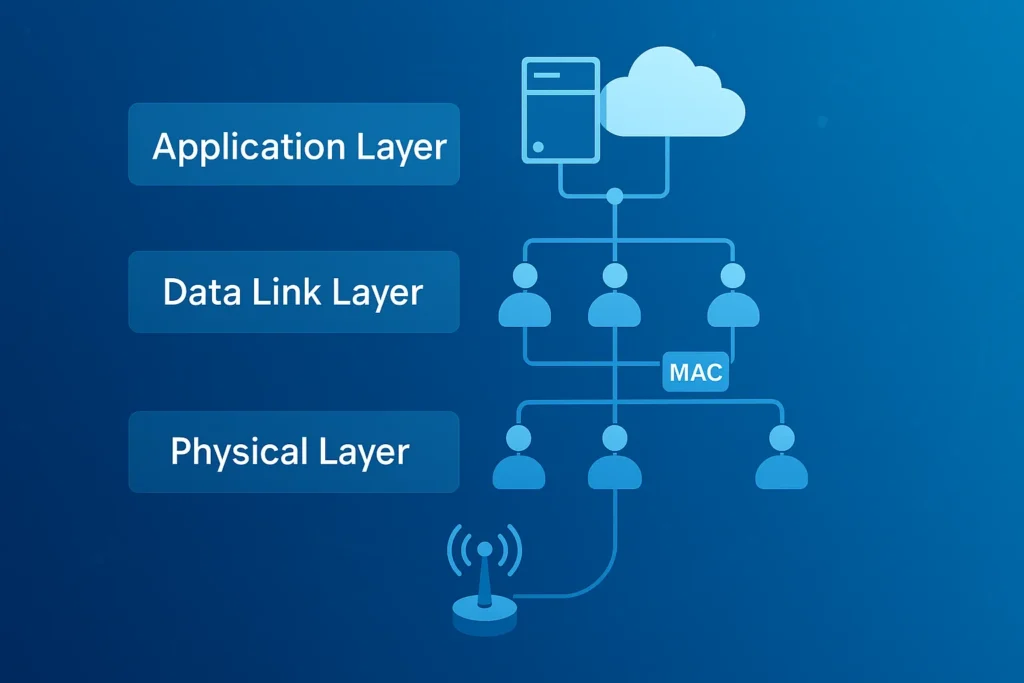
A Wireless Sensor Network (WSN) operates through several layers that together manage communication, coordination, and data processing between sensor nodes and base stations. While architectures can vary depending on application and network type, a typical WSN design features three primary layers: the Physical Layer, the Data Link Layer, and the Application Layer. Each plays a distinct role in ensuring efficient, reliable, and low-power wireless communication.
Physical Layer
The Physical Layer (PHY) governs the actual transmission and reception of raw bit streams over a wireless medium. It defines how radio waves, infrared, or other signals are modulated, transmitted, and received between sensor nodes.
Key Components and Functions:
- Frequency Bands & Power: Common operating bands include 2.4 GHz (globally unlicensed but interference-prone), Sub-GHz (433/868/915 MHz for longer range and better penetration), and licensed bands for industrial applications. Transmission power directly influences coverage distance and energy consumption.
- Modulation & Coding: Typical schemes include O-QPSK (used in IEEE 802.15.4 at 2.4 GHz), FSK/GFSK (common in Sub-GHz networks), CSS (used in LoRa), and OFDM (for Wi-Fi). Forward Error Correction (FEC) and interleaving improve reliability but increase latency and power draw.
- Channel Characteristics: Wireless channels experience multipath fading, interference, and shadowing. Adaptive frequency agility (AFA) and channel hopping can mitigate interference and improve link stability.
- Timing & Synchronization: Low-duty-cycle nodes require precise wake/sleep synchronization. Clock drift correction and synchronization beacons help maintain timing accuracy.
- Link Quality Metrics: Parameters such as RSSI (Received Signal Strength Indicator), LQI (Link Quality Indicator), SNR (Signal-to-Noise Ratio), and PRR (Packet Reception Rate) are monitored to optimize routing and power control.
- Energy Efficiency: Transmission is the most energy-intensive operation, followed by reception. Sleep states, wake-on-radio techniques, and duty cycling reduce power consumption.
Design Insights:
- Antenna placement, RF layout, and impedance matching significantly affect signal quality and link budget.
- For long-range, ultra-low-power networks, Sub-GHz or spread-spectrum (LoRa) PHYs are preferred.
- For high-throughput or interoperability, 2.4 GHz IEEE 802.15.4, BLE, or Wi-Fi PHYs are more practical.
Data Link Layer
The Data Link Layer, often referred to as the MAC (Medium Access Control) layer, provides reliable node-to-node communication. It organizes how sensor nodes share the wireless medium, ensures frame integrity, and manages retransmissions, collisions, and energy-efficient scheduling.
Core Functions:
- Framing and Addressing: Manages frame formats, node identifiers (short or extended), and control headers for data, acknowledgment (ACK), and control frames.
- Error Control: Implements mechanisms like Automatic Repeat Request (ARQ) and adaptive retransmission to handle packet loss or bit errors.
- Medium Access Control (MAC):
- CSMA/CA (Carrier Sense Multiple Access with Collision Avoidance): Common in IEEE 802.15.4; simple and asynchronous but less efficient under heavy load.
- TDMA / Scheduled MAC (e.g., TSCH – Time-Slotted Channel Hopping): Ensures deterministic latency and minimizes collisions through synchronized time slots; ideal for industrial control.
- ALOHA / Slotted ALOHA: Used in LoRaWAN; simple but lower channel efficiency.
- Channel Hopping: Frequency diversity through hopping reduces interference and multipath fading.
- Low Power Operation:
- Duty Cycling: Nodes periodically wake to listen and transmit (e.g., ContikiMAC).
- Beacon Scheduling: Synchronization beacons coordinate network sleep/wake cycles.
- Neighbor Management: Maintains neighbor tables and blacklists to reduce idle listening.
- Security: IEEE 802.15.4 includes AES-128 encryption (CCM* mode), frame counters, and anti-replay protection.
Interaction with Upper Layers:
- Reports link quality metrics (RSSI, LQI, PRR) to the network/routing layer.
- Provides service differentiation and QoS queues for priority data flows.
- Supports slot allocation tables for time-sensitive applications.
Design Insights:
- For wide-area star topologies, LoRaWAN Class A MACs provide minimal power consumption with long-range coverage.
- For industrial or process control requiring predictability and low jitter, use TSCH/TDMA-based MACs.
- For event-driven or bursty data, CSMA/CA is simpler and energy-efficient.
Application Layer
The Application Layer defines the data semantics, formats, and service models used by the WSN. It manages how sensor information is packaged, transmitted, and interpreted by external systems like gateways, servers, or cloud platforms.
Key Protocols and Frameworks:
- Lightweight Messaging Protocols:
- CoAP (Constrained Application Protocol): RESTful, UDP-based protocol supporting resource discovery and publish/observe patterns.
- MQTT-SN: Lightweight publish/subscribe protocol over UDP, suitable for sleeping nodes.
- MQTT (over TCP): Used in higher-power nodes (e.g., Wi-Fi-based sensors) for IoT integration.
- Data Serialization and Modeling:
- CBOR (Concise Binary Object Representation) – Efficient binary encoding for constrained devices.
- SenML (Sensor Markup Language) – Defines standardized metadata for sensor measurements.
- Protocol Buffers – Used in gateways and backend systems for compact structured data.
- Device Management and Service Discovery:
- LwM2M (Lightweight M2M): Manages bootstrapping, firmware updates (OTA), and resource trees.
- mDNS/DNS-SD: Supports service discovery in IP-based WSNs.
- OPC UA PubSub: Used in industrial WSNs for integration with SCADA and MES systems.
- Security and Privacy:
- OSCORE (Object Security for CoAP) – Provides end-to-end encryption and authentication.
- DTLS or TLS – Transport-level protection for CoAP/MQTT sessions.
- OAuth2 / JWT tokens – For identity and access management in cloud-integrated deployments.
Application Layer Design Principles:
- Ensure idempotent APIs to support intermittent connectivity.
- Use semantic data formats with clear units, timestamps, and versioning.
- Employ differential or threshold-based reporting to reduce redundant data transmission.
- Support remote reconfiguration and over-the-air updates (OTA) for long-term maintenance.
Types of Wireless Sensor Networks
Wireless Sensor Networks (WSNs) come in many forms, each designed for specific environments, communication constraints, and operational goals. The deployment setting directly influences network architecture, energy design, and data transmission strategies. From dense forest ecosystems to deep underwater environments, each WSN type must overcome unique challenges to achieve reliable monitoring and communication.
Below are the five main categories of Wireless Sensor Networks, along with their defining characteristics, applications, and engineering considerations.
Terrestrial WSNs
Terrestrial WSNs are the most common and versatile form of wireless sensor networks. They are deployed on land, either in an unstructured (randomly scattered) or structured (planned grid) arrangement. Each node collects environmental data and transmits it wirelessly to a base station for processing and storage.
In terrestrial systems, nodes may communicate directly with a base station (single-hop) or through intermediate relay nodes (multi-hop). Depending on the deployment area, network topologies like star, tree, or mesh are used to optimize communication and energy efficiency. Since most nodes rely on limited battery power, energy conservation techniques—such as sleep scheduling, data aggregation, and low-power routing—are crucial. Many modern terrestrial networks integrate solar panels to extend operational life and reduce maintenance.
Applications:
- Environmental monitoring: Detecting forest fires, measuring air quality, and tracking soil humidity.
- Smart agriculture: Optimizing irrigation, fertilization, and crop health monitoring.
- Industrial automation: Supervising manufacturing plants, warehouses, and logistics systems.
- Infrastructure monitoring: Observing bridges, tunnels, and highways for structural health.
A terrestrial WSN might monitor temperature and humidity across a vineyard, automatically adjusting irrigation schedules based on real-time soil moisture readings, leading to optimal water usage and healthier crops.
Underground WSNs
Underground WSNs are engineered for subsurface monitoring in challenging environments such as soil, mines, tunnels, and pipelines. They are specifically designed to gather information from below the ground’s surface, where direct human access is limited.
Sensor nodes are buried underground and connect wirelessly to sink nodes or relay stations positioned above the surface. These sink nodes then transmit data to a base station or cloud platform. Due to the high attenuation and signal loss in soil, underground WSNs often use low-frequency electromagnetic or acoustic communication, which trades bandwidth for penetration depth. Power efficiency and robust packaging are key, as replacing or recharging underground nodes is difficult and costly.
Challenges:
- Signal attenuation: Soil composition, water content, and density drastically affect radio wave propagation.
- Power constraints: Nodes require long-lasting batteries or specialized energy-harvesting systems.
- Deployment cost: Installing and maintaining buried nodes involves significant logistical complexity.
Applications:
- Soil condition monitoring: Measuring moisture, nutrients, and salinity for precision farming.
- Seismic and geotechnical observation: Detecting earth movements, sinkholes, and tremors.
- Pipeline integrity management: Monitoring leaks, corrosion, and pressure fluctuations in oil, gas, or water pipelines.
- Mining safety: Tracking gas levels and structural stability in underground mines.
An underground WSN deployed along a gas pipeline can detect leaks in real time by monitoring pressure and temperature anomalies, enabling early intervention before catastrophic failure occurs.
Underwater WSNs
Underwater WSNs (UWSNs) are specialized networks designed for aquatic environments, such as oceans, lakes, reservoirs, and rivers. They use acoustic communication rather than radio waves, as water significantly weakens electromagnetic signals.
Architecture and Operation:
Sensor nodes are either anchored to the seabed or suspended in water columns using buoys and tethers. These nodes communicate with each other and with Autonomous Underwater Vehicles (AUVs) or surface buoys, which act as gateways for data collection and relay. The data is eventually transmitted to onshore stations via satellite or radio frequency links.
Due to the unique underwater environment, nodes must withstand high pressure, salinity, and corrosion while maintaining efficient acoustic signaling.
Challenges:
- Propagation delay: Sound travels much slower in water than radio waves in air, leading to high latency.
- Limited bandwidth: Acoustic channels provide low data rates, making multimedia or high-volume transmission difficult.
- Node mobility: Ocean currents can cause nodes to drift, complicating routing and synchronization.
- Energy limitations: Underwater nodes often rely on non-rechargeable batteries due to inaccessibility.
Applications:
- Marine habitat monitoring: Tracking fish populations, coral health, and biodiversity.
- Pollution and water quality control: Measuring pH levels, temperature, and contamination in real time.
- Underwater infrastructure: Inspecting offshore oil rigs, pipelines, and underwater cables.
- Disaster prevention: Detecting tsunamis, landslides, and underwater earthquakes.
A network of underwater sensors could monitor chemical leaks near an offshore drilling platform, automatically alerting operators to changes in water composition or pressure anomalies.
Multimedia WSNs
Multimedia WSNs (MWSNs) extend traditional WSN capabilities by integrating visual and audio sensors—such as cameras, microphones, and video recorders—to capture rich contextual information. These networks are built for applications where images, sound, and video streams are as critical as numerical sensor readings.
Multimedia sensor nodes are equipped with imaging components and often feature high-performance processors for on-board compression and data filtering. They typically rely on high-bandwidth protocols (e.g., Wi-Fi, LTE, or Zigbee-based multimedia extensions) to handle large data volumes. To manage power consumption, nodes use selective data capture, event-triggered recording, and in-network compression algorithms.
Applications:
- Video surveillance: Monitoring industrial facilities, public spaces, and borders.
- Traffic control: Observing congestion patterns and detecting accidents.
- Habitat observation: Capturing animal movement and behavior for ecological research.
- Industrial inspection: Real-time visual monitoring of production lines and machinery.
A multimedia WSN can be installed at highway intersections to capture live video feeds and automatically detect traffic congestion or accidents, improving emergency response and traffic management.
Mobile WSNs
Mobile WSNs (MWSNs) consist of sensor nodes capable of autonomous movement or attachment to moving entities such as vehicles, robots, or animals. Unlike stationary WSNs, these networks can adapt dynamically to changing topologies and environmental conditions.
Each mobile node can sense, process, and transmit data while in motion, forming ad hoc connections as it interacts with other nodes. Mobility enhances network coverage, connectivity, and resilience but introduces complexity in maintaining stable communication paths. Mobile nodes typically use adaptive routing protocols that adjust in real time to changing link conditions.
Applications:
- Search and rescue operations: Deployable networks that help locate survivors after natural disasters.
- Mobile robotics: Coordinated robot swarms for exploration, mapping, and surveillance.
- Wildlife tracking: Sensors attached to animals collect behavioral and environmental data.
- Environmental mapping: Autonomous drones collecting air quality or temperature data over wide areas.
In a disaster relief scenario, drones equipped with sensor nodes can form a temporary mobile WSN, scanning debris zones for signs of life or hazardous gas leaks and relaying data to rescue teams in real time.
Summary of Wireless Sensor Network Types
Each type of Wireless Sensor Network—terrestrial, underground, underwater, multimedia, and mobile—caters to unique operational environments and technical constraints.
- Terrestrial WSNs prioritize energy efficiency and scalability.
- Underground WSNs focus on robustness and communication through dense media.
- Underwater WSNs overcome latency and pressure constraints using acoustic technologies.
- Multimedia WSNs handle high-data-rate sensing with advanced compression and routing.
- Mobile WSNs deliver dynamic coverage and adaptability for mission-critical and real-time applications.
Together, these specialized networks form the foundation of modern sensing ecosystems, enabling smarter, safer, and more connected environments across industries and scientific domains.
The Relationship Between Wireless Sensor Networks and Electronic Components
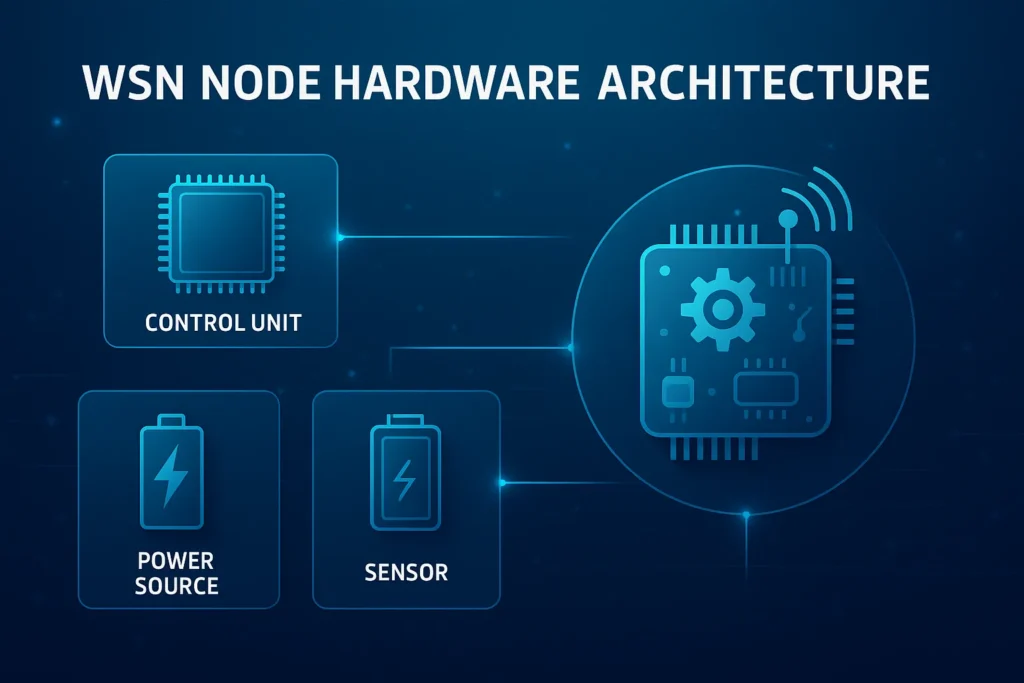
Wireless Sensor Networks (WSNs) are not just communication systems — they are complex electronic ecosystems built upon thousands of miniature hardware nodes. At their core, every WSN is powered by electronic components, which provide the sensing, processing, communication, and energy management capabilities that make wireless data collection possible.
In simple terms, electronic components form the physical foundation of WSNs, determining their intelligence, efficiency, reliability, and overall performance.
Electronic Components as the Building Blocks of Sensor Nodes
Each sensor node in a WSN is essentially a miniature embedded electronic system, comprising multiple functional modules — and each module is constructed from fundamental electronic components.
| Module | Function | Typical Electronic Components |
|---|---|---|
| Sensing Unit | Detects physical or environmental parameters (temperature, pressure, light, gas, vibration, etc.) | Sensors (temperature, pressure, humidity, accelerometers, etc.), signal conditioners, operational amplifiers, filters, resistors, capacitors |
| Processing Unit | Processes sensor data and controls the node | Microcontroller (MCU), CPU, memory ICs (Flash, SRAM, EEPROM), clock oscillators, logic ICs |
| Communication Unit | Handles wireless data transmission and reception | RF transceivers, antennas, power amplifiers (PA), low-noise amplifiers (LNA), impedance matching circuits, inductors, capacitors |
| Power Unit | Supplies power to all components | Batteries, DC/DC converters, voltage regulators, MOSFETs, TVS diodes, solar cells, supercapacitors |
| Optional Units | Add extra features such as positioning or actuation | GPS modules, encryption chips, motor drivers, relays, accelerators, actuator circuits |
In essence, software defines the logic of a WSN, but hardware components define its physical life — from energy efficiency to data accuracy.
Electronic Components Directly Influence WSN Performance
The quality and type of components used in a WSN have a direct impact on the network’s performance, durability, and scalability.
Key system parameters — such as energy efficiency, range, and data reliability — are all determined by the underlying electronics.
| Performance Metric | Influencing Components | Impact |
|---|---|---|
| Power Efficiency | Low-power MCUs, efficient RF chips, energy-saving DC/DC converters | Extends battery life and reduces maintenance cycles |
| Size and Integration | SoCs (System-on-Chip), MEMS sensors, surface-mount passive components | Enables compact, lightweight nodes suitable for large-scale deployments |
| Stability and Reliability | Industrial-grade capacitors, wide-temperature ICs, protective diodes | Ensures operation in harsh environments (e.g., underground, underwater) |
| Communication Range | RF front-end design, power amplifiers, antennas | Determines signal strength, distance, and data throughput |
| Cost and Scalability | Component selection and integration level | Affects mass production feasibility and overall deployment cost |
In short, the choice of components defines whether a WSN can operate for years autonomously or fail within months.
WSN Development Drives Innovation in Electronic Components
While electronic components make WSNs possible, the growing demand for smarter, smaller, and longer-lasting networks has also driven innovation in the electronics industry.
- Ultra-Low-Power Microcontrollers (MCUs) — such as TI MSP430, STMicroelectronics STM32L, and NXP Kinetis series — now operate at microamp-level sleep currents.
- Advanced RF Transceivers — ZigBee, LoRa, BLE, and Sub-GHz chips — provide long-range, energy-efficient communication.
- Energy Harvesting and Power Management ICs — enable autonomous sensor operation from ambient light, vibration, or RF energy.
- MEMS Sensors — micro-electromechanical devices that integrate multiple sensing functions in one compact chip.
- Security Chips and Cryptographic Modules — safeguard WSN communication through lightweight encryption and authentication.
These innovations are a direct response to WSN requirements for miniaturization, longevity, and sustainability — showing the tight feedback loop between the two fields.
WSNs as Embedded Electronic Systems
From an engineering perspective, every WSN node functions as a self-contained embedded system, consisting of multiple electronic subsystems that work together:
- Sensing Layer: Converts physical signals into electrical ones.
- Processing Layer: Digitizes, filters, and processes the sensor data.
- Communication Layer: Transmits information wirelessly across the network.
- Power Layer: Regulates and distributes energy efficiently to all modules.
When hundreds or thousands of these nodes interconnect via wireless protocols, they form a self-organizing, intelligent network capable of large-scale environmental monitoring, industrial automation, and smart infrastructure management.
Without the underlying electronic hardware, such autonomy and scalability would be impossible.
Summary: Electronic Components as the Physical Core of WSNs
| Perspective | Role of Electronic Components in WSNs |
|---|---|
| Hardware Foundation | Provide the sensing, computing, communication, and power backbone. |
| Performance Determinants | Influence energy efficiency, range, reliability, and longevity. |
| Innovation Drivers | Encourage advances in low-power electronics, MEMS, and energy harvesting. |
| Application Enablers | Make large-scale deployment feasible in agriculture, healthcare, industry, and smart cities. |
In essence:
Without electronic components, Wireless Sensor Networks cannot exist.
They are the neurons, muscles, and energy sources of every sensor node — transforming raw physical phenomena into digital intelligence.
Applications of Wireless Sensor Networks (WSNs)
Wireless Sensor Networks (WSNs) have evolved into one of the most transformative technologies of modern engineering. By enabling continuous, real-time monitoring and intelligent decision-making, they bridge the physical and digital worlds — allowing organizations to observe, analyze, and react to environmental and operational changes faster than ever before.
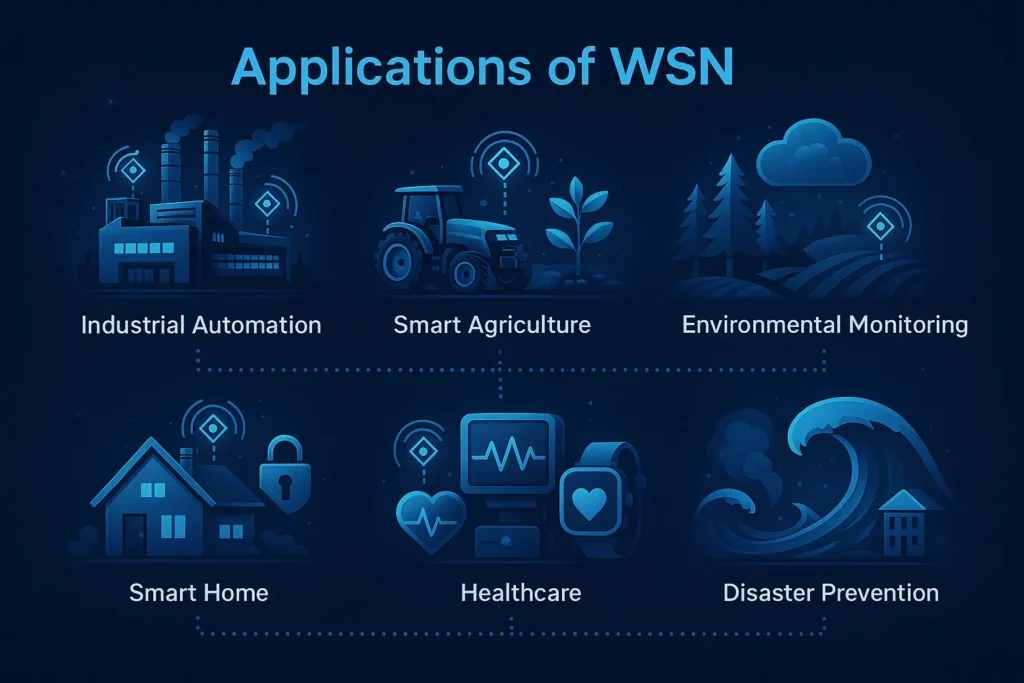
WSNs are deployed across numerous industries, including environmental management, healthcare, agriculture, manufacturing, oil and gas, transportation, and smart cities. Their flexibility, scalability, and ability to operate autonomously make them essential for both research and commercial applications.
Below is an in-depth overview of the key applications of Wireless Sensor Networks and how they are reshaping different domains.
Environmental Monitoring and Conservation
One of the earliest and most impactful uses of WSNs is in environmental monitoring. Sensor nodes scattered across a natural environment continuously collect data on temperature, humidity, air quality, and chemical pollutants. The data helps detect environmental changes, prevent natural disasters, and support ecological preservation.
- Forest Fire Detection: Sensors monitor CO₂ levels, temperature, and smoke particles. A sudden spike in these readings can trigger an early fire alert to local authorities.
- Flood Monitoring: Riverbank nodes track water levels and flow rates, predicting floods and enabling timely evacuations.
- Air and Water Quality Monitoring: WSNs measure pollutants like NO₂, CO, and particulate matter in cities or chemical contaminants in rivers and lakes.
- Wildlife and Habitat Tracking: Sensor collars or embedded ground nodes record animal movements, migration patterns, and habitat conditions.
- Climate and Weather Observation: Remote stations measure long-term trends in atmospheric data, aiding in climate modeling and prediction.
In smart forests, thousands of distributed nodes transmit temperature and smoke data to a central hub. When fire risks increase, the system automatically sends early alerts to firefighting units, saving ecosystems and lives.
Healthcare and Medical Applications
In healthcare, WSNs have revolutionized patient monitoring, asset management, and smart hospital systems. Wireless medical sensor networks (WMSNs) allow continuous, non-invasive monitoring of vital signs and health conditions, improving patient safety and reducing manual intervention.
- Patient Monitoring: Wearable biosensors track heart rate, blood pressure, body temperature, and oxygen levels. Data is transmitted wirelessly to hospital servers or mobile apps for real-time supervision.
- Remote and Telemedicine: Patients in rural or isolated regions can be monitored remotely through sensor nodes connected to cloud platforms, enabling doctors to intervene early.
- Elderly Care and Fall Detection: Smart sensors detect abnormal movements or falls and send instant alerts to caregivers.
- Asset Tracking: Hospitals use WSNs to locate critical equipment such as ventilators, infusion pumps, and wheelchairs in real time.
- Cold Chain Monitoring for Pharmaceuticals: Sensors track the temperature and humidity of medical supplies, vaccines, and blood samples during transport.
A wireless medical sensor system deployed in a cardiac ward continuously tracks patients’ ECG and oxygen levels. If irregularities are detected, the system alerts medical staff instantly, ensuring faster emergency response and reducing the risk of complications.
Agriculture and Smart Farming
Agriculture is one of the most promising fields for WSN deployment, driving the growth of smart farming and precision agriculture. By monitoring soil, crop, and weather conditions, WSNs help farmers make data-driven decisions to optimize yield and reduce resource waste.
- Soil Monitoring: Sensors measure soil moisture, salinity, and nutrient levels, allowing for precise irrigation and fertilization.
- Microclimate Observation: Weather nodes collect real-time data on temperature, humidity, and rainfall to forecast local climatic trends.
- Pest and Disease Detection: Early detection sensors track pest activity and alert farmers to take preventive action.
- Livestock Tracking: RFID and GPS-enabled tags track animal health, movement, and feeding behavior.
- Smart Irrigation Systems: Automated irrigation is triggered when soil moisture falls below a threshold, conserving water.
A vineyard equipped with soil moisture and sunlight sensors automatically regulates irrigation and shade systems, reducing water usage by 30% while maintaining optimal grape quality for winemaking.
Industrial Automation and Manufacturing
In manufacturing, WSNs are central to the Industrial Internet of Things (IIoT). They enable predictive maintenance, process optimization, and safety management by providing continuous insight into machine and environmental conditions.
- Predictive Maintenance: Sensors on motors and bearings measure vibration, temperature, and sound to detect wear before failure occurs.
- Process Control: WSNs monitor critical parameters like pressure, flow rate, and chemical concentration to maintain product quality.
- Asset Tracking and Inventory Management: Wireless tags help locate tools, materials, and goods in large facilities.
- Safety and Compliance: Gas sensors detect hazardous leaks, while temperature sensors prevent overheating in critical systems.
- Energy Optimization: Monitoring energy consumption at the machine level helps reduce waste and improve operational efficiency.
In a chemical plant, vibration and temperature sensors detect early signs of motor bearing failure. Maintenance teams receive an automated alert through a dashboard, allowing proactive servicing and preventing costly downtime.
Oil, Gas, and Energy Sector
The energy sector relies on WSNs to manage remote and hazardous environments such as offshore rigs, pipelines, and refineries. These networks enhance safety, reduce maintenance costs, and improve operational visibility in real time.
- Pipeline Monitoring: Sensors track flow rate, pressure, and leaks over long distances, alerting operators to anomalies.
- Structural Integrity: Vibration and stress sensors monitor the condition of drilling rigs, tanks, and storage facilities.
- Environmental Compliance: Gas and pollutant sensors ensure emission levels meet safety regulations.
- Offshore Operations: WSNs collect data from subsea sensors and transmit it to control centers via satellite.
- Smart Grid Monitoring: Sensors monitor load variations and faults in electrical distribution networks.
A WSN deployed along a remote oil pipeline continuously monitors pressure differentials. When a sudden drop occurs, the system pinpoints the leak location and alerts maintenance crews instantly, preventing environmental damage.
Smart Cities and Urban Infrastructure
Smart cities use WSNs to enhance sustainability, safety, and efficiency in urban living. Integrated sensor systems collect and analyze massive volumes of data to optimize infrastructure, reduce energy use, and improve residents’ quality of life.
- Traffic Management: Roadside sensors monitor vehicle flow, congestion, and accidents, helping to dynamically adjust traffic lights.
- Smart Lighting: Streetlights equipped with motion and light sensors automatically dim or brighten based on pedestrian activity and daylight levels.
- Waste Management: Bin sensors detect fill levels, optimizing collection routes and reducing costs.
- Environmental Monitoring: Urban nodes track pollution, noise, and temperature to inform public health policies.
- Structural Health: WSNs monitor bridges, buildings, and tunnels for vibrations and cracks, preventing catastrophic failures.
In Barcelona, a citywide WSN manages traffic, waste collection, and air quality. The result is a 25% reduction in traffic congestion and significant improvements in public resource management.
Transportation and Logistics
WSNs bring real-time visibility and automation to logistics, transport networks, and supply chains. From cargo tracking to vehicle diagnostics, they ensure safety, efficiency, and traceability.
- Fleet Management: Vehicles equipped with sensors transmit data on fuel usage, tire pressure, and location.
- Cargo Monitoring: Temperature and vibration sensors maintain optimal conditions for perishable goods.
- Railway and Highway Monitoring: Sensors detect rail fractures, bridge strain, and road wear to ensure infrastructure safety.
- Aviation and Maritime Tracking: WSNs track aircraft components or cargo ships for maintenance and route optimization.
A logistics company installs wireless temperature sensors in refrigerated trucks. These sensors continuously monitor perishable goods, ensuring they remain within required storage temperatures throughout transportation.
Disaster Management and Emergency Response
WSNs are invaluable tools in natural disaster detection, rescue operations, and post-event recovery. Their ability to operate autonomously in unstable or dangerous environments makes them ideal for real-time hazard detection.
- Earthquake and Landslide Detection: Seismic and vibration sensors monitor fault lines and detect early warning signs.
- Flood Prediction: Water-level sensors installed in dams and rivers provide real-time flood risk assessments.
- Fire and Gas Leak Detection: Networks deployed in industrial or residential areas detect hazardous gas concentrations or temperature anomalies.
- Rescue Operations: Mobile WSNs mounted on drones help search for survivors by detecting motion, sound, or heat signatures.
In earthquake-prone regions of Japan, seismic WSNs transmit vibration data within seconds of detecting ground movement, allowing early warning systems to trigger automatic train and factory shutdowns, saving countless lives.
Military and Defense Applications
Defense forces use WSNs for surveillance, battlefield monitoring, target tracking, and border security. Their distributed nature and stealth make them ideal for missions requiring persistent situational awareness.
- Border Surveillance: Motion and acoustic sensors detect unauthorized movement in restricted areas.
- Battlefield Intelligence: Networks monitor troop movements, weapon firing, and environmental hazards.
- Asset Tracking: Sensors track the location and status of vehicles, ammunition, and supplies.
- Structural and Equipment Health Monitoring: Ensures reliability of aircraft, ships, and vehicles.
A WSN deployed along a national border uses seismic and infrared sensors to detect human or vehicle movement, transmitting alerts to a central command center in real time for rapid response.
Structural Health and Civil Engineering
In civil engineering, WSNs play a crucial role in monitoring structural integrity and ensuring safety in large-scale infrastructure such as bridges, tunnels, dams, and skyscrapers.
- Vibration and Stress Analysis: Sensors embedded in structures detect mechanical stress, cracks, or deformation.
- Corrosion Detection: Monitors steel reinforcement in concrete structures for early signs of decay.
- Dynamic Load Monitoring: Measures loads on bridges or railways to predict maintenance needs.
- Construction Site Safety: Detects unsafe vibration levels or equipment malfunctions during construction.
A WSN installed in a suspension bridge continuously monitors tension in cables and joint stress. When abnormal vibrations are detected, an alert is sent to engineers, preventing potential structural failure.
Home and Building Automation
WSNs are fundamental to modern smart homes and intelligent buildings, enhancing comfort, security, and energy efficiency through real-time sensing and automated control.
- Climate Control: Temperature and humidity sensors regulate HVAC systems for energy savings.
- Lighting Automation: Motion sensors trigger lights based on occupancy.
- Security and Access Control: Door, window, and camera sensors detect intrusions or unauthorized access.
- Energy Management: Smart meters monitor and optimize household energy consumption.
- Fire and Gas Safety: Smoke and gas sensors provide early detection and automated alarms.
A smart office building uses WSNs to automatically adjust lighting, air conditioning, and blinds based on occupancy patterns, reducing energy costs by up to 40%.
Summary of Wireless Sensor Networks Applications
The applications of Wireless Sensor Networks span virtually every aspect of modern life — from environmental conservation and precision agriculture to smart healthcare, industrial automation, and urban development.
Their ability to collect, transmit, and analyze real-time data enables smarter decisions, greater efficiency, and safer environments.
As technology evolves — integrating AI, edge computing, and 5G connectivity — WSNs will become even more autonomous, adaptive, and indispensable to the intelligent systems driving our connected future.
The Future of Wireless Sensor Networks
As digital transformation accelerates, Wireless Sensor Networks (WSNs) are evolving beyond simple data collection systems into intelligent, autonomous, and self-optimizing ecosystems. The next generation of WSNs will merge artificial intelligence, edge computing, energy harvesting, blockchain, quantum cryptography, and next-generation wireless communication (5G and 6G) to deliver smarter, faster, and more secure connectivity.
This convergence will redefine how sensors interact, analyze data, and make decisions — enabling truly cognitive and sustainable sensor infrastructures capable of serving billions of connected devices worldwide.

Artificial Intelligence and Machine Learning
The integration of Artificial Intelligence (AI) and Machine Learning (ML) will fundamentally transform how WSNs operate. Traditionally, sensor networks relied on fixed routing and static protocols. In contrast, AI-powered WSNs can learn from patterns in their environment, adapt to changing conditions, and optimize themselves over time.
Through predictive analytics, WSNs will anticipate communication failures, balance energy consumption across nodes, and even detect anomalies such as sensor faults or security breaches.
Machine learning algorithms running on lightweight processors or edge devices will enable:
- Intelligent Routing: Choosing optimal communication paths based on network congestion, energy levels, and signal quality.
- Self-Healing Networks: Automatically rerouting data when nodes fail or connections weaken.
- Predictive Energy Management: Forecasting energy usage to extend network lifetime.
- Context-Aware Sensing: Adjusting sampling rates and data collection frequency depending on real-time environmental changes.
In a smart agriculture deployment, AI algorithms analyze soil moisture, temperature, and weather patterns to predict irrigation needs days in advance, preventing water waste and improving crop yield.
Edge Computing and Real-Time Analytics
Edge computing brings data processing closer to where it’s generated — the sensor nodes themselves or local gateways — instead of sending all data to distant cloud servers. This architecture significantly reduces latency, conserves bandwidth, and enables faster decision-making.
By processing data locally, edge-enabled WSNs can detect and respond to critical events in milliseconds. For example, in an industrial safety application, a vibration sensor can detect abnormal machine motion and instantly trigger a shutdown before damage occurs — without waiting for cloud confirmation.
- Ultra-Low Latency: Immediate responses to time-sensitive events.
- Bandwidth Efficiency: Only processed or aggregated data is sent to the cloud, reducing network load.
- Offline Operation: Continued functionality even in environments with limited internet access.
- Enhanced Privacy: Sensitive data can be filtered locally before transmission.
In autonomous vehicle networks, WSNs at the edge analyze road conditions, vehicle speed, and environmental factors locally to support real-time safety decisions, avoiding the delay of cloud communication.
Energy Harvesting and Self-Powered Sensors
Energy efficiency remains one of the greatest challenges in WSN design. The future points toward self-sustaining sensor nodes powered by energy harvesting technologies that draw power from the surrounding environment.
Instead of relying solely on replaceable batteries, sensors will collect energy from:
- Solar Radiation: Using miniature photovoltaic cells in outdoor deployments.
- Vibrations or Motion: Capturing kinetic energy from industrial machines, bridges, or vehicles.
- Radio Frequency (RF) Signals: Harvesting ambient electromagnetic waves emitted by communication devices.
- Thermal Gradients: Exploiting temperature differences in industrial environments or geothermal regions.
By combining these techniques, sensors can operate autonomously for up to 15–20 years, drastically reducing maintenance costs and enabling deployment in inaccessible or hazardous areas like offshore oil platforms or volcanic monitoring zones.
In structural health monitoring, bridge-mounted sensors powered by vibration energy can continuously track stress and fatigue levels without ever needing a battery replacement.
Blockchain Integration and Data Integrity
As WSNs become increasingly interconnected with the Internet of Things (IoT) and cloud ecosystems, data security, traceability, and trust are becoming critical. Blockchain technology offers a powerful solution by creating a decentralized and tamper-proof ledger for sensor data transactions.
Each sensor reading is stored as an encrypted, verifiable record in the blockchain. Once written, it cannot be altered or deleted, ensuring data integrity and transparency across the entire network. This decentralized structure eliminates single points of failure and builds trust among multiple stakeholders, such as manufacturers, regulators, and service providers.
Benefits of blockchain-enhanced WSNs include:
- Immutable Data Records: Preventing data manipulation or falsification.
- Decentralized Validation: Ensuring network trust without central authority.
- Secure Device Authentication: Preventing spoofing or unauthorized node access.
- Automated Smart Contracts: Enabling autonomous actions when sensor conditions are met (e.g., triggering maintenance alerts).
In the food supply chain, blockchain-integrated WSNs monitor temperature and humidity from farm to supermarket. If the temperature of a refrigerated truck exceeds safe limits, the blockchain automatically records the event and triggers an alert, guaranteeing transparency and accountability.
Quantum Cryptography and Physics-Based Security
The rise of quantum computing presents both a challenge and an opportunity for WSN security. While quantum computers could one day break traditional encryption algorithms, they also enable a revolutionary form of protection: quantum cryptography.
Quantum Key Distribution (QKD) uses quantum physics principles — such as the behavior of photons — to exchange encryption keys securely. Any attempt to intercept or measure these quantum keys instantly alters their state, revealing the presence of an intruder. This makes communication virtually unhackable and ensures absolute data confidentiality.
Implications for WSNs:
- End-to-End Quantum Security: Protects data from eavesdropping even across public networks.
- Tamper Detection: Immediate identification of interception attempts.
- Decentralized Key Management: Eliminates reliance on central servers for encryption control.
- Future-Proof Encryption: Safeguards WSNs against quantum-level cyberattacks.
In critical infrastructure like power grids or military surveillance systems, quantum-secured WSNs could guarantee the confidentiality of sensor data even under state-level cyber threats.
5G and 6G Connectivity: The Backbone of Hyperconnected WSNs
Next-generation wireless technologies — 5G and 6G — will serve as the communication backbone for future WSNs. Designed for massive machine-type communication (mMTC), these networks can support billions of low-power devices transmitting data simultaneously with ultra-low latency and near-perfect reliability.
5G Advantages for WSNs:
- High Data Throughput: Supports video, image, and complex sensor data.
- Sub-Millisecond Latency: Enables real-time control in industrial automation and telemedicine.
- Network Slicing: Allocates dedicated virtual networks for specific WSN applications (e.g., emergency response, smart grid).
- Enhanced Mobility: Seamless handover support for mobile WSNs such as drones or autonomous vehicles.
6G Vision:
Expected to emerge by the early 2030s, 6G will combine AI-driven network management with terahertz (THz) communication and quantum-level security. It will deliver extreme bandwidth, ultra-fast speeds, and integrated sensing capabilities that merge communication and environmental detection into one cohesive system.
In a smart city powered by 6G, WSNs embedded in infrastructure, transportation, and healthcare systems will communicate in real time, allowing the city to dynamically manage traffic, reduce energy waste, and respond instantly to emergencies.
Conclusion
Wireless Sensor Networks are transforming how humans interact with the physical world. By providing real-time insights, predictive analytics, and automated responses, WSNs enhance productivity, safety, and sustainability across industries.
While challenges like energy limitations and cybersecurity persist, technological advances in AI, edge computing, and green energy are paving the way for self-powered, intelligent, and secure WSN ecosystems.
As the backbone of the IoT revolution, Wireless Sensor Networks will continue to expand, connecting everything from smart cities to deep-sea sensors, and enabling a more efficient, data-driven future.