What is a Microcontroller
A microcontroller (often shortened to MCU) is a compact, self-contained computer on a single chip, designed to perform specific tasks in electronic devices. Unlike the powerful processors in laptops or smartphones, microcontrollers are purpose-built to run a single program repeatedly, making them ideal for automation and control in everyday technology. You’ve likely interacted with dozens of MCUs today without realizing it—inside your microwave oven, car dashboard, washing machine, game controller, or even your smartwatch. These tiny chips act as the “brains” behind countless modern devices, quietly monitoring inputs, making decisions, and triggering outputs.
In this complete guide, we’ll walk you through everything you need to know about microcontrollers—from how they work, their core components, and different types, to their applications across industries and tips for choosing the right MCU for your project. Whether you’re a student, hobbyist, or engineer, this guide will help you understand MCUs from the ground up.
Microcontroller Basics: What’s Inside an MCU
At its core, a microcontroller (MCU) is a compact computing embedded system designed to control electronic devices. Unlike a general-purpose processor, an MCU integrates processing, memory, and peripheral interfaces into a single chip, making it highly efficient for embedded applications. To understand how microcontrollers work, let’s break down their key building blocks.
CPU / Core
The central processing unit is the “brain” of the MCU. It comes in different bit-widths—commonly 8-bit, 16-bit, or 32-bit—depending on performance requirements. Popular core architectures include ARM Cortex-M (widely used in STM32 and NXP devices), AVR (found in many Arduino boards), PIC (Microchip’s long-standing family), and the open-source RISC-V, which is quickly gaining traction. The bit-width dictates how much data the CPU can process in a single instruction, directly affecting speed and memory handling.
Memory
A microcontroller integrates several memory types on-chip. Flash memory stores the program code and is non-volatile, so it retains data after power is removed. SRAM serves as temporary storage for variables and data while the program runs. Some MCUs also feature EEPROM or FRAM for data that must persist between power cycles, such as configuration settings or calibration values. The balance of these memory types determines the MCU’s flexibility for different tasks.
I/O and Peripherals
One of the most important advantages of MCUs is their wide range of built-in peripherals. General-purpose input/output (GPIO) pins let the MCU interact with sensors, LEDs, and switches. Analog-to-digital converters (ADC) and digital-to-analog converters (DAC) enable measurement and signal generation. Timers control delays, frequency generation, and event counting. Communication interfaces like UART, I²C, SPI, and CAN allow data exchange with other devices, while PWM channels drive motors, LEDs, and power circuits. Higher-end MCUs may also include USB connectivity, real-time clocks (RTC), or even Ethernet.
Clocking, Power, and Reset
To keep the system synchronized, MCUs rely on internal or external oscillators. Phase-locked loops (PLLs) can multiply clock frequencies for higher performance. Power management circuits support low-power modes, essential for battery-driven devices. Safety features like brown-out detection ensure reliable operation when supply voltage dips, while watchdog timers reset the system if the program becomes unresponsive. Together, these features help guarantee stability and robustness in real-world conditions.
In short, every MCU is a self-contained system, combining processing, memory, and control interfaces on a single integrated circuit. This integration is what makes microcontrollers the backbone of countless embedded systems, from simple appliances to advanced industrial and IoT devices.
How Microcontrollers Work (Step-by-Step)
At their core, microcontrollers execute a continuous Sense → Decide → Act loop. This closed feedback cycle is the foundation of nearly every embedded system, from thermostats and motor controllers to IoT edge devices.
-
Sense. The MCU gathers information about the external world. This may come from digital inputs (switches, GPIO), or analog signals converted by ADC modules (temperature, pressure, voltage levels). Peripherals like I²C or SPI also allow the MCU to query external sensors.
-
Decide. Once the data is available, the CPU core processes it according to the programmed logic. This may involve simple threshold checks, mathematical calculations, or more advanced algorithms such as PID control. Here the MCU leverages on-chip memory for variable storage and, if available, hardware accelerators for faster computation.
-
Act. Finally, the MCU drives outputs: toggling GPIOs, generating PWM signals for motors, sending data over UART, or updating a display. This action closes the loop and directly influences the system being controlled.
Role of Interrupts, Polling, DMA, and Timers
While the main loop can be written as a simple “while(1)” structure, efficient MCUs rarely rely on constant polling alone. Interrupts allow the processor to immediately respond to asynchronous events (e.g., a button press, a received byte on UART) without wasting cycles checking flags. Timers generate precise delays, periodic events, or PWM outputs, forming the backbone of scheduling. DMA (Direct Memory Access) further improves efficiency by moving blocks of data between peripherals and memory without CPU intervention—critical for high-speed I/O like audio sampling or network packets. The combination of interrupts, timers, and DMA enables deterministic, low-latency behavior while freeing the CPU for higher-level logic.
Example Flow
Conceptually, a microcontroller program looks like this:
With interrupts and DMA, this loop is augmented. For example, a timer interrupt might trigger sensor sampling at fixed intervals, and DMA could automatically transfer ADC results to memory. The CPU then processes only the most relevant data, minimizing wasted cycles.
If we were to sketch it as a flow diagram: Inputs → CPU (Decision Logic) → Outputs, surrounded by event-driven triggers (interrupts, DMA, timers) that keep the system reactive and efficient.
MCU Types (8-bit, 16-bit, 32-bit)
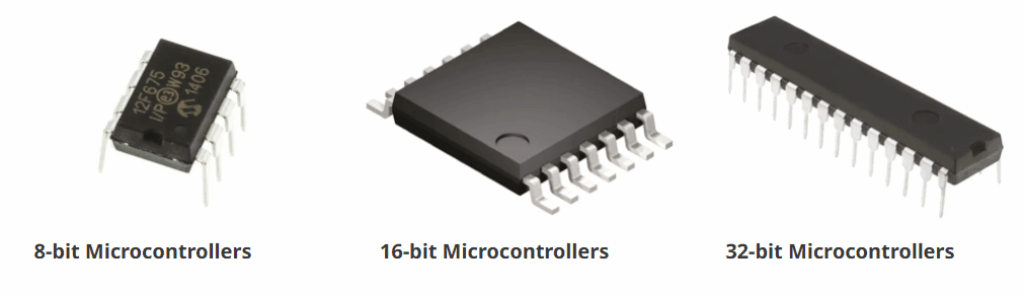
Microcontrollers come in a variety of architectures, primarily categorized by their bit-width: 8-bit, 16-bit, and 32-bit. The bit-width defines the size of the CPU registers, data buses, and the maximum memory addressable in a single instruction, directly affecting performance, precision, and computational capability.
8-bit Microcontrollers
These are the simplest and most cost-effective MCUs. The CPU processes 8 bits of data at a time, which is sufficient for many low-power, low-complexity applications like simple household appliances, toys, or LED controllers. Popular 8-bit cores include AVR and PIC16/18, widely used in education and hobbyist projects.
Popular manufacturers and models:
-
Microchip Technology: PIC16F877A, PIC18F45K22
-
Atmel (now Microchip): ATmega328P, ATtiny85
-
Silicon Labs: C8051Fxxx series
-
NXP (Freescale): S08 and S08LL series
Limitations include slower arithmetic for larger numbers and reduced memory addressing, but these MCUs excel in ultra-low-power consumption and minimal PCB footprint.
16-bit Microcontrollers
16-bit MCUs provide a compromise between performance and cost. With wider registers and data buses, they handle larger calculations and memory accesses more efficiently than 8-bit counterparts. Typical use cases include mid-range industrial automation, portable instrumentation, and simple motor control.
Popular manufacturers and models:
-
Texas Instruments: MSP430G2553, MSP430FR6989
-
Microchip Technology: PIC24FJ256GA702, dsPIC33EP256MC502
-
Renesas Electronics: RL78/G13 series
-
STMicroelectronics: STM8 series (16-bit variants)
Engineers often choose 16-bit MCUs when 8-bit performance is insufficient but a full 32-bit MCU would be overkill in terms of power and cost.
32-bit Microcontrollers
These MCUs dominate high-performance and IoT applications. Featuring 32-bit cores such as ARM Cortex-M, RISC-V, and Atmel SAM series, they offer higher clock speeds, more RAM, and advanced peripherals for complex tasks. 32-bit MCUs are ideal for robotics, sophisticated sensor processing, communication protocols, and edge computing.
Popular manufacturers and models:
-
STMicroelectronics: STM32F103, STM32F407
-
NXP Semiconductors: LPC1768, i.MX RT1050
-
Microchip Technology / Atmel: SAMD21, SAM E70
-
SiFive (RISC-V): E21, E31 Coreplex
-
Texas Instruments: Tiva C Series TM4C123GH6PM
Power consumption is higher than 8- or 16-bit MCUs, but the processing advantages make them the go-to choice for performance-intensive applications.
Choosing Between MCU Types
The selection depends on application complexity, memory requirements, power budget, and peripheral needs. Simple timers or LED controllers may thrive on 8-bit MCUs, while connected IoT devices or embedded signal processing tasks often demand 32-bit cores. 16-bit MCUs serve as a balanced middle ground, offering moderate performance with efficiency.
Understanding these distinctions is crucial for embedded system engineers to match MCU capabilities with project requirements effectively.
Microcontroller Applications
Microcontrollers have become the backbone of modern embedded systems, achieving widespread adoption across consumer, industrial, and automotive domains. Essentially, any device that integrates sensors, displays, user interfaces, or actuators is likely to include an MCU to control operations efficiently and autonomously. Their compact size, low power consumption, and integrated peripherals make them ideal for both low-cost consumer gadgets and complex industrial systems.
Common application areas include:
-
Automation and Robotics: MCUs drive servo motors, stepper motors, and robotic arms, processing feedback from encoders and sensors in real time. Applications range from hobbyist robotics kits to industrial robotic arms for assembly lines. Advanced 32-bit MCUs allow for motion planning, path optimization, and multi-axis coordination.
-
Consumer Electronics & Domestic Appliances: Microcontrollers manage everyday devices such as washing machines, microwaves, smart thermostats, coffee makers, and LED lighting systems. They handle tasks like timing, user interface controls, energy efficiency, and connectivity for smart-home integration.
-
Medical and Laboratory Equipment: Portable diagnostic tools, blood pressure monitors, glucose meters, handheld ultrasound scanners, and lab automation devices use MCUs for precision measurement, data acquisition, and display control. Low-power 8- or 16-bit MCUs are often sufficient for simple measurement tasks, while advanced monitoring systems rely on 32-bit MCUs with integrated ADCs and communication interfaces.
-
Automotive Systems: Modern vehicles contain dozens of microcontrollers managing everything from engine control units (ECUs), anti-lock braking systems (ABS), and traction control to infotainment displays, navigation software, and smart dashboards. MCUs communicate over automotive-grade buses like CAN or LIN, enabling coordination between multiple subsystems in real time.
-
Industrial and Production Controls: MCUs regulate heating, ventilation, and air-conditioning (HVAC) systems, conveyor belts, safety interlocks, and programmable logic control (PLC) systems. Their deterministic performance ensures reliable operations in manufacturing lines and process automation.
-
IoT Devices and Systems: Microcontrollers serve as the central processing element in Internet of Things devices, enabling environmental monitoring, smart metering, wearable electronics, and connected appliances. Integrated wireless communication peripherals (Wi-Fi, BLE, Zigbee) allow MCUs to send sensor data to cloud services and respond to remote commands.
In addition to these areas, microcontrollers are increasingly being used in edge computing, energy management, agricultural technology, and smart city applications, highlighting their versatility and scalability across emerging technological trends.
Microcontrollers are widely used in IoT devices, which benefit from their low power consumption and simplicity. However, FPGAs are often preferred for applications requiring intensive parallel processing and real-time capabilities. You can learn more about the key differences between these technologies in our FPGA vs Microcontroller article.
How to Choose the Right Microcontroller (Checklist)
Selecting the right microcontroller is critical to ensuring the success of an embedded system. Engineers must evaluate a combination of hardware capabilities, software support, and supply-chain factors. The following checklist highlights key considerations:
1. Peripherals and I/O
Assess the required interfaces: GPIOs, ADC/DAC, timers, PWM, UART, SPI, I²C, CAN, USB, or Ethernet. For example, a motor controller may require PWM outputs and quadrature encoder inputs, while a sensor node might prioritize ADC channels and low-power I²C/SPI interfaces.
2. Memory Requirements
Estimate program and data storage. Flash memory stores firmware, while SRAM is used for runtime variables. EEPROM or FRAM may be needed for non-volatile data logging. High-performance applications, like HMI displays, typically require larger memory footprints.
3. CPU Performance
Match the MCU’s clock speed and core architecture (8-bit, 16-bit, 32-bit) to your processing needs. Simple sensor nodes may run on low-power 8-bit MCUs, while real-time motor control or signal processing benefits from 32-bit ARM Cortex-M cores.
4. Power Consumption
For battery-operated devices, consider ultra-low-power MCUs with sleep modes and efficient wake-up routines.
5. Package and Form Factor
Choose a package compatible with your PCB layout and manufacturing capabilities, whether through-hole or surface-mount (QFN, TQFP, BGA).
6. Cost and Availability
Factor in unit cost, bulk discounts, and long-term availability. High-volume products demand MCUs with stable supply chains.
7. Development Tools and Ecosystem
IDE support, debugger interfaces, prebuilt libraries, and community resources can significantly shorten development time.
Use-Case Examples
-
Sensor Node: Low-power 8-bit MCU with ADC, I²C, and sleep modes.
-
Motor Controller: 16/32-bit MCU with PWM, timers, and fast ADCs.
-
HMI (Human-Machine Interface): 32-bit MCU with high RAM/Flash, graphics libraries, and touch display support.
Following this checklist ensures that the selected microcontroller aligns with both technical and practical project requirements, reducing risk and development overhead.
FAQs About Microcontrollers
1. What’s the difference between an MCU and an MPU?
A microcontroller (MCU) is a self-contained unit that integrates a CPU, memory (both volatile and non-volatile), and peripheral interfaces on a single chip. It is optimized for performing specific embedded tasks such as sensor reading, actuator control, or simple signal processing. In contrast, a microprocessor (MPU) provides only a CPU; it relies on external memory, I/O devices, and peripheral circuits. MPUs are generally used for general-purpose computing, capable of running complex operating systems and multitasking applications, but they require additional components and consume more power, making them less ideal for low-cost, low-power embedded designs.
2. Why do some products use multiple MCUs?
Many complex devices distribute functionality across multiple MCUs to improve reliability, reduce software complexity, and isolate critical subsystems. For example, in an automotive system, separate MCUs may manage engine control, infotainment, safety systems, and sensor fusion. Using multiple MCUs allows each processor to focus on a specific task while communicating with others via buses like CAN, SPI, or I²C. This approach ensures deterministic performance for safety-critical tasks and simplifies troubleshooting and updates.
3. Do I need an FPU (Floating-Point Unit)?
An FPU accelerates floating-point arithmetic, essential for digital signal processing, robotics, control loops, and complex mathematical computations. For basic embedded applications—such as reading sensors, toggling LEDs, or controlling timers—an FPU is generally unnecessary. Including an FPU increases both cost and power consumption, so it should be selected only when your application requires high-speed floating-point calculations.
4. Is MicroPython or CircuitPython sufficient for embedded projects?
High-level languages like MicroPython and CircuitPython are excellent for rapid prototyping, learning, and educational projects, especially on 32-bit MCUs. They simplify development and reduce code verbosity. However, performance-critical applications—such as real-time motor control, precise sensor timing, or communication stacks—still benefit from C/C++ implementations. Low-level programming provides tighter timing control, lower memory usage, and better integration with hardware peripherals.
5. Which MCU is best for learning?
For beginners, 8-bit MCUs like AVR or PIC16/18 are ideal due to their simplicity, low cost, and wide availability of tutorials. They allow learners to understand basic concepts such as GPIO, ADC, PWM, and timers. For more advanced embedded education, ARM Cortex-M MCUs—such as STM32 Nucleo, Arduino-compatible variants, or Microchip SAM series—offer 32-bit performance, integrated peripherals, and support for RTOS, making them excellent for learning complex systems and IoT applications.
6. How do I choose MCU peripherals wisely?
Select peripherals based on your application requirements. For example, ADCs are required for analog sensors, PWM outputs for motor control, and UART/SPI/I²C for communication. Overprovisioning peripherals adds unnecessary cost, increases PCB complexity, and may raise power consumption. Match the MCU’s capabilities to real needs while leaving some headroom for future updates or upgrades.
7. How important is long-term availability?
For production designs, MCU longevity is critical. Choose devices supported by manufacturers for 5–10 years to avoid supply shortages and redesigns. Long-term availability ensures stable production, predictable component sourcing, and easier maintenance of end products, especially in industrial, automotive, and medical markets.
8. Can one MCU handle multiple tasks simultaneously?
Yes, through techniques such as interrupts, timers, Direct Memory Access (DMA), and event-driven programming. While a single MCU can manage multiple I/O and processing tasks, extreme multitasking or real-time requirements may necessitate using an RTOS (Real-Time Operating System) or multiple MCUs to ensure deterministic behavior and maintain performance under concurrent operations.
Conclusion & Next Steps
Microcontrollers are the backbone of modern embedded systems, providing compact, efficient, and highly specialized control for a vast array of devices—from home appliances to industrial machinery. Understanding their architecture, types, and capabilities is essential for designing reliable and optimized embedded solutions.
As a next step, try putting theory into practice: pick a development board, program a simple “blink LED” routine, or read sensor data via the ADC to see your MCU in action. Experimenting hands-on helps solidify concepts like I/O control, timers, and interrupts.
For further learning, explore our guides on choosing the right MCU, ARM Cortex-M programming, or microcontroller-based IoT projects, and check out our curated list of recommended development boards and kits.