Understanding the difference between microcontrollers and microprocessors helps engineers, buyers, and product developers choose the right platform for performance, cost, scalability, and power efficiency.
- Microcontrollers integrate the CPU, memory, and I/O peripherals on a single chip.
- Microprocessors mainly focus on processing power and usually require external memory and support components.
- Microcontrollers are ideal for low-power, real-time, task-specific applications.
- Microprocessors are better suited for high-performance computing and multitasking environments.
- The right choice depends on system complexity, software requirements, power budget, and cost targets.
Microcontroller vs Microprocessor: Core Differences
At a high level, the biggest difference lies in integration and application focus.
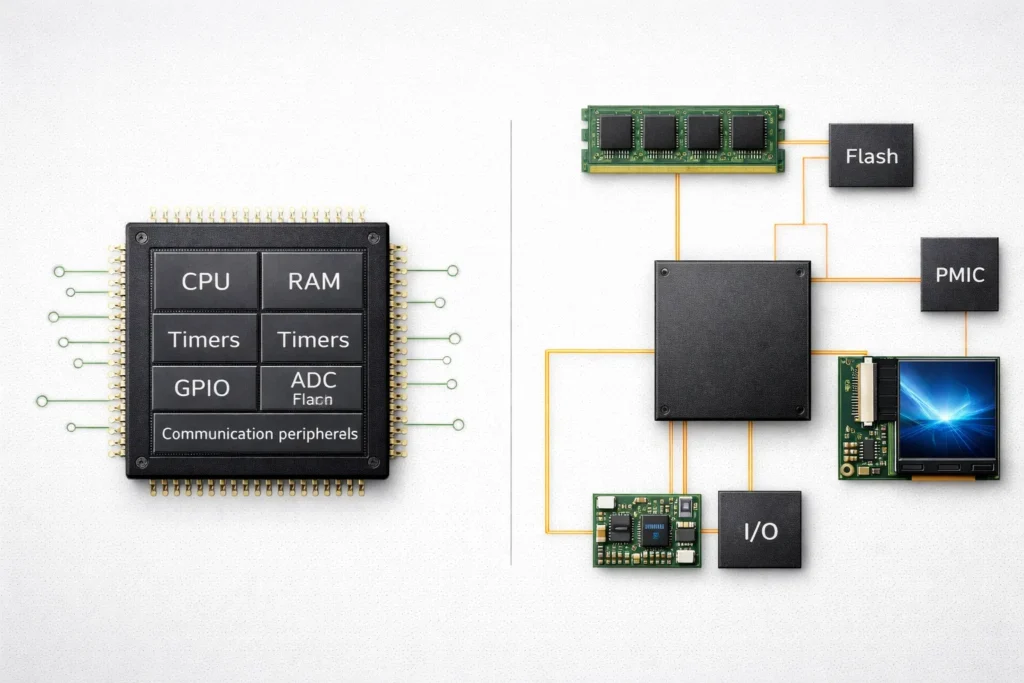
A microcontroller is a self-contained embedded computing system. It combines a processor core, memory, and peripherals such as GPIO, timers, ADCs, and communication interfaces on one chip. This makes it ideal for compact products that need efficient control and real-time responsiveness.
A microprocessor is typically CPU-centric. To build a complete working system around it, designers usually add external RAM, storage, and peripheral devices. This architecture offers greater flexibility and stronger computational performance, but it also increases system complexity.
| Feature | Microcontroller | Microprocessor |
|---|---|---|
| Integration | CPU, memory, and peripherals on one chip | CPU-focused, usually requires external components |
| Main Purpose | Dedicated control tasks | General-purpose computing |
| Architecture | Often Harvard or modified Harvard | Usually von Neumann-based |
| Performance Focus | Low power and real-time control | High-speed processing and multitasking |
| Power Consumption | Low | Higher |
| Typical Applications | IoT, appliances, automotive control, industrial devices | PCs, smartphones, HMI systems, advanced embedded platforms |
If your device mainly needs to sense, control, and react efficiently, a microcontroller is usually the better choice. If it needs to run complex software, advanced interfaces, or multitask heavily, a microprocessor is often the better fit.
Watch: Microcontroller vs Microprocessor Explained
If you want a quick visual overview before diving deeper into architecture, applications, and platform selection, this video offers a helpful introduction.
What Is a Microcontroller?
A microcontroller is a compact integrated circuit designed to perform dedicated control-oriented tasks inside an embedded system. You can think of it as a small computer built onto a single chip.
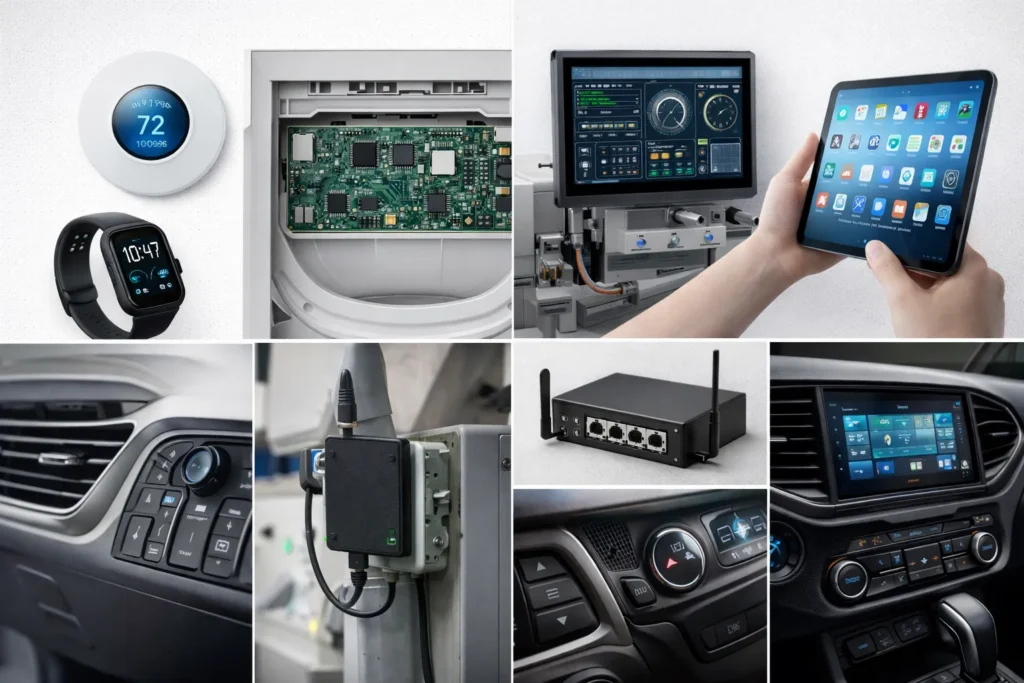
Microcontrollers are found in a wide range of products, including thermostats, wearables, smart locks, washing machines, industrial sensors, and automotive modules. Their strength lies in efficient control, compact design, and low power consumption.
Typical Microcontroller Architecture
A microcontroller usually includes the following functional blocks:
CPU Core
Executes instructions and manages control logic within the embedded system.
Flash Memory
Stores the application code and firmware permanently.
RAM
Provides temporary storage for variables, buffers, and runtime data.
Integrated Peripherals
Includes GPIO, timers, ADC, DAC, UART, SPI, and I2C for direct device interaction.
Because all of these functions are integrated into a single chip, microcontrollers simplify PCB design, reduce BOM cost, and help lower overall system power consumption.
Main Functions of a Microcontroller
| Function | Description |
|---|---|
| Data Acquisition | Reads signals from sensors and external inputs for monitoring and control. |
| Real-Time Control | Manages motors, relays, LEDs, and timing-critical outputs with precise response. |
| Communication | Exchanges data with sensors, displays, modules, or other controllers through standard protocols. |
| Power Management | Supports sleep modes and low-power operation for battery-driven products. |
| Embedded Automation | Executes dedicated and repetitive tasks reliably in compact devices. |
What Is a Microprocessor?
A microprocessor is a processor-centric integrated circuit mainly responsible for executing instructions and processing data. Unlike a microcontroller, it does not usually include all the memory and peripheral resources needed to form a complete system.
Microprocessors are commonly used in systems that need more computing performance, richer software environments, advanced connectivity, and complex user interfaces. You will see them in tablets, industrial HMIs, single-board computers, networking equipment, and infotainment systems.
Typical Microprocessor Architecture
ALU
Performs arithmetic and logical operations required by the application.
Control Unit
Directs the execution flow of instructions and coordinates system behavior.
Registers & Cache
Provide fast-access storage for frequently used instructions and data.
Processor Cores & External Interfaces
Support multitasking, high-speed data exchange, and connections to external memory and peripherals.
To form a complete product, microprocessor-based systems usually require external RAM, storage, power management ICs, and interface chips. This increases design flexibility, but also adds complexity and cost.
Main Functions of a Microprocessor
| Function | Description | Example |
|---|---|---|
| High-Speed Computation | Executes larger and more demanding workloads | Running Linux-based systems |
| Multitasking | Handles multiple threads or applications at the same time | Smart displays and connected gateways |
| Data Processing | Processes large amounts of data quickly | Industrial analytics and edge processing |
| User Interface Support | Works with graphics frameworks, displays, and input systems | HMI panels and tablets |
| Advanced Connectivity | Supports networking stacks and software-heavy communication | Routers, hubs, and smart terminals |
Architecture Comparison: On-Chip Integration vs External Components
One of the most practical ways to compare microcontrollers and microprocessors is by looking at system-level architecture.
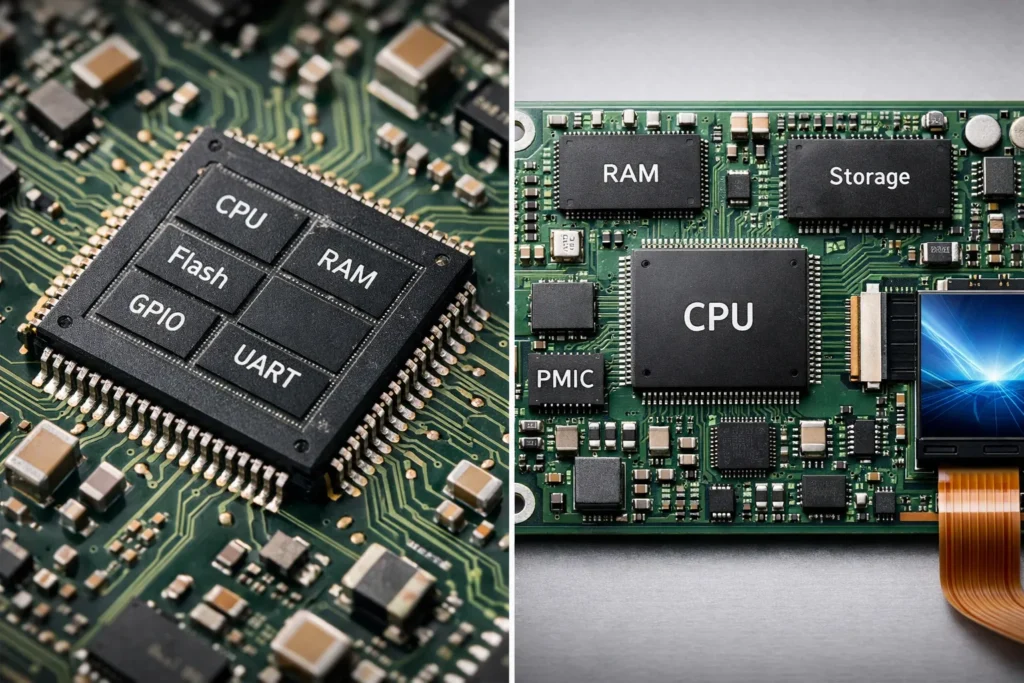
Microcontrollers integrate memory and peripherals directly on-chip, which keeps the design compact and straightforward. Microprocessors depend more heavily on external components, which creates a more scalable but more complex system architecture.
| Feature | Microcontroller | Microprocessor |
|---|---|---|
| Memory | Built-in Flash and RAM | Usually external |
| Peripherals | Integrated GPIO, timers, ADC, communication interfaces | Often limited on-chip and expanded externally |
| PCB Complexity | Lower | Higher |
| System Design | Simpler | More complex |
| Upgrade Flexibility | Limited | Greater |
If your goal is a compact, cost-efficient, control-oriented product, a microcontroller offers a major advantage. If you need a scalable computing platform with richer software support, a microprocessor provides more room to grow.
Performance, Power, and Efficiency
Performance is another major point of difference between microcontrollers and microprocessors.
Microcontrollers typically operate at lower clock speeds, but they are optimized for deterministic behavior, fast interrupt response, and low power operation. Microprocessors run at much higher speeds and support more advanced operating systems, but they also consume significantly more power.
| Metric | Microcontroller | Microprocessor |
|---|---|---|
| Clock Speed | Usually lower | Usually much higher |
| Power Consumption | Low | High |
| Real-Time Control | Strong | Less deterministic |
| Multitasking | Limited | Strong |
| Battery Suitability | Excellent | Less ideal |
| OS Support | Bare-metal or RTOS | Linux, Android, Windows, and more |
When Power Matters Most
If you are designing a battery-powered sensor, portable medical device, or remote monitoring product, a microcontroller is usually the better option because it can maintain long-term operation with minimal power draw.
When Performance Matters Most
If your application needs multimedia handling, advanced networking, rich GUI support, or multiple software layers, a microprocessor is typically necessary.
Types of Microcontrollers
Microcontrollers come in several categories depending on word size, architecture, and intended application.
| Category | Common Types |
|---|---|
| Bit Width | 8-bit, 16-bit, 32-bit, 64-bit |
| Architecture | 8051, AVR, PIC, ARM Cortex-M |
| Instruction Set | RISC, CISC |
| Memory Style | Embedded memory or external memory variants |
For many modern embedded applications, 32-bit microcontrollers have become the mainstream choice because they offer a strong balance of performance, low power consumption, and ecosystem support.
- 8-bit microcontrollers are suitable for simple control tasks such as remote controls or basic appliances.
- 16-bit microcontrollers fit mid-range control applications.
- 32-bit microcontrollers dominate IoT, industrial control, and smart consumer products.
- ARM Cortex-M devices are especially popular in new designs due to broad toolchain support and performance efficiency.
Types of Microprocessors
Microprocessors can also be grouped by performance level, instruction set, and target application.
32-bit Processors
Used in many legacy and mid-range embedded platforms.
64-bit Processors
Common in modern high-performance computing devices and advanced embedded systems.
Application-Specific Processors
Designed for graphics, DSP, AI, networking, and other specialized workloads.
Microprocessors are typically selected when software complexity, UI requirements, or computing throughput become the main priorities.
Microcontroller Applications
Microcontrollers are widely used in products that need reliable control, low power consumption, and cost-effective integration.
| Application Area | Example Uses |
|---|---|
| Consumer Electronics | Wearables, smart remotes, portable accessories |
| Home Appliances | Washing machines, microwave ovens, air conditioners |
| Automotive Electronics | Lighting control, body modules, engine-related control units |
| Industrial Automation | Sensors, control modules, motor drivers |
| Medical Devices | Portable monitors, handheld diagnostic devices, infusion systems |
| Safety Systems | Smoke detectors, gas alarms, access control devices |
Microprocessor Applications
Microprocessors are preferred in systems that need stronger computing resources, richer operating environments, or advanced display and networking capabilities.
- Smartphones and tablets
- Single-board computers
- Industrial HMI systems
- Routers and networking gateways
- Automotive infotainment platforms
- Medical imaging and data analysis systems
- Smart retail terminals and AI edge devices
Hybrid Systems: Using Both Together
In many advanced products, microcontrollers and microprocessors are used together rather than treated as competing options.
For example, in a modern vehicle, a microprocessor may handle infotainment, navigation, and connectivity, while multiple microcontrollers manage real-time control tasks such as lighting, battery management, sensors, and motor actuation.
The same hybrid approach is common in industrial systems and smart home hubs, where a central processor manages system-level intelligence while smaller controllers handle local sensing and control.
Using both device types in one system allows designers to combine high-level computing power with efficient, deterministic real-time control.
Popular Microprocessors & MCU Manufacturers and Common Models
In real-world product development, engineers do not choose between microcontrollers and microprocessors only in theory. They also compare ecosystems, software support, long-term supply, and popular device families already proven in the market. Looking at common manufacturers and well-known series can make the selection process much easier.
Popular Microcontroller Manufacturers and Series
Microcontrollers are available from many major semiconductor vendors, but a few product families appear again and again in embedded design, IoT hardware, industrial control, and consumer electronics. Some are chosen for low cost and simplicity, while others are preferred for wireless connectivity, real-time performance, or strong development ecosystems.
| Manufacturer | Popular Series / Model | Type | Typical Strength | Common Applications |
|---|---|---|---|---|
| STMicroelectronics | STM32F4 / STM32H7 | 32-bit MCU | Strong ecosystem, broad performance range, industrial popularity | Industrial control, HMI, motor control, advanced embedded devices |
| Espressif | ESP32 / ESP32-S3 | Wireless MCU | Integrated Wi-Fi + Bluetooth, strong value for IoT | Smart home, connected sensors, AIoT, wireless consumer devices |
| Microchip | ATmega4809 | 8-bit MCU | Simple development, low power, widely recognized architecture | Basic control, education, appliances, compact embedded products |
| Microchip | ATSAMD21 | 32-bit MCU | Low-power Cortex-M platform with good entry-level performance | Wearables, portable devices, low-power embedded products |
| Raspberry Pi | RP2040 | Dual-core MCU | Low cost, flexible I/O, strong maker and prototyping ecosystem | Education, prototyping, control boards, embedded data acquisition |
| NXP | LPC55S6x | 32-bit MCU | Cortex-M33 performance with security-oriented features | Industrial control, secure embedded devices, smart systems |
| NXP | i.MX RT1060 | Crossover MCU | Very high real-time performance for MCU-class applications | Industrial HMI, audio, edge control, advanced real-time systems |
| Texas Instruments | MSP430 / TM4C | 16-bit / 32-bit MCU | Low-power control and broad embedded support | Metering, portable instrumentation, industrial embedded control |
Among these options, STM32 is often one of the most common choices for general-purpose embedded development because the family scales from entry-level devices to high-performance MCUs. ST positions the STM32H7 series as a high-performance Cortex-M MCU family with substantial SRAM scalability, making it attractive for demanding real-time applications. Espressif’s ESP32-S3 is especially popular in connected products because it integrates 2.4 GHz Wi-Fi and Bluetooth 5 LE on-chip, which reduces external component count for IoT designs.
For lower-cost or easier-entry projects, ATmega4809 and RP2040 remain highly recognizable choices. Microchip describes ATmega4809 as an 8-bit AVR MCU running up to 20 MHz, while Raspberry Pi positions RP2040 as a low-cost, low-power dual-core microcontroller for embedded control, motor control, signal processing, and HMI-related tasks. These devices are especially useful when developers want fast prototyping, simple firmware stacks, or strong community support.
If your project needs built-in wireless connectivity, ESP32-series devices are often a strong starting point. If you want a broad industrial ecosystem, STM32 and NXP MCU families are often safer long-term choices. For cost-sensitive development and fast prototyping, RP2040 and AVR-based devices remain highly practical.
Popular Microprocessor Manufacturers and Series
When a project needs a full operating system, advanced UI, video capability, or stronger multitasking performance, engineers usually look at microprocessor families instead of traditional MCUs. In embedded Linux, industrial HMI, smart display, and edge gateway designs, a few application processor families show up frequently.
| Manufacturer | Popular Series / Model | Type | Typical Strength | Common Applications |
|---|---|---|---|---|
| NXP | i.MX 8M Mini | Applications Processor | Multicore performance, multimedia support, good power efficiency | Industrial HMI, smart displays, embedded Linux products |
| NXP | i.MX 8M Family | Applications Processor | Audio, voice, video, and advanced interface support | Connected panels, automation gateways, multimedia embedded systems |
| Texas Instruments | Sitara AM62x / AM625 | Applications Processor | Linux-ready platform, industrial focus, graphics capability | Industrial HMI, automation, edge gateways, smart terminals |
| STMicroelectronics | STM32MP1 Series | Microprocessor | Hybrid MPU architecture for embedded Linux and control integration | Industrial systems, HMIs, connected controllers |
| Broadcom / Raspberry Pi ecosystem | Raspberry Pi Compute Modules | Embedded Processor Platform | Strong software ecosystem and rapid development support | Edge devices, kiosks, smart displays, prototyping to low-volume products |
NXP’s i.MX line is one of the most familiar names in embedded microprocessor design. NXP describes the i.MX 8M family as based on Cortex-A53 and Cortex-M4 cores for audio, voice, and video processing, while the i.MX 8M Mini is positioned as a multicore applications processor optimized for speed and improved power efficiency. These families are commonly associated with embedded Linux products, multimedia interfaces, and industrial building automation.
Texas Instruments’ Sitara AM62x family is another widely used option in industrial and Linux-capable embedded systems. TI describes AM62x as a low-cost applications processor family built for Linux development, with Cortex-A53 processing and graphics support, making it suitable for industrial interfaces, connected terminals, and more advanced embedded control platforms.
How These Brands Fit Real Design Decisions
In practical sourcing and design work, the choice is often less about a single “best chip” and more about the balance between ecosystem, software stack, unit cost, available interfaces, wireless needs, and long-term support. For simple control logic, popular MCU families such as STM32, ESP32, RP2040, AVR, and LPC are usually easier to integrate. For products requiring Linux, displays, multimedia, or more advanced multitasking, families such as NXP i.MX 8M or TI Sitara are usually more appropriate.
Automotive & Industrial Grade Options
When a design moves from prototyping into automotive, industrial automation, or other long-life embedded platforms, the selection criteria change significantly. At that stage, engineers are not only comparing raw performance or unit price. They also need to evaluate functional safety support, product longevity, ecosystem maturity, industrial communication readiness, and the availability of automotive- or industrial-grade documentation and tools.
That is why certain MCU and crossover MCU families from NXP, Texas Instruments, and STMicroelectronics appear frequently in B2B projects. These product lines are often chosen not simply because they are fast, but because they are backed by stronger long-term roadmaps, safety-oriented architectures, and development ecosystems aligned with automotive and industrial design requirements.
Why Automotive and Industrial Projects Need Different Device Priorities
Automotive Design Priorities
Automotive platforms typically require functional safety alignment, long-term product availability, robust networking support such as CAN or automotive Ethernet, and architectures suitable for zonal control, body electronics, chassis, or powertrain-related functions.
Industrial Design Priorities
Industrial systems often prioritize deterministic real-time control, reliable communication protocols, long lifecycle support, wide operating stability, and easier integration into automation, motor control, sensing, and HMI systems.
In automotive and industrial projects, a “popular chip” is not always the best chip. Buyers and engineers usually favor platforms with stronger safety documentation, software ecosystems, longevity commitments, and proven deployment history in real products.
Representative Automotive & Industrial Grade Families
| Manufacturer | Series / Model | Category | Why It Stands Out | Typical B2B Applications |
|---|---|---|---|---|
| NXP | S32K / S32K1 / S32K5 | Automotive MCU | Functional safety support, embedded security, AUTOSAR ecosystem, long longevity roadmap | Body control, zonal control, chassis electronics, automotive gateways |
| NXP | i.MX RT1060 / RT1170 | Crossover MCU | High real-time performance with stronger integration for industrial and automotive-class embedded systems | Industrial HMI, real-time edge control, advanced human-machine interfaces, connected controllers |
| Texas Instruments | C2000 Series / F29H / F2837x | Real-Time MCU | Strong real-time control performance, safety-oriented options, motor and power control heritage | Motor drives, power conversion, automotive control, factory automation |
| STMicroelectronics | SPC5 Series | Automotive MCU | Automotive-focused architecture covering safety, body, chassis, e-mobility, and gateway applications | ADAS support domains, body electronics, transmission, safety modules, gateways |
| STMicroelectronics | Stellar Automotive MCUs | Automotive MCU | High performance, secure isolation, and architecture aimed at next-generation vehicle systems | Zonal architectures, advanced vehicle electronics, secure automotive platforms |
| STMicroelectronics | STM32 Industrial MCU Families | Industrial MCU | Broad ecosystem, scalable performance, widespread industrial adoption | Industrial control, connected edge devices, smart sensors, automation equipment |
NXP: Strong Fit for Automotive Platforms and Crossover Performance
NXP’s S32 platform is especially relevant when an article needs to signal automotive credibility. NXP positions S32 microcontrollers and processors for automotive and industrial applications, emphasizing a balance between performance, power efficiency, connectivity, security, and safety. Within that portfolio, the S32K family is one of the best-known choices for general-purpose automotive MCU design because it supports functional safety targets up to ASIL B or D depending on the family, works with AUTOSAR and non-AUTOSAR software flows, and is backed by long product longevity commitments.
For projects that need more performance than a traditional MCU but do not want to move fully into application-processor complexity, the i.MX RT family is often a very strong middle ground. NXP describes the i.MX RT series as crossover real-time MCUs for automotive and industrial applications, and parts such as the i.MX RT1010 and i.MX RT1170 combine Cortex-M real-time behavior with much higher integration and clock performance than entry-level microcontrollers. That makes them especially attractive for industrial HMIs, advanced control nodes, and connected edge devices that still require deterministic behavior.
Texas Instruments: Real-Time Control Credibility in Industrial and Automotive Designs
Texas Instruments remains one of the most credible names in real-time industrial control and automotive embedded design, especially through its C2000 platform. TI explicitly positions C2000 real-time MCUs for automotive and industrial systems, and its ecosystem is built around helping developers simplify designs and shorten time to market in control-heavy applications. This matters in B2B environments where software support, tooling, and reference designs can influence platform selection almost as much as raw silicon specifications.
For safety-sensitive applications, TI also highlights functional safety support in automotive C2000 devices. For example, TI states that its C2000 functional safety offering has been independently assessed up to ASIL D systematic capability, and newer devices such as the F29H859TU-Q1 target automotive control with tri-core architecture, lockstep options, and functional safety positioning. This makes TI particularly relevant in motor control, traction-related electronics, power conversion, and other deterministic control environments.
STMicroelectronics: Automotive Lines for Safety-Critical Systems and Scalable Industrial Adoption
STMicroelectronics is often associated with STM32 in mainstream embedded development, but for higher-authority automotive messaging, its dedicated automotive families are more relevant. ST’s automotive MCU portfolio includes SPC5, STM8A, and legacy ST10 products, while the SPC5 family is described as serving a wide range of automotive applications from gateways and e-mobility to ADAS, engine and transmission control, body electronics, chassis, and safety functions. That breadth makes SPC5 especially useful when positioning an article toward automotive electronics buyers or engineers.
For newer vehicle architectures, ST also highlights its Stellar 32-bit automotive MCUs as high-performance, reliability-focused platforms with secure isolation and accelerators aimed at next-generation automotive systems. At the same time, STM32 remains a strong industrial choice because ST’s MCU ecosystem covers industrial IoT, communications equipment, and general embedded control, allowing buyers to scale from standard industrial designs into more specialized or performance-oriented deployments while staying inside one broad vendor ecosystem.
How to Position These Options in Real Projects
In practical terms, these families are not interchangeable. If a project is automotive-first and needs stronger safety language, NXP S32K or ST’s automotive-focused MCU lines usually create a more credible fit. If the application is industrial and centered on deterministic control, power conversion, or motor-drive logic, TI C2000 is often one of the most natural references. If the system needs a higher-performance real-time platform for industrial HMI or connected control without the full overhead of a Linux-class MPU, NXP i.MX RT is often one of the most useful examples to cite.
For a more authoritative B2B tone, frame these devices not just as “popular models,” but as platform choices shaped by safety support, lifecycle commitment, software ecosystem maturity, and suitability for automotive or industrial deployment.
How to Choose Between a Microcontroller and a Microprocessor
The right choice depends on what your project needs most: simplicity, power efficiency, computing performance, software flexibility, or long-term scalability.
Choose a Microcontroller When
- Your application performs a dedicated function
- Low power consumption is critical
- Real-time response is required
- BOM cost must remain low
- PCB space is limited
- You do not need a full operating system
Choose a Microprocessor When
- Your system needs high computing performance
- You plan to run Linux, Android, or another advanced OS
- The product requires a rich graphical interface
- Multitasking and networking are key requirements
- External memory and expansion are acceptable
- Software complexity is a core part of the product value
| Consideration | Microcontroller | Microprocessor |
|---|---|---|
| Simplicity | High | Lower |
| Cost Efficiency | Better | Lower |
| Performance | Moderate | High |
| Power Efficiency | Excellent | Lower |
| Software Complexity Support | Low to moderate | High |
| Real-Time Control | Strong | Moderate |
| Multimedia / GUI | Limited | Excellent |
Final Thoughts
Microcontrollers and microprocessors are both foundational technologies in modern electronics, but they are designed to solve different problems.
Microcontrollers are best for focused, low-power, control-oriented systems. Microprocessors are built for speed, flexibility, and software-heavy computing. The better choice is not about which device is more powerful overall, but which one aligns more closely with your application goals.
Before making a decision, evaluate the following factors carefully:
- Power budget
- Processing requirements
- Memory needs
- System cost
- Real-time control requirements
- Software stack complexity
- Scalability for future product development
Choosing the right architecture early can simplify development, reduce product cost, and improve long-term reliability.
FAQ
What is the main difference between a microcontroller and a microprocessor?
A microcontroller integrates the CPU, memory, and peripherals on one chip for dedicated control tasks. A microprocessor mainly provides CPU performance and typically relies on external components for a complete system.
Which is better for embedded systems?
It depends on the application. Simple, power-sensitive embedded devices usually use microcontrollers, while more advanced platforms with displays, operating systems, or heavy processing often use microprocessors.
Why do microcontrollers consume less power?
Microcontrollers are optimized for task-specific operation and integrate key resources on-chip. They also support sleep modes and low-power states, making them ideal for battery-powered designs.
Can a microprocessor replace a microcontroller?
In some designs, yes. However, for basic control tasks, a microprocessor is often less cost-effective and less power-efficient than a microcontroller.
Can a product use both a microcontroller and a microprocessor?
Yes. Many advanced products use both. A microprocessor handles high-level computing and software, while one or more microcontrollers manage real-time sensing, control, and peripheral tasks.