
The LM324 is a widely used quad operational amplifier designed for single-supply operation. By integrating four independent op amps into a single package, LM324 simplifies analog circuit design while reducing component count and overall system cost.
Thanks to its ground-referenced input capability, wide supply voltage range, and long production history, LM324 remains a popular choice in industrial control systems, consumer electronics, educational platforms, and maintenance-heavy legacy designs.
This guide serves as a comprehensive LM324 quad operational amplifier overview, covering electrical specifications, pinout details, single-supply design advantages, comparator usage tips, testing methods, and sourcing considerations for engineers and procurement teams.
What Is LM324 and What Is It Used For?
LM324 Op Amp is a general-purpose quad operational amplifier IC that contains four internally compensated op amps. Unlike many traditional op amps that require dual ± power supplies, LM324 is designed to operate from a single power supply, typically ranging from 3 V to 32 V.
LM324 is commonly used in:
- Multi-channel sensor signal conditioning
- Industrial monitoring and control circuits
- Power management and feedback loops
- Educational and prototyping platforms
- Consumer electronics requiring low-cost analog processing
For designers familiar with dual op amps, LM324 can be seen as a four-channel extension of the architecture used in devices like the LM358 dual operational amplifier overview, offering similar behavior with higher channel density.
LM324 Key Electrical Specifications (Quick Reference)
Below is a high-level summary of the most referenced LM324 electrical characteristics.
| Parameter | Typical Value |
|---|---|
| Number of Channels | 4 |
| Supply Voltage Range | 3 V to 32 V |
| Input Offset Voltage | 2 mV |
| Gain Bandwidth Product | 1 MHz |
| Slew Rate | 0.5 V/µs |
| Output Current | 20 mA |
| Operating Temperature | –40°C to +85°C |
While these figures provide a useful starting point, real-world behavior depends on load conditions, signal amplitude, and operating environment. For practical interpretation of these parameters, refer to the LM324 datasheet explained guide.
LM324 Pinout and Package Overview
LM324 Pinout Diagram (DIP-14 / SOIC-14)
The LM324 pinout is identical across common packages such as DIP-14 and SOIC-14, making it easy to transition between prototyping and production.
Each amplifier includes:
- A non-inverting input (+)
- An inverting input (–)
- A shared supply pin configuration
Because LM324 supports single-supply operation, the negative supply pin is typically connected to ground in most applications.
This pin compatibility simplifies PCB layout and allows engineers to reuse reference designs across different package formats.
LM324 Pinout Explained (DIP-14 / SOIC-14)
The LM324 is a quad operational amplifier packaged in 14 pins, with four independent amplifier channels sharing common power supply pins. The pinout is identical across DIP-14 and SOIC-14 packages, making it easy to migrate from prototyping to mass production.
LM324 Pinout Table (Pin Function Reference)
| Pin No. | Pin Name | Function Description |
|---|---|---|
| 1 | OUT1 | Output of amplifier channel 1 |
| 2 | −IN1 | Inverting input of amplifier 1 |
| 3 | +IN1 | Non-inverting input of amplifier 1 |
| 4 | +V<sub>S</sub> | Positive supply voltage |
| 5 | +IN2 | Non-inverting input of amplifier 2 |
| 6 | −IN2 | Inverting input of amplifier 2 |
| 7 | OUT2 | Output of amplifier channel 2 |
| 8 | OUT3 | Output of amplifier channel 3 |
| 9 | −IN3 | Inverting input of amplifier 3 |
| 10 | +IN3 | Non-inverting input of amplifier 3 |
| 11 | −V<sub>S</sub> / GND | Negative supply or ground (single-supply designs) |
| 12 | OUT4 | Output of amplifier channel 4 |
| 13 | −IN4 | Inverting input of amplifier 4 |
| 14 | +IN4 | Non-inverting input of amplifier 4 |
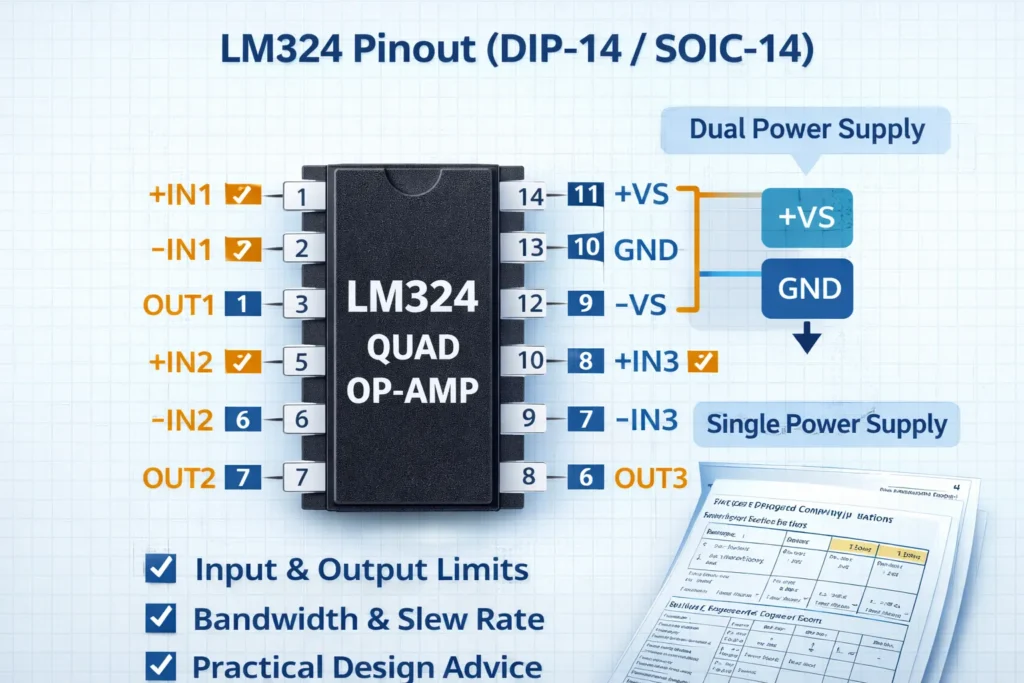
LM324 Power Supply Pins
- Pin 4 – +V<sub>S</sub> (Positive Supply Voltage)
This pin connects to the positive supply rail. LM324 supports a wide supply range from 3 V to 32 V. In single-supply designs, this pin is connected to the system’s positive voltage (for example, +5 V or +12 V). - Pin 11 – −V<sub>S</sub> / GND (Negative Supply or Ground)
In dual-supply configurations, this pin connects to the negative rail.
In single-supply designs, it is typically tied directly to ground, which is a key feature that simplifies LM324-based circuits.
👉 Design note:
LM324 is optimized for single-supply operation, but its output does not swing fully to the positive rail. Adequate voltage headroom should be reserved near +V<sub>S</sub>.
Amplifier Channel 1 (Pins 1–3)
- Pin 1 – Output 1 (OUT1)
The output of amplifier channel 1. - Pin 2 – Inverting Input 1 (−IN1)
The inverting input of amplifier 1, typically used for feedback networks. - Pin 3 – Non-Inverting Input 1 (+IN1)
The non-inverting input of amplifier 1, commonly used as the signal input or reference node.
Amplifier Channel 2 (Pins 5–7)
- Pin 5 – Non-Inverting Input 2 (+IN2)
- Pin 6 – Inverting Input 2 (−IN2)
- Pin 7 – Output 2 (OUT2)
Channel 2 shares the same electrical characteristics as channel 1 and can be used independently or in combination with other channels for multi-stage amplification.
Amplifier Channel 3 (Pins 8–10)
- Pin 8 – Output 3 (OUT3)
- Pin 9 – Inverting Input 3 (−IN3)
- Pin 10 – Non-Inverting Input 3 (+IN3)
Channels 3 and 4 are located on the opposite side of the package but behave identically to channels 1 and 2.
Amplifier Channel 4 (Pins 12–14)
- Pin 12 – Output 4 (OUT4)
- Pin 13 – Inverting Input 4 (−IN4)
- Pin 14 – Non-Inverting Input 4 (+IN4)
Channel 4 is often used for auxiliary functions such as reference buffering, threshold detection, or additional signal conditioning.
Single-Supply vs Dual-Supply Pin Usage
Single-Supply Configuration (Most Common)
- Pin 4 → Positive supply (e.g., +5 V)
- Pin 11 → Ground
This configuration is widely used in sensor interfaces, industrial control circuits, and low-cost analog designs.
Dual-Supply Configuration (Less Common)
- Pin 4 → Positive supply (e.g., +12 V)
- Pin 11 → Negative supply (e.g., −12 V)
Dual-supply operation allows for symmetrical signal swing around ground but is not required for most LM324 applications.
Practical Pinout Design Tips
- Tie unused inputs to a defined voltage to prevent oscillation
- Add decoupling capacitors close to Pin 4 and Pin 11
- Do not drive inputs beyond supply rails
- Remember: output does not swing to +V<sub>S</sub>
For deeper electrical behavior analysis, see the LM324 datasheet explained.
If your design requires different pin compatibility or performance, consult the LM324 alternatives and equivalents guide.
When Pinout Knowledge Matters Most
Understanding the LM324 pinout is especially important when:
- Migrating from DIP-14 prototyping to SOIC-14 production
- Using LM324 as a basic comparator
- Replacing multiple dual op amps with a single quad device
- Troubleshooting or testing LM324 on existing boards
For deeper insight into how pin behavior interacts with electrical limits, refer to the LM324 datasheet explained. If your application requires different pin compatibility or performance characteristics, the LM324 alternatives and equivalents guide provides structured comparison options.
Common LM324 Packages and Ordering Options
LM324 is available in multiple package types to support different manufacturing needs:
- LM324N DIP-14 package – ideal for prototyping, education, and industrial repair
- LM324DR SOIC-14 package – widely used in automated surface-mount production
For volume projects, engineers and buyers often review available operational amplifier IC categories to compare packaging, temperature grades, and inventory status across similar devices.
How Does LM324 Make Single-Supply Design Easier?
One of LM324’s most valuable features is its ability to operate effectively in single-supply designs.
Key advantages include:
- Input common-mode range includes ground
- Output can swing close to ground under light load
- No need for a negative supply rail
By eliminating the requirement for a dual ± supply, LM324 reduces BOM cost, simplifies power management, and improves overall system reliability.
This design philosophy is shared with other single-supply op amps such as the LM358 dual operational amplifier overview, but LM324 provides four channels in a single IC, making it especially attractive for multi-signal systems.
How to Use LM324 as a Comparator (With Practical Tips)
Although LM324 audio amplifier is designed as an operational amplifier, it is frequently used as a basic comparator in low-speed applications.
Basic LM324 Comparator Configuration
In simple comparator setups:
- One input receives a reference voltage
- The other input monitors the signal
- The output switches based on input comparison
This approach is commonly used in threshold detection, level monitoring, and basic alarm circuits.
When LM324 Is Not a Good Comparator Choice
LM324 is not a dedicated comparator, and certain limitations should be considered:
- Slower response compared to true comparators
- Output saturation recovery time
- Lack of internal hysteresis
For applications requiring fast switching or clean logic-level outputs, designers should review the LM324 alternatives and equivalents to evaluate more suitable comparator or op amp options.
Common LM324 Applications in Real Designs
LM324 is widely deployed across industries due to its versatility and cost efficiency.
Typical applications include:
- Multi-channel sensor interfaces
- Power supply monitoring
- Motor control feedback
- Signal buffering and filtering
- Educational laboratory equipment
In many of these systems, LM324 replaces multiple dual op amps, reducing board space and assembly complexity.
How to Test an LM324 IC (Quick Functional Checks)
Testing an LM324 is often required during troubleshooting, incoming inspection, or failure analysis.
Simple Bench Test Using Single Supply
A basic functional test involves:
- Applying a single supply voltage
- Feeding a small input signal
- Observing output response on each channel
Consistent output behavior across all four amplifiers usually indicates a functional device.
Common Failure Symptoms in LM324
Common issues observed in faulty LM324 devices include:
- Output stuck at ground or supply rail
- Excessive input offset
- Abnormally high supply current
When failures are suspected, sourcing replacement parts from verified channels and following best practices outlined in how to avoid counterfeit electronic components can significantly reduce risk.
LM324 vs Other Operational Amplifiers: When to Choose Alternatives
While LM324 remains a reliable choice for many designs, it is not always optimal.
Designers may consider alternatives when:
- Fewer channels are required (dual op amps)
- Higher bandwidth or lower noise is needed
- Automotive or extended temperature ratings are required
A detailed comparison of replacement options, including channel count and performance trade-offs, is available in the LM324 alternatives and equivalents guide.
Availability, Lifecycle, and Sourcing Considerations
LM324 benefits from a long production history and multi-source manufacturing, making it a stable choice for long-term projects.
From a procurement perspective:
- LM324 is not approaching end-of-life
- Multiple manufacturers offer compatible versions
- Common packages are widely stocked
For current inventory, packaging options, and related devices, buyers often explore the broader operational amplifier IC category to support second-sourcing and supply continuity.
LM324 OP-Amp Frequently Asked Questions (FAQ)
Is LM324 rail-to-rail?
No. The input includes ground, but the output does not reach the positive supply rail.
Can LM324 be used as a comparator?
Yes, for low-speed applications, but it is not ideal for high-speed or precision switching.
Is LM324 still recommended for new designs?
Yes, for cost-sensitive and general-purpose applications where advanced performance is not required.
Summary: When LM324 IC Is the Right Choice
LM324 remains a dependable solution for multi-channel, single-supply analog designs. Its ease of use, long-term availability, and wide industry adoption make it suitable for both new projects and legacy systems.
For deeper technical interpretation of specifications, review the LM324 datasheet explained. If your design requires higher performance or different operating characteristics, the LM324 alternatives and equivalents guide provides structured comparison insights.