- A thermoelectric module is a solid-state heat transfer device commonly used for localized cooling and temperature control.
- TEC module and Peltier module are often used interchangeably in buyer conversations, but understanding the application still matters more than the label.
- A thermoelectric module does not replace airflow management by itself. In many real systems, it works together with thermal management components, heatsinks, and fans.
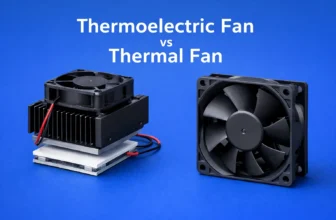
- If you searched for “thermoelectric fan,” you may actually be looking for a thermoelectric cooling module or a complete cooling stack built around a TEC module.
- The right part selection depends on voltage, current, cooling capacity, Delta T, module size, and system integration.
When buyers search for thermoelectric cooling, Peltier cooling, or even a so-called thermoelectric fan, they are often trying to solve a more specific engineering problem: how to move heat away from a small area, stabilize temperature, or build a compact cooling system. In many of those cases, the actual component they need is not a conventional fan at all. It is a thermoelectric module.
A thermoelectric module is a solid-state device that transfers heat using the Peltier effect. In simple terms, when current passes through the module, one side becomes cold and the other side becomes hot. That makes thermoelectric modules attractive for applications where buyers need spot cooling, precise temperature control, or a compact alternative to compressor-based refrigeration. The source text behind this content cluster also frames thermoelectric products around Peltier modules and cooling kits rather than standard airflow fans, which is exactly why this page matters in the broader cluster.
For electronics buyers, procurement teams, and engineers, understanding what a TEC module actually does is more useful than simply comparing brand names or repeating broad search phrases. The better question is: What thermal job must the module perform in the real system? Once that is clear, the selection process becomes much more straightforward.
Quick Answer
A thermoelectric module is a solid-state heat transfer device commonly associated with the Peltier effect. In buyer language, this is often the actual component people mean when they search for “thermoelectric cooling” or even “thermoelectric fan” in electronics contexts. Rather than acting like a standard airflow fan, a TEC module actively moves heat from one side of the device to the other, which is why it is often paired with heatsinks, fans, and broader thermal management hardware.
If your application needs localized cooling, temperature stabilization, or a compact controlled thermal assembly, then a thermoelectric module may be the correct starting point. If your application mainly needs airflow across a board, enclosure, or heatsink, then you likely need a fan-based solution instead.
What Is a Thermoelectric Module?
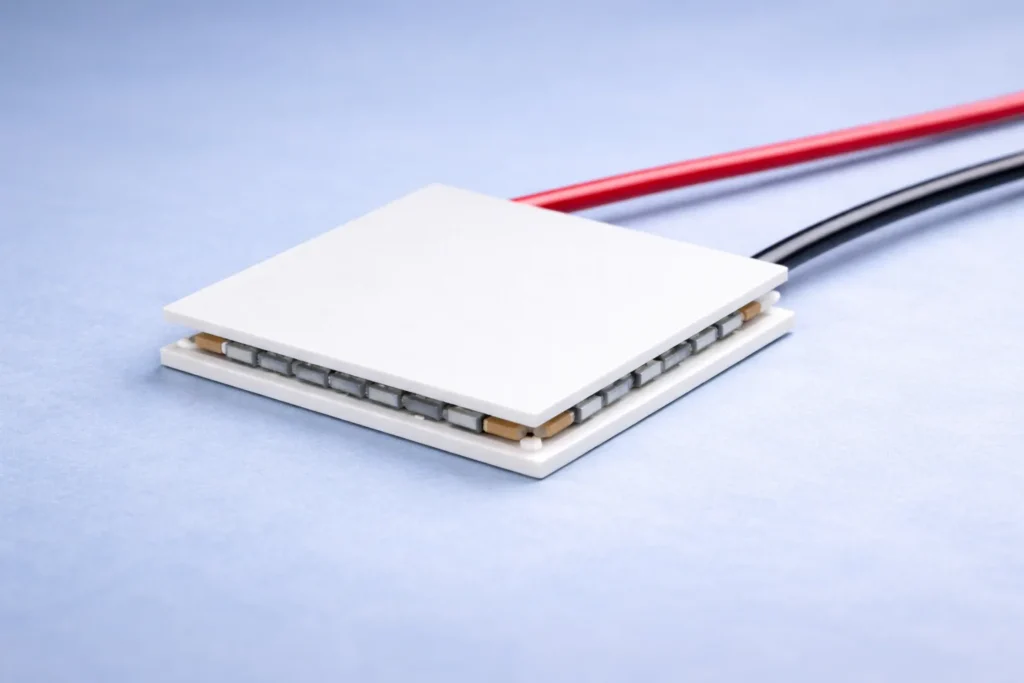
TEC Module Definition
A thermoelectric module, also often called a TEC module or thermoelectric cooler module, is a compact solid-state component designed to transfer heat when electrical current passes through it. Unlike a traditional fan, it does not cool by moving air. Instead, it cools by creating a temperature difference across the module itself.
Physically, a TEC module usually consists of many semiconductor junctions sandwiched between ceramic plates. When powered correctly, one side absorbs heat while the opposite side rejects it. That hot side must then be cooled effectively, usually by attaching a heatsink, a fan, or a larger thermal dissipation structure.
This is why thermoelectric modules are frequently misunderstood. Buyers may see a finished cooling kit that includes a small fan and assume the fan is the core product. In reality, the thermoelectric module is the active thermal component, and the airflow hardware is supporting infrastructure.
Is TEC the Same as Peltier?
In most sourcing conversations, TEC module and Peltier module are used almost interchangeably. “TEC” stands for thermoelectric cooler, while “Peltier” refers to the physical effect that allows the module to move heat.
In practical terms, a buyer asking for a Peltier module is usually describing the same component family as a buyer asking for a thermoelectric module. The more important issue is not the naming difference. It is whether the selected part matches the application’s cooling load, electrical limits, available space, and reliability needs.
That distinction becomes especially useful in content clusters like this one. Someone who arrives from a broad query such as “thermoelectric fan” may really be looking for a Peltier-based cooling assembly, not a catalog of standard cooling fans.
How a Thermoelectric Module Works
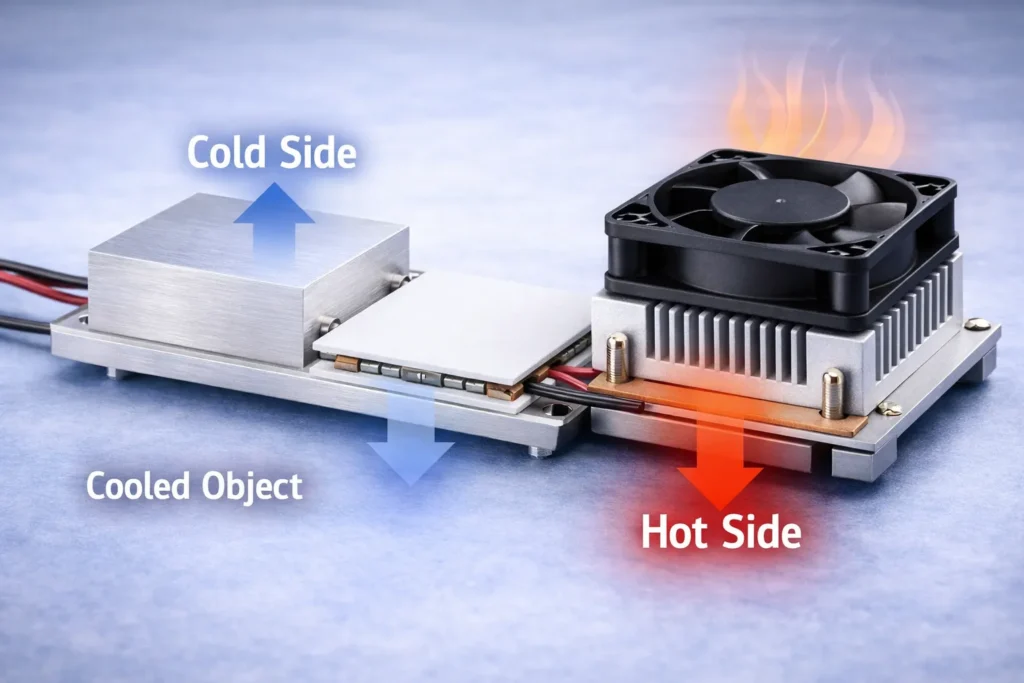
Heat Moves From One Side to the Other
The easiest way to understand a thermoelectric module is to think of it as a heat pump without moving parts. When DC current passes through the semiconductor junctions inside the module, heat is absorbed on one side and expelled on the other.
That means the module creates two thermal zones:
- a cold side, where heat is drawn away from the target area
- a hot side, where that heat must be rejected into the environment
This behavior makes TEC modules useful for compact cooling tasks where direct contact and local temperature control matter more than general airflow. Examples may include small optical devices, sealed enclosures, sensor stabilization, specialty electronics, medical instruments, or localized cooling in test equipment.
However, a thermoelectric module does not make heat disappear. It only moves it. That is the most important operational concept buyers need to understand before choosing one.
Why Heatsinks and Fans Are Often Needed
Because the hot side of a TEC module must reject both the moved heat and the electrical energy consumed by the module, the surrounding thermal design matters just as much as the module itself. A poorly managed hot side will quickly reduce cooling performance.
That is why a real thermoelectric cooling system often includes:
- the TEC module
- a heatsink on the hot side
- a fan or blower for airflow
- thermal interface materials
- a control or power stage
On MOZ Electronics, this is exactly where the broader Thermal Management section becomes relevant, and where a buyer may also need to browse cooling hardware such as fans and blowers rather than sourcing the TEC module in isolation.
A TEC module does not replace the need for heat dissipation. In most real assemblies, the module only works well when paired with the right heatsink, airflow path, and thermal interface stack.
When Buyers Should Choose a TEC Module
Spot Cooling
Buyers should consider a thermoelectric module when the application needs cooling in one defined area rather than broad system airflow. For example, if a small sensor chamber, optical surface, or compact electronics zone needs to stay below ambient or maintain a narrow temperature range, a TEC module may be more appropriate than a standard fan.
Fans are excellent for removing heat from a larger area, but they do not provide the same kind of direct heat transfer at a controlled interface. A thermoelectric module is often the better solution when the cooling target is physically small and thermally sensitive.
Temperature Stabilization
Another strong use case is temperature stabilization. Some systems care less about achieving the lowest possible temperature and more about staying within a tight range. In those cases, a TEC module can be paired with sensing and control electronics to maintain a stable operating condition.
This is where internal educational content around sensing becomes useful. If your design also requires accurate monitoring, the MOZ tutorials section and related sensor content can help guide the system-level decision. Relevant examples include the site’s temperature sensor guides and tutorial resources.
Compact Systems With Precise Control Needs
Thermoelectric modules are also attractive when buyers need a compact thermal solution with no compressor, low mechanical complexity, and precise controllability. They are often selected where size, integration, or silence matters more than raw bulk cooling efficiency.
That said, “compact” does not mean “simple.” Once a buyer factors in hot-side heat rejection, power supply sizing, and control strategy, the total assembly may still require careful design review. If the application is small but thermally demanding, the right answer may be a full cooling stack rather than just one module.
Key Specifications to Compare
Choosing the right thermoelectric module requires more than checking a part number. Buyers should compare several core specifications and evaluate them in the context of the full thermal system.
| Specification | Why It Matters | What Buyers Should Check |
|---|---|---|
| Voltage | Power compatibility | Match system design |
| Current | Driver and PSU sizing | Confirm peak draw |
| Cooling capacity | Determines usable performance | Compare application load |
| Delta T | Temperature differential capability | Avoid overestimating real-world results |
| Module size | Mechanical fit | Match heatsink and enclosure |
| Reliability | Lifetime and consistency | Review duty cycle and environment |
Voltage and Current
Voltage and current define how the module will be powered and what kind of driver or supply the system needs. Buyers should never treat these as paperwork-only specs. They directly affect controllability, system safety, and overall thermal performance.
If the module draws more current than the design can support, the real cooling result may be unstable or incomplete. If the power stage is oversized without proper control, the module may be driven inefficiently. This is especially important in compact electronics, battery-powered systems, or tightly regulated assemblies.
Cooling Capacity
Cooling capacity is one of the most misunderstood specs in thermoelectric selection. A module may look strong on paper, but usable performance depends on real conditions such as ambient temperature, hot-side cooling quality, mounting surfaces, and target load.
In buyer terms, this means the application load must be defined before the module can be selected confidently. Do not choose by headline numbers alone.
Delta T
Delta T refers to the temperature difference between the hot side and the cold side of the module. It is an important capability indicator, but it is often misread as a guaranteed real-world operating result.
In practice, the full rated Delta T is rarely achieved under meaningful thermal load. Buyers should therefore treat Delta T as a comparative performance figure, not as a simple promise of final system temperature.
Module Size
Module size affects more than fit. It influences thermal contact area, heatsink compatibility, clamping method, and integration inside the enclosure. A module that is electrically correct but mechanically awkward can still create a poor final design.
Buyers should therefore compare module footprint alongside cold plate size, heatsink dimensions, and the available assembly space.
Reliability and Thermal Cycling
Reliability matters because thermoelectric modules often run in applications with repeated on-off cycles, environmental changes, or extended operating hours. Thermal stress, poor mounting, and unstable control can shorten life.
If the product is expected to operate under constant cycling or in demanding industrial conditions, reliability review should include duty cycle, expected thermal gradients, vibration exposure, and long-term control method.
Common Integration Mistakes
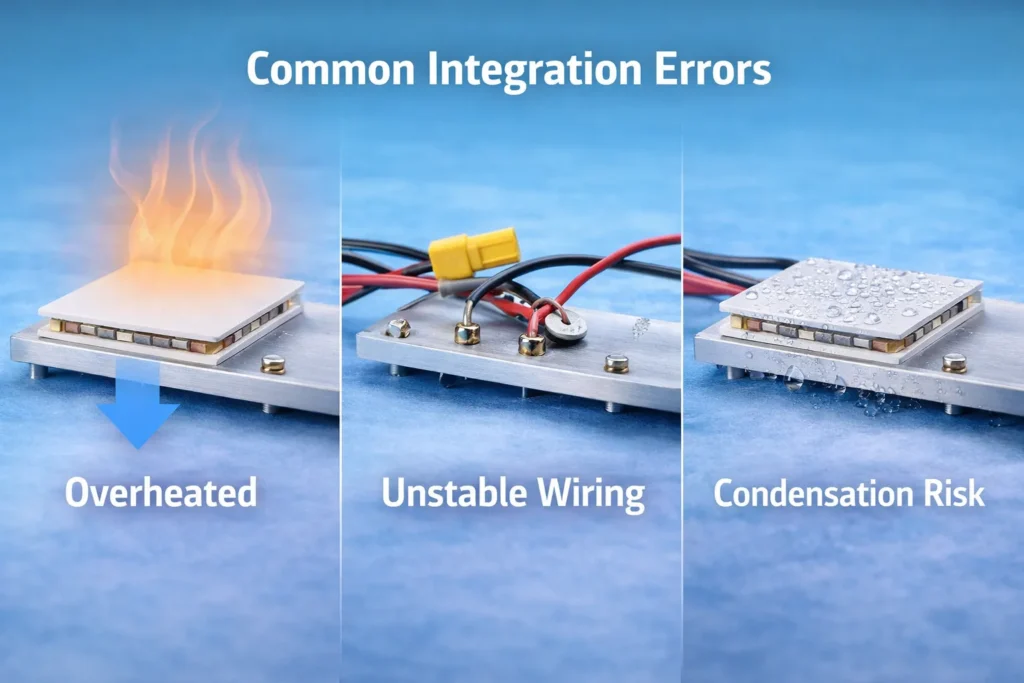
No Hot-Side Heat Dissipation
The most common design mistake is treating the thermoelectric module as if it cools independently. It does not. Without effective hot-side heat dissipation, the module will quickly lose performance and may even worsen system temperatures.
That is why thermoelectric designs should always be reviewed as assemblies, not as standalone parts. If needed, support the design with appropriate airflow hardware from the broader fan and blower category.
Wrong Power Supply
Another frequent problem is using the wrong power source or underestimating current requirements. A thermoelectric module may appear simple to wire, but poor power delivery can limit cooling, create thermal instability, or stress the control electronics.
If the design needs power monitoring or current-aware control logic, it may also be useful to review current sensing and related integration guidance. The MOZ site already includes current-sensing content that can support those broader system decisions. :contentReference[oaicite:8]{index=8}
Ignoring Condensation Risk
When a TEC module pulls a surface below ambient dew point, condensation can become a real risk. This is especially important in sealed housings, sensor systems, optics, or electronics that are sensitive to moisture.
Buyers and engineers should therefore evaluate not only the desired cooling performance, but also the humidity environment, sealing strategy, and insulation requirements. A module that cools successfully in theory can still create reliability problems if condensation is ignored.
Need a complete thermoelectric cooling stack? Pair your TEC module with heatsinks, fans, and thermal interface materials through the broader thermal management workflow, then validate the power and sensing strategy before final selection.
How to Source the Right Thermoelectric Module
For sourcing teams, the best thermoelectric module selection process starts with the application, not the part number. A strong buyer workflow usually follows these steps:
1. Define the thermal jobIs the system trying to cool below ambient, stabilize a sensor, remove a local hotspot, or maintain a process temperature?
2. Define the electrical limitsConfirm supply voltage, available current, control method, and allowable power consumption.
3. Define the mechanical envelopeCheck footprint, mounting surfaces, heatsink space, enclosure clearance, and airflow path.
After that, compare candidate modules against the real system requirements rather than a single headline spec. If possible, buyers should gather the following information before requesting quotes or technical recommendations:
- target cold-side temperature
- ambient operating temperature
- estimated thermal load
- available input voltage and current
- space for heatsink and fan
- expected duty cycle
- any moisture or condensation concerns
This is also where internal education pages can support the sourcing journey. The site’s tutorials hub gives buyers and engineers a place to continue learning across sensing, control, and integration topics, while Thermal Management and AC Fans provide adjacent product families that may be required in the final design. :contentReference[oaicite:9]{index=9}
If your content cluster’s main pillar page on thermoelectric fan vs thermal fan is already live, this article should also link back to that comparison page as the broader educational entry point. If not, keep that internal link ready for rollout as soon as the pillar page is published.
Final Buying Advice
A thermoelectric module is not simply a “cooling gadget.” It is a system-critical heat transfer component. Buyers who understand that will make better sourcing decisions and avoid the most common integration mistakes.
Use a TEC module when the application needs localized cooling, controlled temperature, or a compact solid-state thermal solution. Do not expect the module to work well without proper hot-side cooling, good thermal interfaces, and a realistic power design. In many successful products, the module is only one part of a larger thermal architecture that also includes heatsinks, fans, airflow management, sensing, and control.
If you arrived here while searching for a “thermoelectric fan,” this is often the component you were actually trying to identify. The next step is not just finding a module. It is matching the right module to the right system.
Explore Thermal Management
Browse the broader cooling and heat-dissipation ecosystem needed around a thermoelectric module.
Browse Fans & Blowers
Support your TEC design with the airflow hardware needed for hot-side heat rejection.
FAQ
Is a thermoelectric module the same as a Peltier module?
In most sourcing conversations, yes. A thermoelectric module, TEC module, and Peltier module usually refer to the same general type of solid-state heat transfer device. The more important difference is not the name, but whether the selected module fits the application’s thermal and electrical requirements.
Can a thermoelectric module work without a fan?
Technically, a thermoelectric module can operate without a fan, but many real applications still require a heatsink and airflow on the hot side to achieve usable performance. Without proper heat rejection, the module’s cooling ability drops quickly.
What is Delta T in a TEC module?
Delta T is the temperature difference between the hot side and the cold side of the module. It is a useful performance indicator, but buyers should not assume the maximum published Delta T will appear under full real-world load.
Are thermoelectric modules good for electronics cooling?
Yes, especially for localized cooling, temperature stabilization, and compact systems with precise thermal requirements. They are less suitable when the real need is broad enclosure airflow or large-scale bulk heat removal.
What accessories are needed with a TEC module?
Typical supporting parts include heatsinks, fans or blowers, thermal interface materials, power/control electronics, mounting hardware, and sometimes temperature sensors or insulation depending on the design.
How do I choose the right module size?
Choose module size based on both thermal and mechanical requirements. The footprint should match the cold plate or target surface, while the thermal performance must also align with the cooling load, hot-side heat rejection, and enclosure constraints.