When buyers search for a thermoelectric fan or a thermal fan, they often assume the two terms describe similar products. In practice, they usually point to different cooling concepts, different component categories, and different sourcing paths.
That confusion matters. If your actual need is localized heat transfer, you may need a thermoelectric module or a complete TEC-based cooling assembly rather than a conventional fan. If your goal is airflow for electronics cooling, then a powered axial fan, blower, or heatsink-and-fan setup is usually the better fit.
- Thermoelectric fan usually refers to a heat-powered stove fan or a Peltier/TEC-related cooling assembly, not a standard electronics fan category.
- Thermal fan usually means an electrically powered fan used to move air and remove heat from electronics or enclosures.
- If you need active heat transfer, start with thermoelectric modules and supporting hardware.
- If you need general airflow, start with AC fans, blowers, and thermal management products.
- In many real projects, the right answer is a combined cooling stack: module + fan + heatsink + control.
For distributors, OEM buyers, and engineers, the real question is not which label sounds more correct. The real question is whether the application needs active heat transfer, air movement, or a combined thermal management assembly.
Quick Answer
Many people use “thermoelectric fan” and “thermal fan” as if they mean the same thing, but they usually refer to different product categories. A thermoelectric product is typically related to a Peltier or TEC-based heat transfer setup, while a thermal fan in electronics usually means an electrically powered fan used to move air and remove heat. In practical sourcing, buyers often need to choose between heat transfer components, airflow components, or a combined cooling assembly rather than searching for a “fan” in the abstract.
Why These Terms Are Often Confused
“Thermoelectric” Sounds Like a Fan Category, But Often Isn’t
The term thermoelectric sounds like it should refer to a specific fan technology, but in practice it more often points to thermoelectric cooling or Peltier-based heat transfer. In buyer language, that can blur into phrases like “thermoelectric cooling fan,” even when the fan is only one small part of a larger cooling assembly.
“Thermal Fan” Is Often Used Loosely in Consumer and Electronics Contexts
The phrase thermal fan is equally broad. Some people use it to mean a fan that reacts to temperature. Others use it as a loose label for any fan involved in heat removal. In electronics sourcing, that usually maps to standard powered cooling products found under broader thermal management categories rather than to a unique product type.
That loose language makes search results messy. A user looking for a compact electronics cooling part may end up seeing stove fans, DIY thermoelectric kits, industrial axial fans, or enclosure cooling products in the same search journey. This is exactly why a clean selection framework matters.
What a Thermoelectric Fan Usually Refers To
Heat-Powered Stove Fans
One common meaning is a heat-powered stove fan. These products sit on top of a stove or fireplace and use a temperature difference to generate enough power to spin the fan blades. This is a real product class, but it is not the same thing as a standard electronics cooling fan.
Peltier-Based Cooling Kits and Small Assemblies
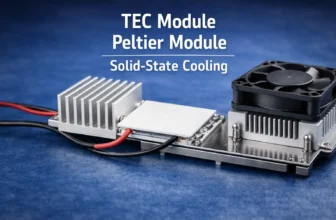
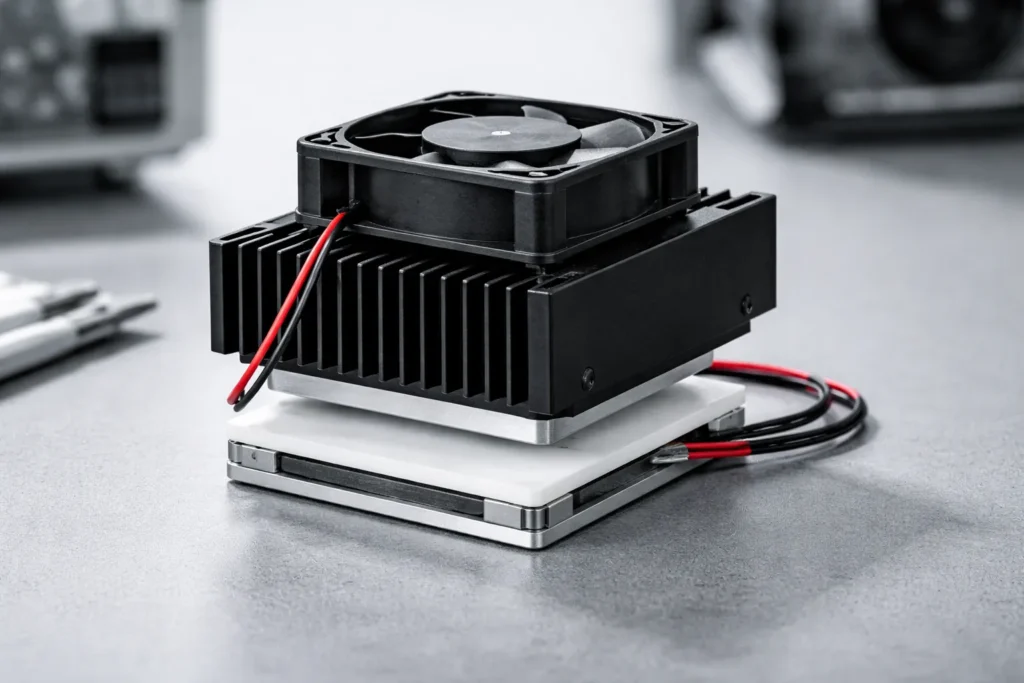
The other common meaning is a small thermoelectric cooling setup built around a TEC or Peltier module. In that setup, the actual cooling mechanism is the module itself, while the fan helps remove heat from the hot side. In other words, the “fan” is often not the core technology at all.
Why Buyers May Actually Need a TEC Module Instead
If your application needs spot cooling, temperature stabilization, or active heat transfer, searching for a “thermoelectric fan” may lead you in the wrong direction. What you may really need is:
You may actually need:
- a TEC / Peltier module
- a heatsink
- a compact support fan
- a temperature controller
- a complete cooling assembly
Good starting points on MOZ Electronics:
What a Thermal Fan Usually Refers To in Electronics
DC Cooling Fans
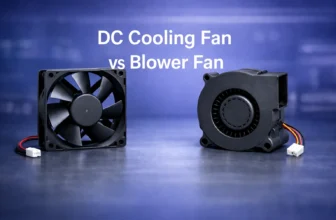
In electronics, a thermal fan usually means an electrically powered cooling fan used to move air across heat-generating components. In sourcing terms, that normally points buyers toward axial fans, blower fans, enclosure fans, or heatsink fan assemblies.
Case Fans, Axial Fans, and Blowers
This is where real component selection begins. The most common options include:
- Axial fans for broad airflow
- Blower fans for directed airflow and higher static pressure
- Case or enclosure fans for ventilation
- Integrated fan-based thermal solutions inside a wider thermal management stack
If your project is cooling a board, enclosure, power supply, control cabinet, or industrial assembly, the best place to start is usually the site’s AC Fans category or broader Thermal Management section.
Fans Used With Heatsinks and Radiators
A thermal fan is rarely a complete solution by itself. In real designs, fans are commonly paired with:
- heatsinks
- thermal interface materials
- ducting or enclosure airflow paths
- temperature sensing
- PWM or thermostat-based control
If the application only needs airflow, do not overcomplicate the search with thermoelectric terminology. Start with fan type, airflow path, voltage, mounting space, and control method.
Thermoelectric Modules vs Thermal Fans
| Feature | Thermoelectric Fan | Thermal Fan |
|---|---|---|
| Core mechanism | Thermoelectric effect or Peltier-related system | Motor-driven airflow |
| Main job | Heat transfer or localized cooling | Air movement and heat dissipation |
| Power source | Heat difference or electrical TEC system | Electrical power supply |
| Common real-world forms | Stove fan, TEC cooling kit, compact thermoelectric assembly | Axial fan, blower fan, PC cooling fan, enclosure fan |
| Best fit | Small localized cooling or niche thermal control | General electronics cooling and airflow |
| What buyers may actually need | TEC module, controller, heatsink, complete cooling assembly | Cooling fan, blower, PWM fan, fan accessories |
Heat Transfer vs Air Movement
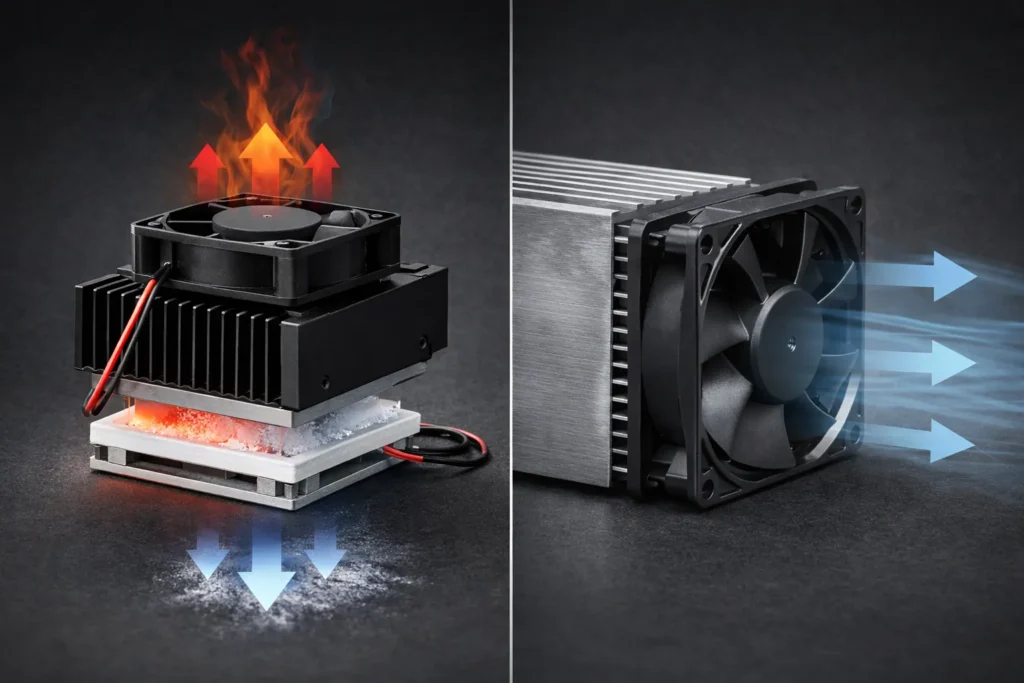
This is the most important distinction. A thermoelectric system actively moves heat from one side of a module to the other. A thermal fan does not directly move heat through a semiconductor process. It moves air, helping heat escape from components and surfaces through convection.
Power Source Differences
Some thermoelectric fan products, especially stove-top versions, operate from a temperature difference. Thermoelectric cooling assemblies using TEC modules usually require electrical power. A thermal fan, by contrast, is normally just an electrically powered airflow device.
Integration Requirements
Thermoelectric cooling typically requires more system thinking. Buyers may need to plan for hot-side heat rejection, control circuitry, condensation risk, and power budget. Fan-based cooling is usually simpler, but correct selection still depends on airflow, pressure, size, voltage, noise, and duty cycle.
Which Product Do You Actually Need?
If You Need Spot Cooling
If the application needs localized cooling or tighter temperature control, start by evaluating modules and supporting thermal hardware. A broad starting point is the site’s Modules section.
If You Need General Airflow
If the application needs air movement through an enclosure or across a heatsink, start with the fan path. The most relevant internal category on the site today is AC Fans, which already includes axial fans, centrifugal fans, blowers, and compact cooling fans.
If You Need a Complete Thermal Assembly
Many real projects need a hybrid answer rather than a single part. That may include:
- TEC module + heatsink + fan
- blower + airflow duct + sensor
- fan + controller + monitoring components
For sensor-based monitoring and thermal control logic, these two guides are useful companion reads:
Temperature Sensor Types & Selection Guide
Useful for monitoring, protection, and closed-loop temperature control in thermal systems.
Current Sensor Guide
Helpful when power draw, fan current, driver selection, or control-stage monitoring matters.
Recommended Thermal Management Components
TEC / Peltier Modules
Use these when you need active heat transfer, spot cooling, or a controlled temperature differential. If your site later adds a dedicated TEC or Peltier guide, that page should become one of the strongest internal targets for this article.
DC Axial Fans
Use these for broad airflow in electronics, cabinets, and general cooling paths. For the current site structure, the broader Thermal Management section is the best umbrella link.
Blower Fans
Choose blowers when airflow must be directed through a narrow path or confined space. The existing AC Fans category already references blowers and centrifugal formats, making it the most relevant internal destination for now.
Heatsinks and Thermal Interfaces
Both thermoelectric systems and fan-based solutions depend on proper heat rejection. Even when the exact heatsink landing page is not yet a clean standalone category, the broader thermal management architecture still applies: fan + heatsink + airflow path + control.
Temperature Sensors and Controllers
Temperature sensing becomes increasingly important when the cooling target is tight or the workload changes over time. For readers who want to understand sensing choices, this guide on temperature sensor types and selection is a logical next step.
Final Buying Advice for Electronics Sourcing Teams
If your team is comparing thermoelectric fan vs thermal fan, treat the phrase as a starting point rather than a final product category.
A thermoelectric product usually points toward TEC or Peltier-based heat transfer, sometimes packaged into a kit or heat-powered fan format. A thermal fan usually points toward a powered airflow device used for electronics cooling. The correct decision usually comes down to three questions:
- Do you need active heat transfer or just airflow?
- Is the cooling target localized or system-wide?
- Are you choosing a single component or a complete thermal stack?
If the application needs airflow, start with fans, blowers, and thermal management products. If it needs localized active cooling, start with modules and supporting hardware. If the system is complex, combine fans, heatsinks, sensing, and control into a more complete solution.
Not sure whether you need airflow or active cooling? Explore modules and cooling fans, or ask your sourcing team to compare voltage, airflow, Delta T, available space, and enclosure constraints before locking in a part.
FAQ
Is a thermoelectric fan the same as a Peltier cooler?
Not exactly. A thermoelectric fan may refer to a heat-powered fan or a small cooling assembly, while a Peltier cooler usually refers more specifically to a thermoelectric module-based cooling device. In many electronics contexts, the Peltier or TEC module is the actual core component.
What is the difference between a thermal fan and a cooling fan?
In electronics, those terms often overlap. A thermal fan usually means a powered fan used for heat management, while “cooling fan” is the clearer and more common sourcing term.
Are thermoelectric fans used in electronics?
Sometimes, but often as part of a broader assembly rather than as a standard fan category. In electronics, buyers are more likely to source modules, heatsinks, and support fans separately.
Do thermoelectric fans need external power?
Some heat-powered stove fans can run from temperature difference alone, while thermoelectric cooling assemblies using TEC modules usually require electrical power.
When should I choose a TEC module instead of a DC fan?
Choose a TEC module when you need active heat transfer, localized cooling, or tighter temperature control. Choose a fan when the main need is airflow and general heat dissipation.
What cooling components are usually needed in a compact electronics project?
Typical parts include a fan or blower, heatsink, thermal interface material, sensor, and sometimes a TEC module or controller depending on the application.