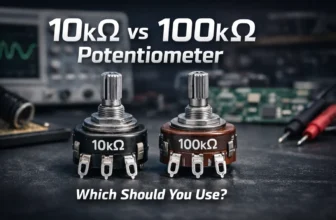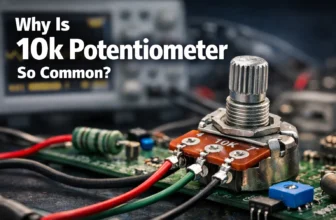
The best potentiometer value depends on circuit impedance, current consumption, noise sensitivity, and the load connected to the wiper. In most general-purpose analog and microcontroller circuits, 10k potentiometers are the safest default choice because they provide a good balance between power draw and signal stability. Lower values such as 1k or 5k are better when stronger drive capability and lower noise susceptibility matter, while higher values such as 50k or 100k are more suitable when minimizing current consumption is the priority.
Choosing a potentiometer looks simple until you reach the question every engineer, buyer, or maker eventually asks:
Should I use 1k, 5k, 10k, 50k, or 100k?
At first glance, these values seem interchangeable. After all, every potentiometer does the same job: it provides an adjustable resistance or acts as a variable voltage divider. In real circuits, however, the value you choose directly affects current consumption, signal stability, ADC accuracy, audio behavior, loading effects, and even the user experience of the control itself.
Selecting the wrong value can lead to noisy readings, unstable output voltages, unnecessary power waste, or poor response in the next stage of the circuit. Selecting the right one helps the entire design behave more predictably and makes the control feel more natural in actual use.
In this guide, we will compare the most common potentiometer values—1k, 5k, 10k, 50k, and 100k—and explain when each one makes sense. We will also cover typical use cases such as Arduino analog inputs, audio volume controls, bias adjustment, industrial interface panels, and low-power embedded systems.
Why Potentiometer Value Matters
A potentiometer is normally used in one of two ways:
As a Voltage Divider
The two outer terminals are connected across a voltage source, and the wiper provides an adjustable output voltage somewhere between the two ends.
As a Variable Resistor
One outer terminal and the wiper are used together to create an adjustable resistance, often for tuning or calibration purposes.
The resistance value determines how much current flows through the resistive track and how strongly the potentiometer can drive the next stage. That is the core tradeoff:
Lower-value potentiometers draw more current but resist noise and loading better.
Higher-value potentiometers draw less current but are more sensitive to input leakage, noise pickup, and loading from the following circuit.
This is why 10k has become the “safe default” in so many applications. It usually sits in the middle of the design window: low enough to avoid many loading problems, but high enough to keep current consumption reasonable.
Quick Answer: Which Potentiometer Value Should You Choose?
| Value | Best For | Main Advantage | Main Limitation |
|---|---|---|---|
| 1k | Low-impedance circuits, stronger drive, robust control | Low noise sensitivity, less loading error | Higher current draw |
| 5k | Moderate-impedance analog stages | Good compromise when 10k feels too high | Still consumes more current than 10k |
| 10k | General-purpose electronics, MCU analog input, control panels | Best overall balance | Not always ideal for ultra-low-power or special audio cases |
| 50k | High-input-impedance stages, reduced current consumption | Lower power loss | More sensitive to noise and loading |
| 100k | Very high impedance inputs, low-power designs, some audio controls | Minimal current draw | Most sensitive to instability and interference |
Understanding the Real Design Tradeoffs
1. Current Consumption
When a potentiometer is connected across a supply rail, it continuously draws current. Lower resistance means more current. In battery-powered devices or large-volume products, that extra current may matter. A 1k potentiometer across a supply rail wastes much more power than a 100k part.
2. Output Impedance at the Wiper
A potentiometer does not provide an ideal zero-ohm output. The wiper has an effective output impedance that changes with position. When the next stage has limited input impedance, the potentiometer output can be pulled away from the intended voltage. Higher-value pots are more vulnerable to this issue.
3. Noise Sensitivity
Higher resistance values are usually more susceptible to electrical noise, contamination effects, and leakage current problems. This is especially noticeable in sensitive analog systems or circuits with long traces, poor shielding, or noisy environments.
4. ADC and Sensor Stability
In embedded systems, a potentiometer often feeds an ADC pin. Many microcontroller examples use a standard rotary potentiometer in a simple voltage-divider configuration because it is easy to read and provides stable analog values. In practice, 10k is commonly preferred because it keeps source impedance moderate without wasting too much current.
5. User Feel and Application Behavior
The resistance value is only one part of the selection process. The overall potentiometer selection workflow should also consider taper, power rating, mounting style, mechanical life, and environmental conditions. A value that works electrically may still be the wrong component mechanically or ergonomically.
When to Use a 1k Potentiometer
A 1k potentiometer is a low-resistance option typically used when the circuit needs stronger drive capability and can tolerate higher current draw.
Good Use Cases
- Low-impedance analog circuits
- Control points that feed heavier loads
- Situations where noise immunity matters more than efficiency
- Some industrial or panel-control circuits
Watch Out For
- Higher continuous current draw
- Not ideal for battery-powered products
- Can waste power unnecessarily in simple signal-level controls
In short, use 1k when you know the circuit benefits from a low source resistance. It is not usually the first choice for general-purpose control knobs, but it can be the right solution in designs where robustness matters more than power efficiency.
When to Use a 5k Potentiometer
A 5k potentiometer sits between 1k and 10k. It is often chosen when 10k is acceptable in principle, but the designer wants slightly lower source impedance for better stability or lower susceptibility to loading.
This value can work well in analog front ends, tuning networks, and practical control circuits where 1k would burn too much current and 10k feels a bit too high. It is less common than 10k in hobby documentation, but it is still a very reasonable engineering choice.
Why 10k Is the Default Recommendation
For many circuits, 10k is the best all-around potentiometer value. It offers the most practical balance among current consumption, stable output behavior, noise tolerance, and compatibility with common analog inputs.
This is why 10k potentiometers appear so frequently in microcontroller tutorials, analog test circuits, and general control interfaces. If you are reading a sensor with a microcontroller, creating an adjustable reference voltage, or building a simple user control panel, 10k is usually the safest place to start.
If you do not have a strong reason to choose 1k, 5k, 50k, or 100k, use 10k.
If your project involves a broader potentiometer selection decision—including body style, power rating, lifecycle, and environment—this companion guide is useful: How to Choose the Right Potentiometer.
When to Use a 50k Potentiometer
A 50k potentiometer becomes attractive when reducing current consumption matters and the next circuit stage has high enough input impedance to avoid loading problems.
Typical examples include:
- Signal-level control inputs into high-impedance amplifier stages
- Some calibration points
- Systems where the wiper is not expected to source meaningful current
- Designs where lower power dissipation is a priority
However, 50k is less forgiving than 10k. If the following circuit has leakage current, bias current, or poor shielding, you may see more instability, drift, or noise pickup.
When to Use a 100k Potentiometer
A 100k potentiometer is best reserved for circuits with very high input impedance and a strong need to minimize current draw. It is often seen in certain audio controls, low-power signal paths, and some set-and-forget adjustment networks.
But 100k is also the most sensitive option in this comparison. In poorly designed layouts, long cable runs, or noisy environments, it can produce inconsistent behavior more easily than lower-value parts.
If you use 100k, make sure the next stage truly has high input impedance and that your layout, grounding, and shielding are under control.
What About Audio Applications?
Audio circuits add another important variable: taper. In many volume-control applications, the resistance value alone does not determine whether the control feels right. Human hearing responds logarithmically, so many audio controls use audio/log taper rather than linear taper.
In practice, audio controls commonly use values such as 10k, 50k, or 100k, depending on the input stage and circuit architecture. Choosing the wrong taper can make the control feel too abrupt or too compressed even if the resistance value is technically workable.
If you are comparing form factors as well as values, see Linear vs Rotary Potentiometers for the mechanical side of the decision.
Best Potentiometer Values by Application
| Application | Recommended Value | Notes |
|---|---|---|
| Arduino / MCU analog input | 10k | Most common and well-balanced choice |
| General voltage divider control | 10k | Usually the safest default |
| Lower-impedance analog stage | 1k or 5k | Better drive strength, more current draw |
| Battery-sensitive high-impedance signal path | 50k or 100k | Use only if loading is not a problem |
| Audio volume control | 10k / 50k / 100k | Taper is often more important than value alone |
| Digital replacement option | Device-specific | Consider digital potentiometers for programmable control |
Analog Potentiometer vs Digital Potentiometer
In some modern systems, an engineer may replace a manual potentiometer with a digital potentiometer to enable remote adjustment, software calibration, or one-time programmable settings. If your application needs electronic control rather than a user-operated knob, a digital potentiometer may be the better fit.
For example, MOZ Electronics currently lists the AD5171BRJZ100-R2 digital potentiometer, which is aimed at programmable resistance adjustment rather than manual front-panel control.
Common Mistakes When Choosing Potentiometer Value
Choosing Only by Habit
Using 10k by default is usually fine, but not if the circuit has unusual load, leakage, or power constraints.
Ignoring Input Impedance
A high-value potentiometer can behave badly if the next stage does not have sufficiently high input impedance.
Forgetting Taper
A perfectly correct resistance value can still feel wrong if you choose the wrong taper for the application.
Recommended Selection Workflow
- Identify whether the potentiometer is used as a voltage divider or variable resistor.
- Check the input impedance of the next stage.
- Estimate whether current draw matters in the final product.
- Start with 10k unless the application pushes you clearly lower or higher.
- Confirm taper, power rating, package style, and environmental needs.
- Review available components in relevant categories such as passive components or by supplier pages such as Bourns.
Conclusion
So, what potentiometer value should you use: 1k, 5k, 10k, 50k, or 100k?
The practical answer is straightforward:
- Use 10k for most general-purpose circuits.
- Use 1k or 5k when lower impedance and stronger drive matter more than power consumption.
- Use 50k or 100k only when the next stage is high impedance and reducing current draw is important.
In many real designs, the correct answer is not simply “the highest value that works” or “the most common value available.” The correct answer is the one that matches the electrical behavior of the entire circuit.
If you want a broader engineering framework for choosing resistance value, taper, mechanical form, and lifecycle requirements, start with this potentiometer selection guide, then continue with the complete guide to potentiometers.
How to Choose the Right Potentiometer
Deep dive into resistance value, taper, power rating, mechanical life, and environmental selection.
The Complete Guide to Potentiometers
Foundational guide covering structure, working principles, and core potentiometer types.
Linear vs Rotary Potentiometers
Compare form factor, motion type, applications, and user-interface implications.
Digital Potentiometer Example
A useful reference point when your application needs programmable resistance instead of manual adjustment.
FAQ
Is 10k the best potentiometer value for most circuits?
Yes, 10k is usually the best default value for general-purpose analog designs, microcontroller inputs, and adjustable voltage-divider applications because it balances current draw and stability well.
Can I replace a 10k potentiometer with a 100k potentiometer?
Sometimes, but not always. A 100k potentiometer reduces current draw, yet it also increases sensitivity to loading, leakage current, and noise. It only works well when the next circuit stage has very high input impedance.
Which potentiometer value is best for Arduino?
A 10k potentiometer is the most common and practical choice for Arduino analog input circuits.
Is a lower-value potentiometer always better?
No. Lower values can improve drive strength and reduce sensitivity to loading, but they also waste more current. The correct value depends on the full circuit context.
For audio, is value or taper more important?
Both matter, but taper is often the deciding factor for user experience. Many audio volume controls need an audio/log taper to feel natural across the rotation range.