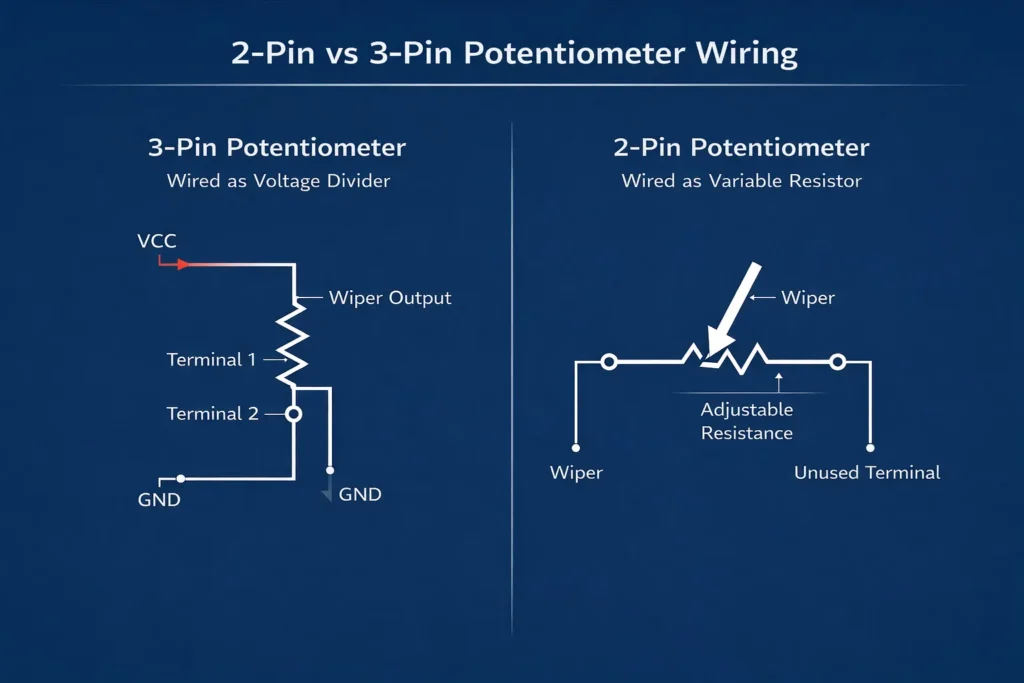
The potentiometer symbol represents a three-terminal variable resistor with a movable contact called the wiper. In schematics, the two outer terminals connect to the ends of the resistive track, while the arrow shows the adjustable wiper position. When all three terminals are used, the component works as a voltage divider. When only two terminals are used, it functions as a variable resistor.
- The arrow in the symbol marks the wiper, which is the adjustable terminal.
- A potentiometer normally has three terminals: two ends and one wiper.
- With three terminals connected, it acts as a voltage divider.
- With two terminals connected, it behaves like a variable resistor.
- The symbol shows electrical function, not always physical knob direction or pin view orientation.
What Is a Potentiometer Symbol?
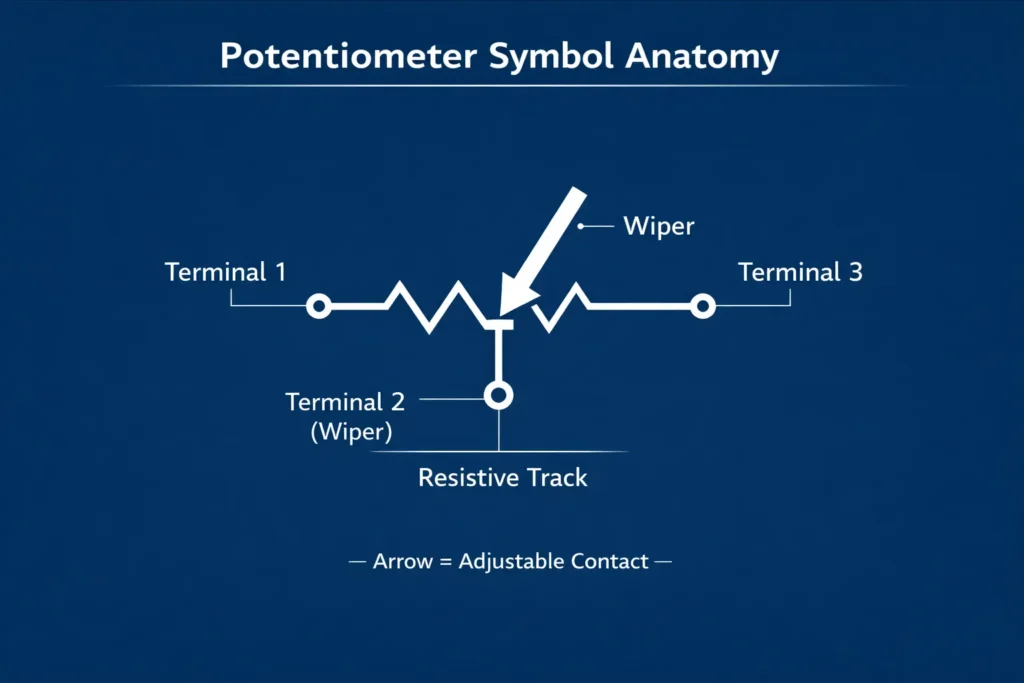
A potentiometer symbol is the schematic representation of a three-terminal adjustable resistor. It shows a resistive element with a movable contact, called the wiper, that can slide or rotate along the resistive track. This allows the component to produce an adjustable resistance ratio or an adjustable output voltage, depending on how it is wired.
In practical electronics, potentiometers appear in everything from volume knobs and brightness controls to calibration circuits, sensor interfaces, and analog input adjustment. If you want a broader overview of how the part works in real hardware, this complete guide to potentiometers is a useful companion resource.
The reason this symbol matters is simple: the potentiometer is not just “a resistor you can turn.” It is usually a control point in a circuit. The symbol tells you that the circuit designer wants an adjustable node, not just a fixed resistance.
How to Read the Potentiometer Symbol
Once you break the symbol into parts, it becomes much easier to understand:
Resistive Element
This is the resistor body, shown as either a zigzag line or a rectangular resistor block depending on the drawing standard.
Outer Terminals
The two ends of the resistive track connect to the outer pins. Measuring across them gives the full nominal resistance.
Wiper
The arrow or angled contact points to the resistor body and marks the adjustable output terminal.
The single most important thing to remember is that the arrow is the wiper. On a schematic, that is the point that moves electrically. In most voltage-divider circuits, that is also the output node that the rest of the circuit reads.
The drawing orientation does not always tell you how the shaft behaves physically in the real product. Always check pin numbering, datasheet orientation, and whether the drawing is referenced from the front side or solder side.
Common Potentiometer Symbol Variants
You may see different symbol styles depending on the schematic standard, ECAD library, or regional drafting convention. The appearance changes, but the electrical meaning stays the same.
| Symbol Style | Appearance | Typical Meaning |
|---|---|---|
| ANSI style | Zigzag resistor with arrow | Traditional resistor-style drawing used in many legacy schematics |
| IEC style | Rectangular resistor block with arrow | Common in international and modern CAD environments |
| Trim potentiometer | Potentiometer symbol with adjustment indication | Used for calibration or preset tuning rather than frequent user adjustment |
| Dual-gang potentiometer | Two linked pot sections | Two channels adjusted together, often used in stereo circuits |
| Rheostat configuration | Potentiometer used with only two terminals | Same part, but functioning as a variable resistor |
This is similar to how many other passive component symbols work: the graphical style may change, but the underlying function does not. The important part is recognizing the adjustable wiper and the three-terminal structure.
How the Potentiometer Symbol Works in a Circuit
The symbol can represent different practical uses depending on how the circuit connects the pins.
Potentiometer as a Voltage Divider
This is the most common configuration. The two outer terminals connect across a fixed voltage, and the wiper provides an adjustable fraction of that voltage as the output. This is how potentiometers are commonly used in analog controls, threshold adjustment, and microcontroller input circuits.
Outer terminal 1 → Ground
Wiper → Adjustable output
Outer terminal 2 → Supply voltage
In circuits like this, the potentiometer symbol tells you there is an adjustable node somewhere between the two reference points. Choosing a suitable resistance value matters here, and many designers start from common values explained in this potentiometer value guide.
Potentiometer as a Variable Resistor
If only the wiper and one outer terminal are used, the same component acts as a variable resistor. In this configuration, the effective resistance changes as the wiper moves. This arrangement is common in simple tuning, current trimming, timing adjustment, and low-power calibration circuits.
Three-Terminal Use
Electrical role: Voltage divider
Typical use: level control, analog reference, user input
Two-Terminal Use
Electrical role: Variable resistor
Typical use: trimming, gain setting, simple adjustment
Potentiometer Wiring Diagrams Explained
A schematic symbol shows function. A wiring diagram shows actual physical pin connections. Translating between the two is where many readers get confused, especially when they are working with breadboards, panel-mount controls, or modules that do not label the pins clearly.
Standard 3-Pin Potentiometer
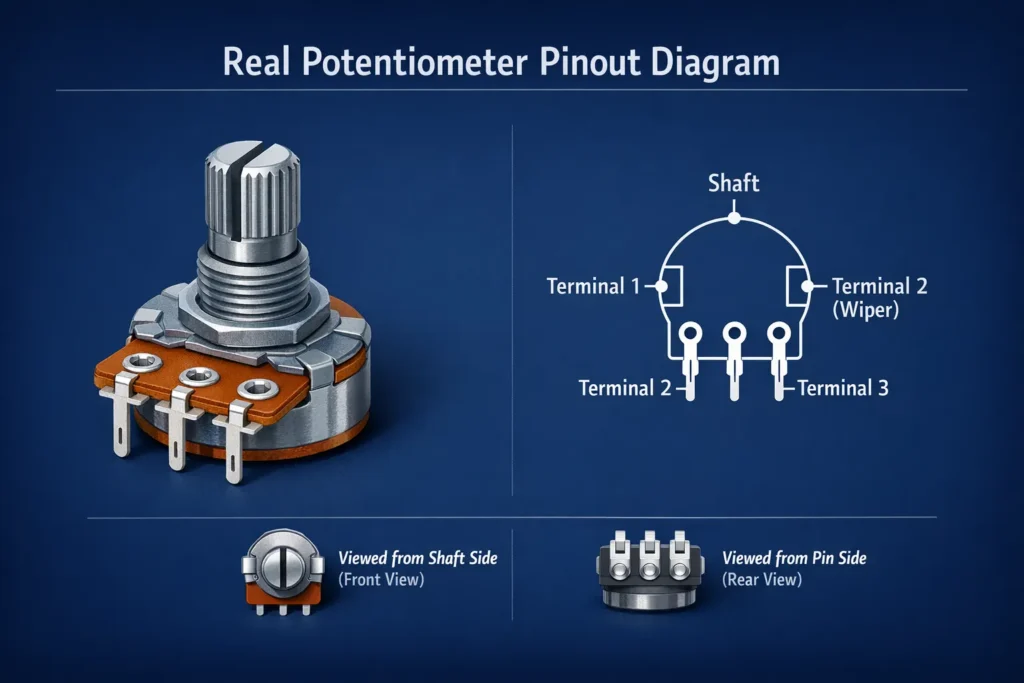
A typical potentiometer has three terminals:
- Pin 1: one end of the resistive track
- Pin 2: the wiper
- Pin 3: the opposite end of the resistive track
When used as a voltage divider, the two outer pins go to the voltage endpoints and the center pin becomes the adjustable output. If the knob response feels reversed, swapping the two outer pins will invert the control direction without changing the total resistance.
2-Pin Variable Resistor Wiring
To use a potentiometer as a variable resistor, connect the wiper and one outer terminal. The remaining outer pin may be left unconnected, or tied to the wiper in some low-power designs to avoid an open-circuit condition if the wiper contact becomes unreliable.
In real assemblies, always verify terminal numbering against the manufacturer’s datasheet. The same part may look different when viewed from the knob side versus the solder-pin side, which can easily lead to reversed wiring.
Practical Applications of the Potentiometer Symbol
Microcontroller Analog Input
A classic example is a potentiometer feeding an ADC input on a microcontroller. The wiper provides a variable voltage, making the symbol easy to interpret once you know it is acting as a voltage divider.
Audio Volume Control
Audio circuits often use a potentiometer symbol that looks almost identical to a general-purpose one, but the actual part may use an audio taper rather than a linear taper. That is why understanding the symbol alone is not enough. You also need to choose the right component characteristics for the application.
Display Contrast Adjustment
Small LCD modules often use a potentiometer to set contrast. In this case, the symbol usually represents a one-time or occasional adjustment rather than a front-panel user control.
Position or Displacement Sensing
Not every potentiometer is rotational. A linear device can represent physical position, especially in feedback or sensor applications. If you are comparing these form factors, linear vs rotary potentiometer differences are worth reviewing.
Common Mistakes When Reading or Wiring a Potentiometer
Assuming the Symbol Defines Knob Direction
The symbol shows electrical behavior, not always the final clockwise increase direction in the product.
Forgetting That the Arrow Is the Wiper
This is the most common beginner mistake and often leads to incorrect output wiring.
Using the Wrong Resistance Value
Too low wastes current. Too high may create loading or noise problems depending on the circuit.
Confusing Potentiometers with Trimmers or Rheostats
They are related, but intended use, adjustment method, and power expectations may differ.
Another frequent issue is assuming that every potentiometer symbol refers to a front-panel knob. In many circuits, it actually represents a small trim control meant only for setup or calibration.
Choosing the Right Potentiometer for the Diagram
Once you understand the symbol, the next step is choosing the right part. A good schematic reader should also think about what the designer intended in practice.
- Resistance value: Common options include 1k, 5k, 10k, 50k, and 100k.
- Taper: Linear taper is common for control and measurement; logarithmic taper is often used for audio.
- Mechanical format: Rotary, slide, trimmer, panel mount, or PCB mount.
- Power handling: Important when the part is used as a variable resistor rather than only as a divider.
- Reliability: Consider contamination, life cycle, tolerance, and environment.
For a more application-focused selection process, this potentiometer selection guide fits naturally after this article. If you are comparing common resistance values in practical design work, the well-known 10k baseline discussed in this 10k potentiometer overview is also useful context.
The potentiometer symbol is easy to interpret once you identify the wiper and remember the two main operating modes. Three connected terminals mean an adjustable voltage divider. Two connected terminals mean a variable resistor. The symbol is simple, but understanding how it maps to real wiring and real parts is what makes schematics easier to read and troubleshoot.
FAQ
Tip: Click each question below to expand the answer. This layout is useful for both readers and rich, scannable WordPress presentation.
What does the arrow mean in a potentiometer symbol?
The arrow represents the wiper, which is the movable contact that changes position along the resistive element. In many circuits, this is the adjustable output terminal.
How many terminals does a potentiometer have?
A standard potentiometer has three terminals: two outer terminals connected to the ends of the resistive track and one center or movable terminal connected to the wiper.
Is a potentiometer the same as a variable resistor?
A potentiometer is a three-terminal adjustable resistor device. When all three terminals are used, it usually works as a voltage divider. When only two terminals are used, it behaves like a variable resistor.
Why does my potentiometer seem to work backwards?
The control direction is usually reversed by swapping the two outer terminals. This does not change the total resistance, but it changes how the wiper output moves relative to rotation direction.
What potentiometer value is most common?
For many general-purpose voltage-divider applications, 10k is a very common choice because it provides a practical balance between current draw and circuit loading. However, the right value still depends on the application.