What Is ESP32? Why It’s the Best Beginner Microcontroller for IoT (ESP32 vs ESP8266 vs Arduino)
A complete engineering-level guide explaining what ESP32 is, how it compares to ESP8266 and Arduino UNO, which ESP32 models to choose, and how to move from beginner prototypes to production-ready IoT systems.
ESP32 is a wireless microcontroller platform developed by Espressif that integrates Wi-Fi and Bluetooth into a single chip. Compared with Arduino UNO, ESP32 offers significantly higher processing power, larger memory, and built-in connectivity without additional modules. Compared with ESP8266, ESP32 adds Bluetooth, more peripherals, better multitasking, and improved long-term scalability. For modern IoT development, ESP32 is widely considered the most balanced platform for beginners and production engineers alike.
What Is ESP32? (Technical Definition)
The ESP32 is a family of low-cost, low-power system-on-chip (SoC) microcontrollers developed by Espressif Systems. It integrates:
- 2.4 GHz Wi-Fi transceiver
- Bluetooth Classic + BLE
- Dual-core Xtensa (or RISC-V on C-series)
- Integrated SRAM and flash interface
- Multiple hardware peripherals (ADC, DAC, SPI, I2C, UART, PWM)
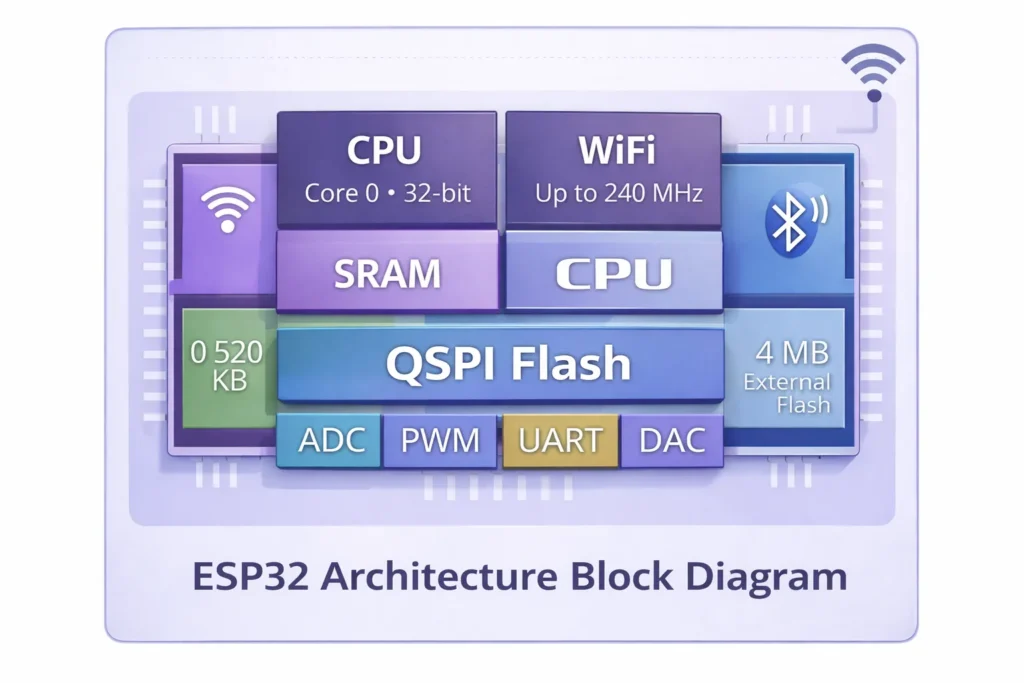
Unlike single-board computers such as Raspberry Pi, ESP32 runs firmware directly and does not require a full operating system. It is optimized for deterministic control, wireless communication, and embedded automation.
If you’re evaluating modules specifically, start here: What Is ESP32-WROOM-32D Used For?
What Can ESP32 Be Used For?
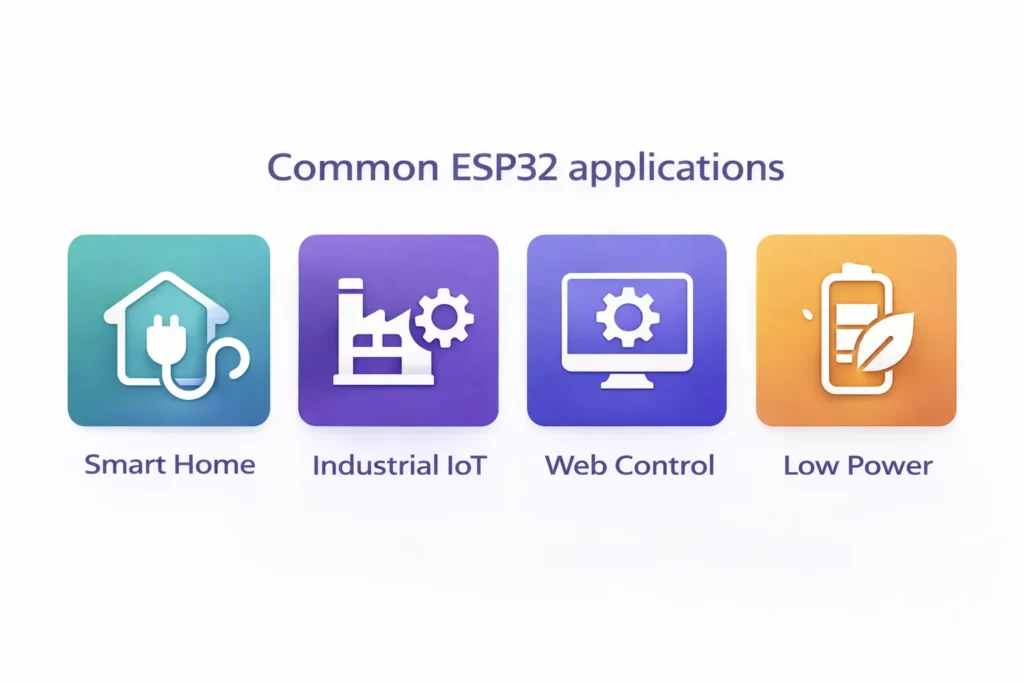
Smart Home Systems
ESP32 is widely used in smart home ecosystems due to its integrated Wi-Fi and Bluetooth capability. It powers Wi-Fi light switches, smart plugs, BLE-enabled locks, HVAC monitoring systems, and environmental sensors such as temperature and humidity nodes.
With built-in TCP/IP stack support, ESP32 devices can communicate directly with cloud platforms, mobile apps, or local home automation servers (such as Home Assistant). BLE support also enables secure device provisioning and smartphone-based configuration without additional hardware modules.
Industrial IoT Nodes
In industrial IoT (IIoT) deployments, ESP32 serves as a wireless data acquisition and remote monitoring controller. It is commonly used for collecting sensor data such as vibration, temperature, pressure, and current measurements from machinery and transmitting it to central dashboards.
Its dual-core architecture allows separation between networking tasks and real-time sensor sampling. Combined with MQTT, Modbus gateways, or REST APIs, ESP32 can act as a cost-effective industrial edge node in monitoring systems.
For small-scale industrial gateways or proof-of-concept monitoring systems, ESP32 offers a low-cost entry point before migrating to more complex industrial controllers.
Web-Based Control Systems
One of ESP32’s most powerful features is its ability to host an embedded web server directly on the microcontroller. Developers can create HTML-based control panels accessible via any browser without requiring external single-board computers.
This capability enables:
- Remote relay control
- Real-time sensor dashboards
- Wi-Fi configuration portals
- OTA firmware management interfaces
Because of its higher memory capacity compared to Arduino UNO, ESP32 can handle lightweight web frameworks and secure HTTPS communication, making it suitable for connected device control scenarios.
Low-Power Remote Devices
ESP32 supports multiple low-power modes, including deep sleep and RTC wake-up functionality. This allows battery-powered devices to operate for extended periods by waking only when sensor data needs to be transmitted.
Typical use cases include:
- Outdoor environmental monitoring
- Remote agricultural sensors
- Battery-powered BLE beacons
- Periodic reporting IoT nodes
Careful power design — including voltage regulator selection, sleep configuration, and RF transmission management — is critical to achieving stable operation.
Power design guide: ESP32 Power Consumption
ESP32 vs ESP8266 vs Arduino UNO (Engineering Comparison)
From a real engineering and procurement perspective, the platform decision depends on connectivity requirements, scalability, and lifecycle expectations.
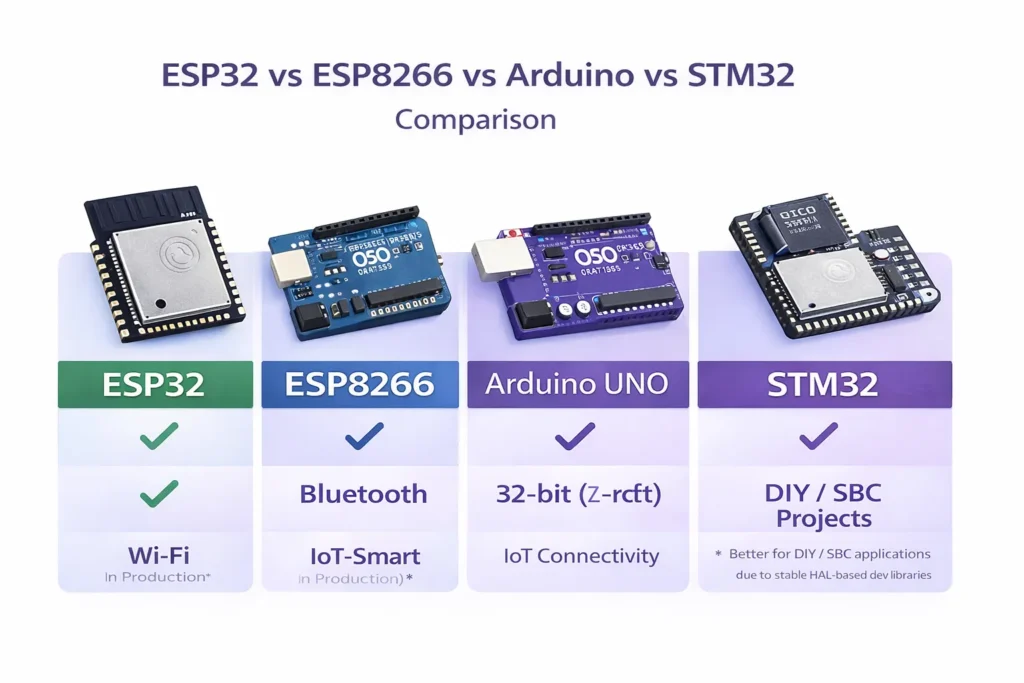
| Feature | ESP32 | ESP8266 | Arduino UNO |
|---|---|---|---|
| Wi-Fi | Built-in | Built-in | No |
| Bluetooth | BLE + Classic | No | No |
| Performance | Up to 240 MHz | 80/160 MHz | 16 MHz |
| Best Stage | Prototype → Production | Budget IoT | Education |
Detailed comparisons:
ESP32 Model Selection Guide & Strategy
ESP32 is not a single chip but a growing ecosystem. In reality, ESP32 is a family of SoCs designed around different priorities:
- Cost optimization
- Wireless protocol evolution
- USB-native integration
- AI / vector acceleration
- Low-power specialization
- Long-term roadmap positioning
This modular evolution is one reason ESP32 has remained relevant while many hobby platforms stagnated.
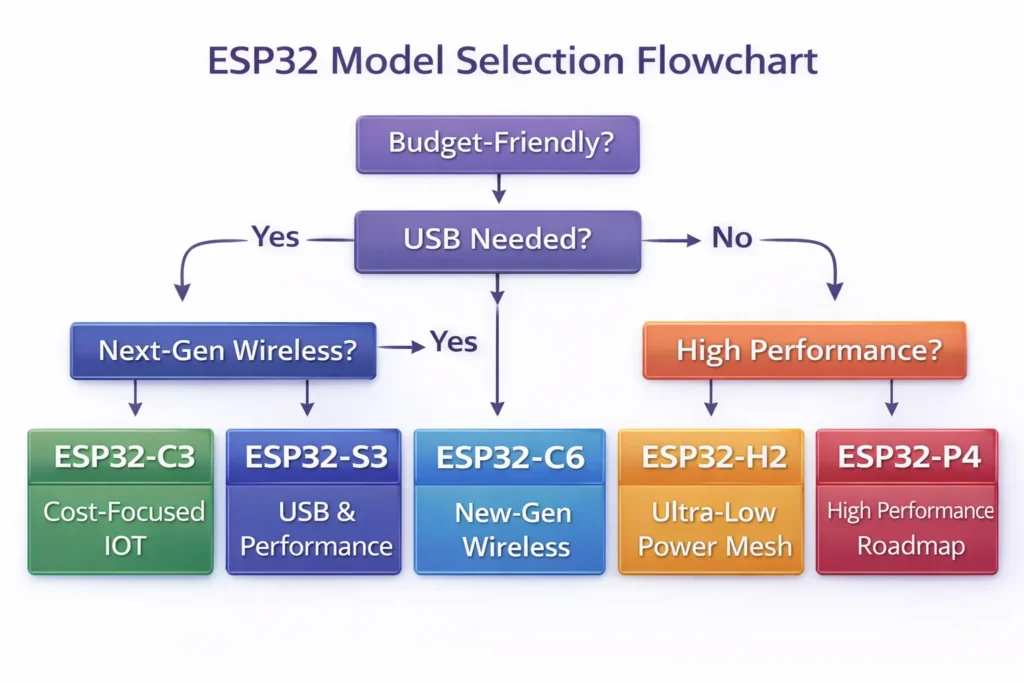
- ESP32-C3 – Cost-focused IoT platform built on a 32-bit RISC-V core.
Designed for budget-sensitive wireless devices such as smart plugs, Wi-Fi sensors, BLE gateways, and entry-level IoT nodes.
Compared to classic ESP32, it offers lower cost, improved security features, and Bluetooth LE support, making it a practical modern replacement for ESP8266 in production deployments. - ESP32-S3 – USB-native performance MCU optimized for advanced embedded applications.
It integrates native USB OTG, enhanced vector instructions, expanded GPIO flexibility, and improved peripheral mapping.
Ideal for smart displays, human-machine interfaces, multimedia IoT systems, and edge AI experimentation where higher processing capability and USB connectivity are required. - ESP32-C6 – Next-generation wireless-focused MCU targeting future IoT ecosystems.
Built for multi-protocol environments and evolving wireless standards, C6 positions itself as a forward-compatible solution for long-lifecycle connected products.
It is particularly suitable for infrastructure nodes, gateways, and advanced smart home deployments requiring expanded connectivity flexibility. - ESP32-H2 – BLE + Thread optimized solution for low-power mesh networks.
Focused on energy-efficient wireless communication, it is designed for battery-powered IoT nodes, smart lighting systems, and Matter-compatible ecosystems.
H2 emphasizes low-power operation and stable mesh networking rather than general-purpose Wi-Fi applications. - ESP32-P4 – High-performance roadmap MCU for advanced embedded and edge computing workloads.
Positioned beyond traditional IoT sensor nodes, P4 targets applications requiring higher computational throughput and expanded system capability.
It signals Espressif’s continued evolution toward more powerful and scalable embedded processing solutions.
ESP32 Model Ecosystem & Selection
Entry-Level & Cost-Optimized: ESP32-C3
The ESP32-C3 is built around a 32-bit RISC-V core instead of the original Xtensa architecture, marking a strategic shift in Espressif’s silicon roadmap. It integrates 2.4 GHz Wi-Fi and Bluetooth LE while maintaining a compact footprint and reduced cost profile.
Compared to the original ESP32, C3 reduces power consumption and BOM cost while preserving essential wireless performance. For many production IoT deployments, it has effectively replaced ESP8266 as the default entry-level platform due to better security, BLE support, and long-term ecosystem alignment.
Designed for:
- Cost-sensitive IoT nodes
- Smart plugs and relays
- Wi-Fi environmental sensors
- BLE gateways
- Simple connected devices
Why engineers choose C3:
- Lower cost compared to classic ESP32
- Sufficient performance for IoT workloads
- Wi-Fi + BLE in a compact footprint
For many production IoT devices, ESP32-C3 is the modern replacement for ESP8266.
Performance & USB Integration: ESP32-S3
The ESP32-S3 represents the performance-oriented mainstream branch of the ESP32 family. It introduces native USB OTG support, expanded vector instruction capabilities, and improved peripheral mapping flexibility. These enhancements make it suitable for more complex firmware architectures.
Key advantages:
- USB-connected embedded devices
- Enhanced vector instructions
- Improved AI inference capability
- More GPIO flexibility
- Smart displays and HMI systems
- Edge AI experimentation
- Audio processing and multimedia IoT
Ideal for:
- USB-connected devices
- Smart displays
- Edge AI experiments
- Audio or multimedia IoT products
With enhanced instruction acceleration and increased GPIO versatility, S3 is particularly attractive for applications requiring USB device emulation, HID interfaces, or moderate signal processing tasks. Developers moving beyond simple Wi-Fi sensor nodes often adopt ESP32-S3 as their primary development target. When developers move beyond basic sensor nodes, S3 often becomes the preferred choice.
Product references: ESP32-S3-WROOM-2N32R16V Module
Next-Generation Wireless: ESP32-C6
ESP32-C6 reflects Espressif’s long-term connectivity roadmap and multi-protocol direction. Built with future wireless infrastructure in mind, it focuses on improved coexistence, expanded protocol support, and forward-compatible IoT deployment strategies.
It targets:
- Future-oriented wireless standards
- Mesh and multi-protocol ecosystems
- IoT gateways and infrastructure nodes
Strategic relevance:
- Multi-protocol environments
- Mesh networking
- Edge gateway systems
Comparison: ESP32-C6 vs ESP32-S3
As IoT environments increasingly require multi-radio coexistence and protocol flexibility, C6 offers a forward-looking silicon option. For developers building long-lifecycle products that must remain compatible with evolving connectivity ecosystems, ESP32-C6 provides strategic alignment with emerging standards.
Ultra-Low Power & Specialized Wireless: ESP32-H2
The ESP32-H2 is optimized for low-power wireless communication, focusing primarily on Bluetooth LE and Thread networking. Unlike general-purpose ESP32 variants, H2 targets highly efficient mesh-based IoT ecosystems and battery-operated deployments.
The ESP32-H2 focuses on:
- BLE
- Thread
- Low-power mesh networking
Particularly suitable for:
- Smart lighting systems
- Battery-powered IoT nodes
- Matter-compatible ecosystems
Its architecture is particularly relevant as the industry transitions toward standardized smart home frameworks such as Matter. By prioritizing low-energy communication and mesh networking stability, ESP32-H2 supports next-generation distributed IoT environments.
High-Performance Roadmap: ESP32-P4
The ESP32-P4 signals Espressif’s expansion beyond classic IoT microcontroller roles into higher computational domains. It is positioned for applications requiring stronger processing throughput, expanded memory interfaces, and more advanced embedded workloads. The ESP32-P4 indicates Espressif’s expansion beyond traditional IoT nodes.
It targets:
- Higher computational workloads
- Advanced embedded applications
- Future edge processing scenarios
- High-performance IoT gateways
- Future AI-assisted edge devices
This demonstrates that the ESP32 ecosystem is continuously evolving rather than remaining static.
If you’re comparing next-gen architectures: read ESP32-C6 vs ESP32-S3 SoC Comparison
Beginner to Production: Recommended Path
- Start with Arduino IDE
- Understand module variants (WROOM vs S3 vs C3)
- Master power design and RF layout basics
- Move to PlatformIO for scalable firmware
- Evaluate supply chain reliability
PlatformIO setup: ESP32-S3 PlatformIO Guide
Why ESP32 Is the Strategic Choice for Modern IoT
For beginners, ESP32 removes friction by integrating wireless directly into the MCU.
For engineers, it offers a scalable ecosystem with multiple SoC variants.
For procurement teams, Espressif maintains strong lifecycle support compared to many hobby platforms.
That combination makes ESP32 uniquely positioned between Arduino simplicity and STM32 industrial control.
ESP32 Frequently Asked Questions
Is ESP32 better than Arduino?
For wireless IoT applications, ESP32 offers built-in Wi-Fi and Bluetooth, making it more powerful and scalable than Arduino UNO.
Should I choose ESP32 or ESP8266?
ESP32 adds Bluetooth, more peripherals, and better multitasking compared to ESP8266.
Which ESP32 model should I buy?
For cost-focused IoT use ESP32-C3. For USB-native development choose ESP32-S3.