
Optocouplers
Optocouplers, also known as opto-isolators or photocouplers, are electronic components that transfer signals between two isolated circuits using light. They typically consist of an LED on the input side and a photosensitive device – such as a phototransistor, diode array, or triac – on the output side. Because the input and output are optically linked without direct electrical connection, optocouplers provide excellent electrical isolation, noise immunity, and protection against high-voltage transients.
They are widely used in power supplies, industrial control systems, communication interfaces, and motor drive circuits.
Showing all 9 results
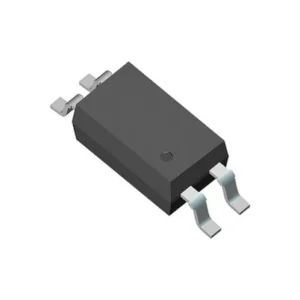
- Balanced CTR (63–125 %) with Safety Compliance: Offers moderate drive while assuring safe-isolation certification.
- High Isolation Performance: Ensures electrical separation in demanding systems at 3750 VRMS rating.
- Compact Tape-and-Reel Format: "T" suffix allows efficient SMT integration; “X001” ensures agency approved variant.
- High CTR at Low Input Current: The -3 bin (100 %–200 %) enables efficient signal coupling even with minimal LED drive, beneficial for low-power designs.
- High Isolation Voltage: With a 3750 VRMS isolation test rating and repetitive peak isolation well over 500 V, it safeguards high-voltage to low-voltage interfaces.
- Compact Low-Profile Package: SSOP-4 half-pitch package allows slim board real estate usage, making this optocoupler suitable for space-constrained applications.
- Safety-Certified Isolation (Option 1): This variant includes the “X001” safety option making it compliant for applications requiring guaranteed insulation separation (e.g., per IEC standards).
- 100-200 % CTR Bin: High transfer ratio helps reduce LED drive current, improving efficiency and reducing system power consumption.
- Compact Tape-and-Reel Packaging: “T” suffix indicates reel packaging, facilitating automated surface-mount assembly flows.
- Compact High-Performance Isolation Device: Delivers full isolation performance in a minimal footprint.
- Low Input Drive Requirement: Compatible with designs where LED drive current is constrained.
- Robust Voltage Ratings: With 80 V VCEO and 3750 VRMS isolation, it withstands demanding electrical environments.
- Mid-Range CTR (80–160 %): Well matched for designs with moderate LED drive and cost-sensitive requirements.
- High Isolation Assurance: 3750 VRMS isolation ensures safe separation between input/output circuits in noisy or high-voltage environments.
- Space-Efficient Packaging: The SSOP-4 format allows minimal board real estate while delivering full isolation performance.
- Very High CTR (130–260 %): Enables ultra-low drive currents from the LED side, reducing power consumption.
- Strong Isolation Capability: 3750 VRMS isolation ensures robust separation of circuits in harsh electrical environments.
- Compact SSOP-4 Mini-Flat Package: Designed for PCB area savings and surface-mount reliability.
- Extremely Flexible CTR Range (50–600 %): Allows designers to optimize LED drive and circuit coupling across a wide range of applications.
- Certified Option 1 Insulation: The “X001” version ensures compliance with safety insulation standards, making the part suited for critical medical/industrial isolation.
- Compact and SMT-ready Form Factor: The SSOP-4 package and tape-and-reel (T suffix) format streamline automated assembly in compact systems.
- Wide CTR Range (50–600 %): Provides selection flexibility for designers to match input current and drive conditions.
- High Isolation Performance: With 3750 VRMS test rating and robust insulation distances, it delivers reliable electrical separation.
- Compact Packaging, Robust Design: The SSOP-4 package allows integration into dense PCBs while delivering high performance.
- Efficient Isolation with Moderate CTR: The 63-125 % CTR bin balances input drive and cost, suitable for many mainstream isolation tasks.
- High Isolation Voltage: Like the rest of the series, this part provides 3750 VRMS isolation, ensuring safety between high-voltage and low-voltage domains.
- Space-Saving SSOP-4 Package: Enables use in compact PCB footprints, fitting well in modern dense electronic designs.
Optocouplers, also known as opto-isolators or photocouplers, are components that transmit electrical signals using light while providing complete galvanic isolation between circuits. Their operating principle is straightforward yet highly effective: an LED (or another light-emitting device) on the input side emits light when energized, and a photosensitive device on the output side detects this light and converts it back into an electrical signal.
Since no direct electrical connection exists between the input and output stages, optocouplers provide strong protection against high voltages, electrical noise, and transient disturbances – safeguarding low-voltage control circuitry from high-voltage power stages.
In practical systems, optocouplers are widely used in power isolation, digital communication interfaces, motor and power device isolation, industrial automation, and control systems.
Optocouplers Types
Optocouplers can be categorized by output element type, application environment, and functional characteristics. The following sections explain each category in detail, covering structure, advantages, limitations, and common use cases.
Phototransistor Output Optocouplers
Structure and Characteristics
This type consists of an LED on the input side and a phototransistor on the output side.
It functions as a simple transistor-based switch, offering stable performance, straightforward design, and low cost.
Typical models include PC817, 4N25, and similar widely adopted components.
Advantages
-
Highly versatile and suitable for most low-speed isolation applications
-
Low cost and widely available
-
Easy to integrate into analog and digital circuits
-
Mature, stable, and reliable in production
Disadvantages
-
Slower response time; not suitable for high-speed or high-frequency switching
-
CTR (Current Transfer Ratio) varies with temperature, aging, and LED brightness
-
Limited bandwidth for rapid communication
Common Applications
-
Isolation between microcontrollers and high-voltage circuits
-
Low-frequency digital signal isolation
-
Power supply feedback and analog signal isolation
-
General-purpose switching isolation
Darlington Output Optocouplers (Darlington Phototransistor)
Structure and Characteristics
The output stage uses a Darlington transistor pair, effectively connecting two transistors in series to significantly boost current gain. This makes it ideal for driving larger loads compared to standard phototransistor output types.
Advantages
-
Very high current gain (suitable for driving relays or heavier loads)
-
Maintains the same isolation benefits as standard phototransistor optocouplers
-
Excellent for low-speed but high-current applications
Disadvantages
-
Slower switching speed due to the two-stage transistor amplification
-
Slightly higher input current and power consumption
-
Limited use in fast digital communication
Typical Applications
-
Relay driving and isolated switching modules
-
Industrial control systems requiring amplified output signals
-
Buffer stages between microcontrollers and power components
-
Isolation for motor control or high-power switching devices
SCR / TRIAC Output Optocouplers (Photo-SCR / Photo-TRIAC)
Structure and Characteristics
These optocouplers employ an SCR (Silicon-Controlled Rectifier) or TRIAC at the output, enabling them to handle AC loads and perform high-voltage switching safely.
This makes them ideal for applications that require isolation between low-voltage control circuits and mains-level AC power.
Advantages
-
Direct control of AC loads with galvanic isolation
-
Capable of handling high voltages and large AC switching currents
-
Suitable for ON/OFF control in household appliances and industrial systems
Disadvantages
-
Not compatible with high-speed digital signal transmission
-
Requires specific triggering conditions (gate current, holding current, etc.)
-
Typically supports only switching functions, not high-precision control
Common Applications
-
AC dimmers and lighting control
-
Household appliances and smart home devices
-
Motor speed controllers
-
High-voltage AC switching modules
-
Industrial automation involving AC loads
Logic / High-Speed Optocouplers
Structure and Characteristics
Designed for high-speed digital signal isolation, these optocouplers use a high-efficiency photodiode combined with amplification or specially designed logic output circuits.
They often provide TTL or CMOS-compatible levels, making them perfect for digital communication interfaces.
Advantages
-
High data rate capability (tens of Mbps or higher)
-
Low propagation delay
-
Excellent for isolating clock lines, serial interfaces, and digital buses
-
Strong noise immunity with high CMTI (Common-Mode Transient Immunity)
Disadvantages
-
Higher cost than basic phototransistor types
-
Requires careful PCB layout for optimal performance
-
More sensitive to electrical noise if not properly designed
Typical Applications
-
Isolation between microcontrollers/FPGA and high-voltage equipment
-
Isolated data communication (USB, UART, SPI, I²C)
-
Inverter and motor drive control signals
-
Switching power supply feedback requiring high-speed response
-
High-performance industrial control systems
Other / Specialized Optocoupler Types
Photoresistor (Vactrol / LDR Output)
-
Uses a light-dependent resistor (LDR) on the output
-
Very slow response time
-
Suitable for analog signal control, especially smooth transitions
-
Common in audio circuits (e.g., guitar effects, compressors)
Reflective or Slotted Optosensors
-
Designed for object detection or movement sensing, not electrical isolation
-
Operate by detecting light interruption or reflection
-
Used in printers, encoders, tachometers, and position sensors
Although useful for specific applications, these types are less commonly used for general signal isolation.
Selection Guidelines & Key Considerations
When choosing an optocoupler, engineers should evaluate:
Isolation Voltage
Different models offer varying isolation ratings—often up to several kilovolts—to protect against high-voltage surges.
Data Rate / Response Time
High-speed digital interfaces require high-speed logic optocouplers.
Low-speed controls can use phototransistor or Darlington types.
Output Type and Load Capability
-
Phototransistor → low/medium current
-
Darlington → high current
-
SCR/TRIAC → AC loads
-
High-speed logic → fast digital signals
Signal Type (AC or DC)
AC loads require TRIAC or SCR-based models.
DC loads can use phototransistor or logic output types.
Noise Immunity / CMTI
Critical in industrial environments with frequent voltage spikes.
Packaging, Creepage, Life Expectancy
PCB layout, insulation distance, and thermal considerations affect system reliability.
Overall, selecting the correct optocoupler depends heavily on the application—whether the focus is digital communication, analog isolation, AC load switching, or industrial noise mitigation.
Optocoupler Comparison Table
| Category | Output Device | Speed | Output Drive | Typical Use | Pros | Cons |
|---|---|---|---|---|---|---|
| Phototransistor | NPN/PNP transistor | Low–Medium | Medium | General isolation, low-speed logic | Low cost, widely available | Slow, CTR variation |
| Darlington | Darlington pair | Low | High | Relay drive, industrial control | High gain | Slowest switching |
| SCR / TRIAC | Photo-SCR / TRIAC | Low | High (AC loads) | AC switching, dimming, appliances | Handles AC mains | Not for digital signals |
| High-speed / Logic | Photodiode + amplifier | High | Low–Medium | Communication, digital isolation | Fast, low delay | Higher cost |
| Photoresistor (Vactrol) | LDR | Very Low | Variable | Audio, analog control | Smooth analog behavior | Very slow |
Summary
Optocouplers play a crucial role in providing electrical isolation between circuits, preventing interference, and protecting sensitive electronics.
They can be grouped into phototransistor types, Darlington types, SCR/TRIAC types, high-speed logic types, and specialized optosensors.
Understanding their differences in structure, performance, and application scenarios allows engineers to select the ideal device for any isolation requirement—improving performance, safety, and long-term reliability of electronic systems.