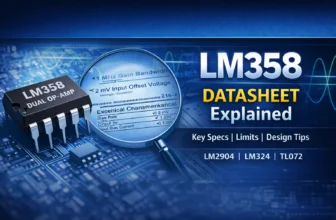
What Is LM358 and Why Is It Still Used in Modern Designs?
The LM358 is a general-purpose dual operational amplifier (op amp) designed for single-supply or dual-supply operation. It integrates two independent, internally compensated op amps in a single package, making it suitable for a wide range of analog signal-processing tasks.
Unlike many traditional operational amplifiers that require dual ± power rails, LM358 can operate from a single supply as low as 3 V, while allowing the input common-mode voltage range to include ground. This feature significantly simplifies circuit design in low-voltage and battery-powered systems.
Key reasons LM358 IC remains popular today:
- Proven design with decades of field use
- Single-supply operation capability
- Low power consumption
- Wide operating temperature range
- Multiple package options for different assembly methods
- Long-term production from major semiconductor manufacturers
For procurement teams, LM358 offers another major advantage: stable global availability. Parts such as LM358N (DIP-8) and LM358DR (SOIC-8) are commonly stocked by authorized electronic components distributors.
LM358 Key Electrical Specifications (Quick Reference)
The table below summarizes the most commonly referenced electrical characteristics of LM358. These parameters are often used by engineers during initial component selection.
| Parameter | Typical Value |
|---|---|
| Supply Voltage Range | 3 V to 32 V (single supply) |
| Number of Amplifiers | 2 |
| Input Offset Voltage | 2 mV (typical) |
| Input Bias Current | 20 nA |
| Slew Rate | 0.3 V/µs |
| Gain Bandwidth Product | 1 MHz |
| Output Current | 20 mA |
| Operating Temperature | –40°C to +85°C |
While the table above summarizes key parameters, real-world behavior often depends on operating conditions and load characteristics. For practical interpretation and design considerations, refer to the LM358 datasheet explained guide.
LM358 Supply Voltage, Input Range, and Output Characteristics
LM358 supports a wide supply voltage range from 3 V to 32 V, enabling both single-supply and split-supply configurations. Its input common-mode range includes ground, which is especially valuable in low-side sensing and single-supply analog circuits.
The output stage can swing close to ground under light load conditions, though it does not reach the positive supply rail. Designers should account for this limitation when defining output headroom.
LM358 Speed, Bandwidth, and Gain Limitations
With a typical gain bandwidth product of 1 MHz and a slew rate of 0.3 V/µs, LM358 is optimized for low-frequency and low-speed applications. It is not intended for high-speed signal amplification or precision instrumentation.
Understanding these limitations early helps engineers avoid over-specifying LM358 in applications where higher bandwidth or faster transient response is required.
LM358 Package Types and Ordering Options
LM358 is available in several package types to support different production and assembly requirements. Choosing the correct package is critical for manufacturing efficiency and long-term supply stability.
LM358N (DIP-8) for Prototyping and Through-Hole Designs
LM358N is packaged in an 8-pin DIP (Dual In-Line Package), making it ideal for:
- Prototyping and development boards
- Educational and laboratory use
- Industrial maintenance and repair
- Legacy through-hole designs
DIP versions remain popular in industrial and service applications where manual soldering or socketing is required.
LM358DR (SOIC-8) for High-Volume Surface-Mount Production
LM358DR comes in an SOIC-8 package, commonly used in:
- High-volume automated assembly
- Consumer electronics
- Industrial control boards
- Power management modules
SOIC packages offer a strong balance between compact size and ease of PCB layout, making them one of the most widely stocked LM358 variants.
LM358DT (TSSOP-8) for Space-Constrained Applications
For space-constrained applications, LM358DT in TSSOP-8 is preferred. Typical use cases include:
- Compact sensor modules
- Portable devices
- Dense multi-channel boards
When selecting a package, buyers should also consider packaging format (tube, tray, or tape & reel), especially for automated production lines.
LM358 Pinout (DIP-8 / SOIC-8)
The LM358 dual operational amplifier is available in an 8-pin package, commonly in DIP-8 and SOIC-8 formats. The pin configuration is identical across package types, allowing seamless transition from prototyping to surface-mount production.
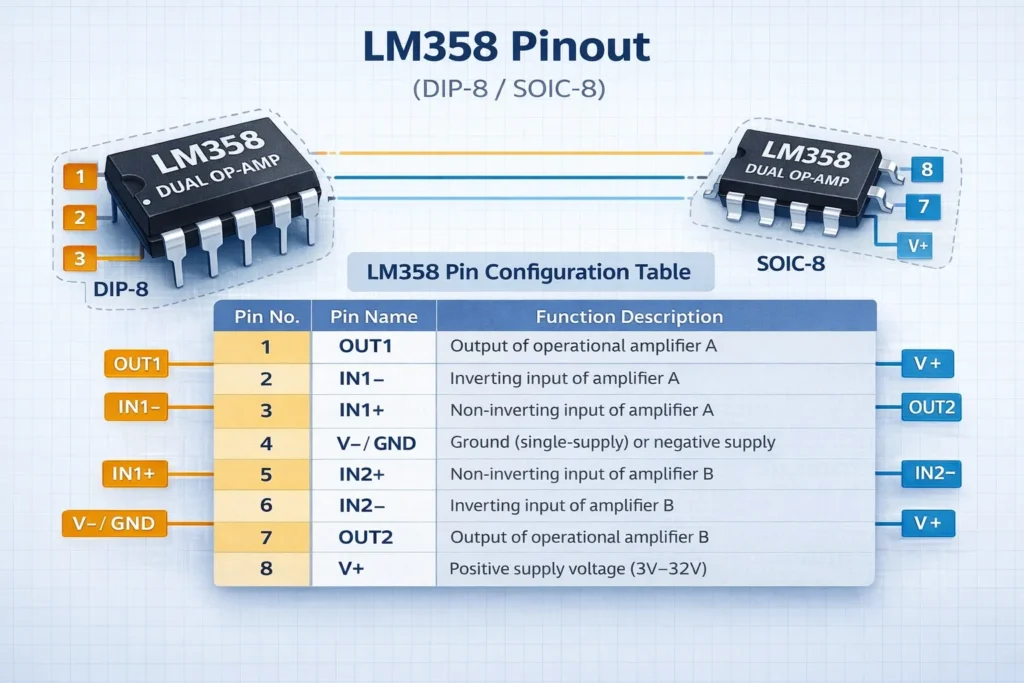
LM358 Pin Configuration Table
| Pin No. | Pin Name | Function Description |
|---|---|---|
| 1 | OUT1 | Output of operational amplifier A |
| 2 | IN1− | Inverting input of amplifier A |
| 3 | IN1+ | Non-inverting input of amplifier A |
| 4 | V− / GND | Ground (single-supply) or negative supply |
| 5 | IN2+ | Non-inverting input of amplifier B |
| 6 | IN2− | Inverting input of amplifier B |
| 7 | OUT2 | Output of operational amplifier B |
| 8 | V+ | Positive supply voltage (3V–32V) |
Understanding the LM358 Pin Layout
When viewing the chip from the top:
- Pins are numbered counter-clockwise.
- Pin 1 is marked by a notch or dot.
- The two op amps (A and B) are internally independent.
Each amplifier consists of:
- One non-inverting input (+)
- One inverting input (−)
- One output
Power Supply Pins Explained
Pin 8 – Positive Supply (V+)
- Supports 3V to 32V in single-supply mode
- Can operate with dual supplies (±1.5V to ±16V)
- Common usage: +5V, +9V, +12V
Pin 4 – Ground or Negative Supply (V−)
- Connected to GND in single-supply systems
- Connected to negative rail in dual-supply configurations
👉 This ground-referenced input structure is what makes LM358 especially suitable for low-voltage and battery-powered applications.
For a deeper explanation of supply limitations and output swing behavior, see the LM358 datasheet explained.
Single-Supply vs Dual-Supply Pin Usage
Single-Supply Configuration (Most Common)
- Pin 8 → +V
- Pin 4 → GND
Used in:
- Sensor interfaces
- ADC front-end circuits
- Battery-powered designs
Dual-Supply Configuration
- Pin 8 → +V
- Pin 4 → −V
Used when symmetrical output swing around ground is required.
Practical LM358 Pinout Design Tips
- Always decouple Pin 8 to Pin 4 with 0.1µF capacitor
- Tie unused inputs to a defined voltage
- Do not exceed input voltage beyond supply rails
- Remember: output does not swing to the positive rail
For package-specific availability, engineers commonly select variants such as the LM358N DIP-8 package or the LM358DR SOIC-8 package depending on assembly requirements.
Common LM358 Applications in Industrial and Consumer Electronics
LM358 is not designed for high-speed or precision instrumentation use, but it excels in general-purpose analog signal processing. Its characteristics make it particularly suitable for the following applications:
Sensor Signal Conditioning and Analog Front-End Circuits
LM358 is widely used to amplify and condition low-level signals from temperature sensors, pressure sensors, current shunts, and photodiodes. Its ground-referenced input capability simplifies analog front-end design.
Battery-Powered and Low-Voltage Systems
Low quiescent current and single-supply operation make LM358 suitable for battery-powered instruments, handheld devices, and portable measurement systems.
Industrial Control, Monitoring, and Feedback Loops
In industrial environments, LM358 commonly appears in PLC I/O modules, motor control feedback circuits, and power monitoring systems, where stability and long-term availability are critical.
Audio Buffering and Low-Frequency Signal Processing
While not intended for high-fidelity audio, LM358 is often used in audio buffering, tone control, and low-frequency amplification where performance requirements are modest.
LM358 vs Other Operational Amplifiers: When to Choose Alternatives
Although LM358 is highly versatile, it is not always the optimal choice. Engineers may consider alternatives depending on performance requirements.
In some designs, LM358 may not be the optimal choice due to temperature, bandwidth, or noise constraints. A detailed comparison of drop-in replacements and performance upgrades is available in this LM358 alternatives and equivalents guide.
Common comparisons include:
- LM358 vs LM2904 – Similar architecture, often automotive-qualified
- LM358 vs TL072 – Higher bandwidth and lower noise, but requires dual supply
- LM358 vs LM324 – Quad op amp version for multi-channel designs
In some cases, newer low-power or rail-to-rail operational amplifiers may be better suited for modern designs. However, LM358 remains a strong choice where cost, availability, and simplicity are priorities.
LM358 vs LM2904 for Automotive and Industrial Use
LM2904 is often considered an automotive-grade counterpart to LM358, offering similar electrical behavior with extended qualification options.
LM358 vs TL072 for Noise and Bandwidth Requirements
TL072 provides higher bandwidth and lower noise performance but typically requires dual supply rails, making it less suitable for simple single-supply designs.
LM358 vs LM324 in Multi-Channel Designs
LM324 op amps integrates four op amps in a single package and is often chosen when multiple channels are required within the same design.
LM358 Availability, Lifecycle Status, and Long-Term Supply
One of LM358’s strongest advantages is its long and stable lifecycle. It is actively manufactured by multiple reputable semiconductor suppliers, reducing the risk of sudden end-of-life notices.
Lifecycle Status
- Actively produced
- Not approaching EOL
- Widely second-sourced
This makes LM358 a safe choice for long-term industrial and commercial projects.
Is LM358 Approaching End of Life?
LM358 is actively manufactured by multiple semiconductor suppliers and is not approaching end-of-life. Its multi-source status significantly reduces supply chain risk.
Multi-Source Manufacturing and Second-Sourcing Benefits
Multiple original manufacturers ensure continuity of supply and compatibility across production batches.
How to Source LM358 Safely from Reliable Distributors
Due to its popularity, LM358 is also a common target for counterfeit components. Risks increase when sourcing from unverified suppliers or secondary markets.
To minimize risk:
- Source from authorized or well-established distributors
- Verify date codes and packaging
- Avoid unusually low-priced offers without traceability
Reputable electronic components distributors provide documentation, batch traceability, and quality control processes to ensure authenticity.
Avoiding Counterfeit LM358 Components
Due to its popularity, LM358 is frequently targeted by counterfeiters. Buyers should verify traceability, packaging, and date codes when sourcing electronic components.
Packaging Options, MOQ, and Lead Time Considerations
Understanding tube, tray, and tape-and-reel packaging options helps optimize procurement and manufacturing efficiency.
Why Authorized and Experienced Distributors Matter
Authorized and experienced electronic components distributors provide quality control, documentation, and long-term sourcing support.
How to Select the Right LM358 Variant for Your Design
When selecting an LM358 part number, consider the following factors:
- Package type – DIP, SOIC, or TSSOP
- Operating temperature range – Commercial vs industrial
- Assembly method – Manual or automated
- Supply voltage and environment
For volume production, discussing availability and lead times with a distributor early in the design phase can prevent supply chain issues later.
Choosing Between DIP, SOIC, and TSSOP Packages
Package selection depends on assembly method, board density, and production volume.
Operating Temperature and Environmental Factors
Designers should confirm operating temperature ranges and environmental requirements before finalizing part numbers.
LM358 Frequently Asked Questions (FAQ)
Is LM358 Suitable for Single-Supply Operation?
Yes. LM358 is specifically designed for single-supply operation and includes ground in its input common-mode range.
Can LM358 Output Swing to Ground or the Supply Rail?
The output can swing close to ground but does not reach the positive rail.
Is LM358 Still Recommended for New Designs?
Yes, for general-purpose and cost-sensitive applications where high speed or rail-to-rail performance is not required.
Summary: When LM358 Is the Right Choice
LM358 remains a dependable solution for general-purpose analog designs that require single-supply operation, low power consumption, and long-term availability. Its wide adoption across industries makes it a safe and practical choice for both engineers and procurement teams.