


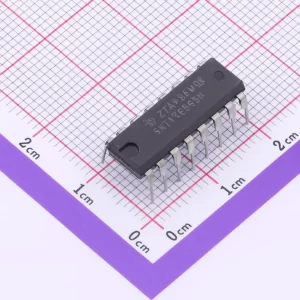
SN74HC595N TI SN74HC595N – Through-Hole 8-Bit Shift Register with Output Storage
- Through-hole DIP package – Ideal for prototyping and repairs
- 15 LSTTL load drive capability – Strong output for direct loads
- Cascadable serial output – Expand to unlimited bits
TI SN74HC595N Shift Register – Reliable Parallel Output Expansion for Embedded Systems
The SN74HC595N is a high-reliability through-hole implementation of Texas Instruments’ 74HC595 shift register, packaged in a rugged 16-pin PDIP (Plastic Dual In-line Package). This device combines serial-to-parallel conversion capability with output latching functionality in a single IC, making it exceptionally versatile for both modern and legacy digital systems.
Core Functional Architecture:
- 8-bit Shift Register:
- Serial input (SER) accepts data at rates up to 29MHz at 6V supply
- Positive-edge triggered serial clock (SRCLK) controls data shifting
- Direct clear input (SRCLR) asynchronously resets all register bits
- Output Storage Register:
- Separate positive-edge triggered register clock (RCLK)
- Double-buffered architecture prevents data corruption during shifting
- Storage register holds data until explicitly updated
- Output Stage:
- Parallel 3-state outputs (Qa-Qh) with 6mA source/sink capability
- High-impedance state controlled by active-low output enable (OE)
- Cascading output (Qh’) for multi-device daisy-chaining
Enhanced Material Properties:
- Gold-Plated Kovar Leads:
- 1.27μm minimum gold plating over nickel barrier
- Compatible with wave, reflow, and hand soldering processes
- Withstands >50 insertion/removal cycles in socket applications
- High-Temperature Mold Compound:
- 150°C maximum storage temperature rating
- UL94 V-0 flame retardant certification
- 67°C/W thermal resistance (junction-to-ambient)
Electrical Performance Advantages:
- Noise Immunity:
- CMOS technology provides 30% Vcc noise margin (typical)
- Balanced propagation delays (tPHL/tPLH) minimize output skew
- 100mA power supply decoupling recommended
- Power Efficiency:
- 80μA max quiescent current at 6V
- Symmetrical output drive reduces switching noise
- Output transition control prevents shoot-through currents
Legacy System Compatibility:
- Maintains pin-for-pin compatibility with:
- Original 74LS595 TTL devices (with level shifting)
- 4000-series CMOS equivalents (CD4094, etc.)
- Industry-standard 16-pin DIP layouts
Reliability Features:
- 2000V HBM ESD protection on all pins
- Output short-circuit protection (<35mA continuous)
- Latch-up performance exceeds 250mA per JESD78
This combination of technical attributes makes the SN74HC595N particularly suitable for applications requiring long-term field serviceability, including industrial control systems, test equipment maintenance, and educational electronics platforms where through-hole components remain preferred. The device’s robust construction ensures reliable operation in environments with mechanical vibration, temperature cycling, and occasional ESD events that would challenge surface-mount alternatives.
SN74HC595N Shift Register Specifications
General Characteristics
| Parameter | Specification |
|---|---|
| Manufacturer | Texas Instruments |
| Series | 74HC |
| Base Part Number | 74HC595 |
| Lifecycle Status | Active |
| Lead Time | 6 weeks |
| Package Type | 16-DIP (300mil) |
| Dimensions | 19.3×6.35×5.08mm |
| Weight | 951.69mg |
| MSL Rating | Level 1 (Unlimited) |
| RoHS Compliance | ROHS3 Compliant |
| Lead-Free | Yes |
Electrical Characteristics
| Parameter | Specification |
|---|---|
| Supply Voltage Range | 2V to 6V |
| Recommended Voltage | 5V |
| Input High Voltage (Vcc=2V) | ≥1.5V |
| Input Low Voltage (Vcc=2V) | ≤0.5V |
| Output Current | ±6mA @5V |
| Quiescent Current | ≤8μA |
| Propagation Delay | ≤250ns |
| Maximum Clock Frequency | 29MHz |
| Load Capacitance | ≤50pF |
Functional Characteristics
| Parameter | Specification |
|---|---|
| Logic Family | HC CMOS |
| Logic Type | Shift Register |
| Bit Width | 8-bit |
| Output Type | 3-State |
| Operating Mode | Serial-In Parallel-Out/Serial-Out |
| Total Output Lines | 10 (8+2) |
| Additional Feature | Registered Parallel Output |
| Clock Edge | Positive Edge Triggered |
Environmental Ratings
| Parameter | Specification |
|---|---|
| Operating Temperature | -40°C to +85°C |
| Storage Temperature | -65°C to +150°C |
| ESD Protection | 2000V HBM |
Mechanical Specifications
| Parameter | Specification |
|---|---|
| Mounting Style | Through-Hole |
| Pin Count | 16 |
| Pin Pitch | 2.54mm (100mil) |
| Lead Finish | Matte Tin (Sn) over Gold |
Compliance Information
| Parameter | Specification |
|---|---|
| ECCN Classification | EAR99 |
| REACH SVHC | Not Present |
| Radiation Hardening | No |
Note: All specifications are typical values at 5V supply and 25°C ambient unless otherwise noted. Refer to official datasheet [SCLS041J] for complete details.
Applications
1. Education & Prototyping
- Arduino/RPi expansion – Add dozens of outputs using just 3 GPIO pins
- Breadboard projects – Gold-plated pins withstand repeated insertions
Example: In university labs, chains of SN74HC595N devices create LED arrays demonstrating binary counting and data patterns.
2. Industrial Control Systems
- Legacy PLC retrofits – Maintain existing DIP-based designs
- Status indicator panels – Drive banks of pilot lights/alarms
Thermal Advantage: PDIP package’s 67°C/W thermal resistance handles panel heating better than SMD versions.
3. Consumer Electronics Repair
- CRT monitor repairs – Original equipment component
- Appliance controls – Replace failed shift registers
Availability: Remains in production when many DIP logic ICs have been discontinued
Technical Comparison
| Feature | SN74HC595N | SN74HC595D | SN74HC595PW |
|---|---|---|---|
| Package | PDIP-16 | SOIC-16 | TSSOP-16 |
| Mounting | Through-hole | SMD | SMD |
| Temp Range | -40°C to 85°C | -40°C to 85°C | -40°C to 85°C |
| Price (1k) | $0.78 | $0.68 | $0.72 |
SN74HC595 Shift Register Selection Guide
The SN74HC595 is a popular 8-bit serial-in, parallel-out shift register used for applications like LED driving, digital I/O expansion, and serial-to-parallel conversion. Depending on your design requirements, Texas Instruments offers different package variants:
| Variant | Description | Advantages | Typical Applications |
|---|---|---|---|
| SN74HC595N (PDIP-16) | Through-hole (DIP) package | ✔ Easy to breadboard & prototype ✔ Robust mechanical durability ✔ Hand-solderable |
➤ Prototyping ➤ Educational projects ➤ Lab testing |
| SN74HC595D (SOIC-16) | Surface-mount (SOIC) package | ✔ Smaller footprint than DIP ✔ Suitable for mass production ✔ Cost-effective |
➤ Consumer electronics (PCBs) ➤ Automation controllers ➤ Industrial equipment |
| SN74HC595PW (TSSOP-16) | Ultra-thin shrink SOP | ✔ Space-saving (smallest option) ✔ Better for high-density PCBs ✔ Suitable for portable devices |
➤ Wearables ➤ Compact IoT devices ➤ Smartphones/digital gadgets |
Detailed Comparison
1. SN74HC595N (PDIP-16) – Best for Prototyping
- Package: Plastic Dual In-Line Package
- Size: 19.3mm × 6.35mm (relatively bulky)
- Soldering: Through-hole, hand-solder friendly
- Thermal & Mechanical: More durable for repeated plugging/unplugging
- Best When:
- You need quick testing on breadboards/protoboards
- Working with DIY/hobbyist circuits
- Learning digital logic circuits
2. SN74HC595D (SOIC-16) – Best for Production
- Package: Small Outline IC (SOIC)
- Size: 10mm × 4mm (nearly 50% smaller than PDIP)
- Soldering: SMD (requires reflow or solder paste)
- Best When:
- Designing PCBs for consumer electronics
- Manufacturing cost-sensitive products
- Smaller boards but don’t need extreme miniaturization
3. SN74HC595PW (TSSOP-16) – Best for Space-Constrained Designs
- Package: Thin Shrink Small Outline Package
- Size: 5mm × 4.4mm (~75% smaller than PDIP)
- Soldering: Requires fine-pitch soldering techniques
- Best When:
- Designing ultra-compact electronics (wearables, IoT sensors)
- PCBs have limited space
- Needs high-density assembly
Recommendations Summary
| Scenario | Recommended Variant |
|---|---|
| Prototyping/Breadboarding | SN74HC595N (PDIP-16) |
| Mass Production (Consumer Electronics) | SN74HC595D (SOIC-16) |
| Miniature Devices (IoT/Wearables) | SN74HC595PW (TSSOP-16) |
Additional Considerations
- Power Consumption: All variants have identical electrical specs (2V–6V operation, ≤8μA quiescent current).
- Cost: PDIP is usually cheapest in small quantities; SOIC/TSSOP become cheaper in bulk orders.
- Availability: SOIC (SN74HC595D) is the most commonly stocked variant.
For detailed PCB layouts, refer to Texas Instruments’ mechanical drawings (SN74HC595N, SN74HC595D, SN74HC595PW).
Design Support
PCB Layout Tips
- Power Decoupling
- Install 0.1μF ceramic capacitor within 25mm of Vcc/GND
- Add 10μF electrolytic per every 5 devices
- Clock Routing
- Keep SRCLK and RCLK traces <100mm
- Route clocks first when layout permits
- Thermal Relief
- Use larger pads (0.05″ min) for hand soldering
- Allow 2mm clearance for heat dissipation
Common Pitfalls
| Symptom | Cause | Solution |
|---|---|---|
| Flickering outputs | Insufficient clock timing | Add 100ns delay between SRCLK/RCLK |
| Hot components | Excessive load current | Add ULN2803 for heavy loads |
Compliance: RoHS3 compliant, Lead-free processing
Conclusion
The SN74HC595N remains the go-to through-hole shift register nearly 40 years after its introduction, prized for:
🛠️ Repairability: Replacement for vintage equipment
🎓 Educational Value: Perfect for teaching digital logic
🏭 Industrial Resilience: Withstands vibration better than SMD
For new designs, consider surface-mount versions unless through-hole is specifically required.
Support Resources:
📖 Datasheet
🎥 Application Video
Specification: TI SN74HC595N – Through-Hole 8-Bit Shift Register with Output Storage
|
User Reviews
Only logged in customers who have purchased this product may leave a review.
Related Products

There are no reviews yet.